On the third night of the new year, the camp at Chenqiao was loud with the clatter of armour.
Zhao Kuangyin lay in his tent. He was said to be drunk, and he had not woken.
Outside, the crowd around the tent kept growing. Men talked in low voices. Men sharpened knives. Some men did nothing at all but stand and look at the canvas.
Just before dawn they went in and put a yellow robe on him.
The robe was ready.
It had not been pulled off anybody, and it had not been cut and sewn that night. The colour was right. The size was right. It had been folded flat and laid aside, as if it had been waiting.
Zhao Kuangyin woke up.
He looked at the men kneeling in the tent and said one thing. The Records of the Song wrote it down. His words, put plainly, come to this. You want riches and rank, so you make me Son of Heaven. If you obey me, I will take it. If you will not obey me, I will not be your lord.
They said, with one voice, that they would obey.
To understand that night, go back four days.
It was the seventh year of Xiande, in the Later Zhou dynasty. In the Western calendar, 960, and the first day of the new year.
In the city of Kaifeng the new year was being kept.
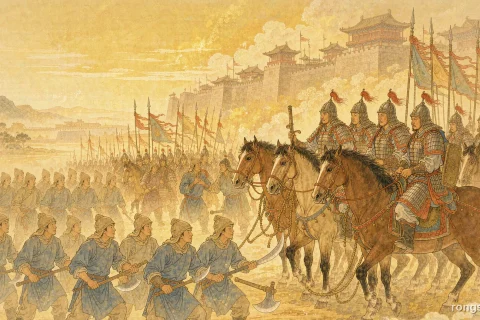
Then the dispatches came. Two frontier towns, Zhenzhou and Dingzhou, reported that the Northern Han and the Khitan had joined forces and were marching south in great strength, and asked for help.
What kind of court was this?
Half a year earlier the emperor, Shizong of Later Zhou, had died. He was thirty nine. The throne passed to his son Chai Zongxun, who was seven. The empress dowager, whose family name was Fu, was young herself and had no head for decisions.
A boy of seven on the throne. A dowager who would not decide. A hall of officials who had been looking forward to the holiday.
Shizong had been the second of the three rulers of Later Zhou, and the ablest. In less than six years he had shaken up the finances, cut the tax burden, reorganised the army, beaten the Northern Han at Gaoping, taken territory from the Southern Tang, and then gone north against the Khitan and taken three passes and three prefectures before illness turned him back. He died at thirty nine with the work unfinished, and left a child to hold it.
When the dispatch came, the first thing the chancellors Fan Zhi and Wang Pu did was ask who could be sent.
Who could be sent?
The highest post in the palace army was Commander of the Palace Guards. That post was held by Zhao Kuangyin. He was thirty three. He had been in the army since the founding of the dynasty, had fought hard at Gaoping, had served in the campaigns in the south, and had been promoted step by step while Shizong lived.
The year before, when Shizong fell ill, he had dismissed the man who held the post and given it to Zhao Kuangyin. The highest command in the army passed to a man barely past thirty.
Fan Zhi named him. Take the army north.
Zhao Kuangyin refused once. He said his troops were too few and his officers too thin for such a campaign.
Fan Zhi had no other choice, and handed over the authority to move troops with fewer strings than before. All the soldiers in the state answered to him.
So Zhao Kuangyin marched out of the city.
Before he left, a sentence was already going round Kaifeng. On the day the army marches, the Commander will be made Son of Heaven.
Who started that sentence, the histories do not say. The Records of the Song note only this: the people of the capital were frightened and began to pack and hide, and inside the palace nobody knew.
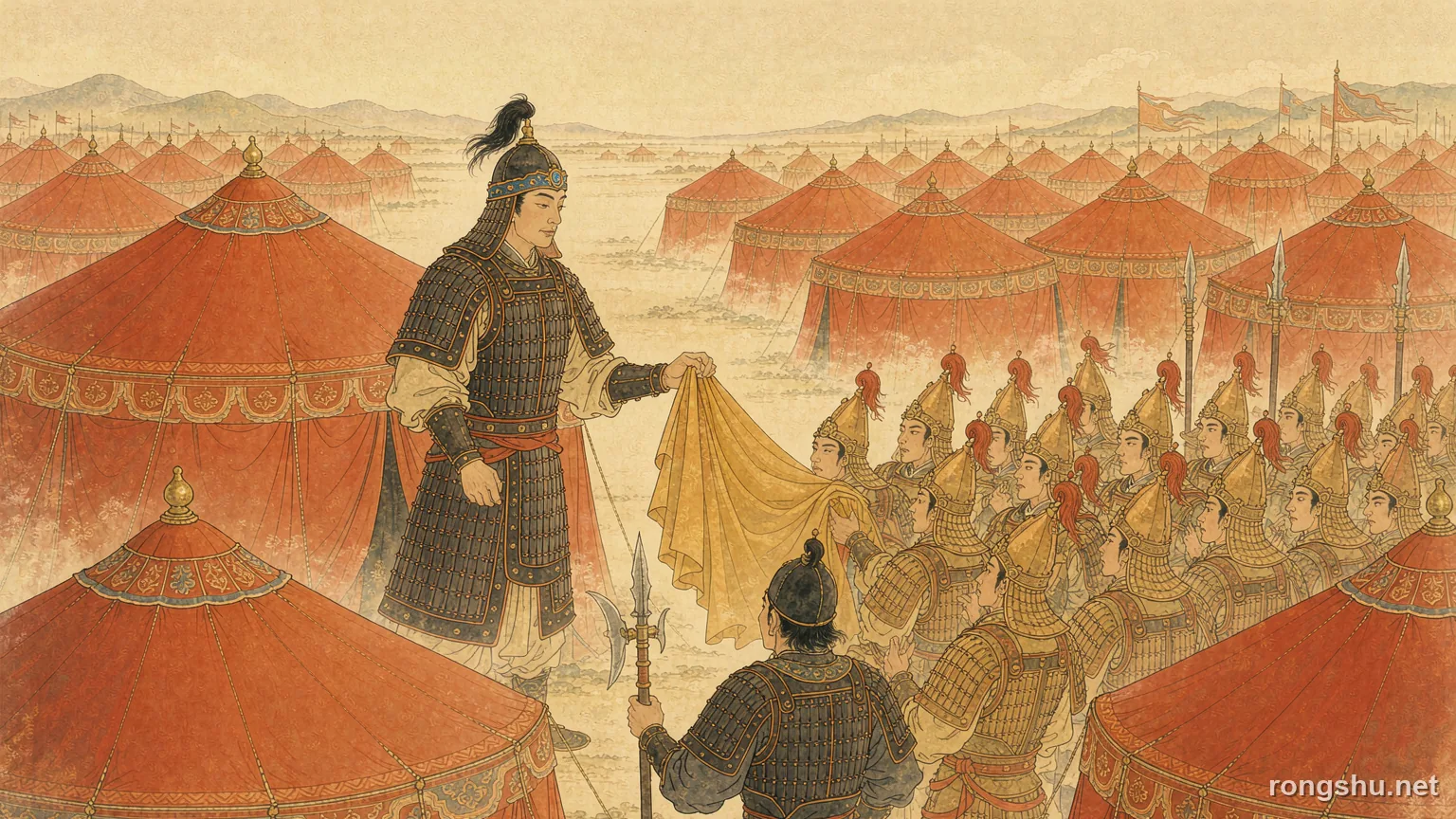
The Night in the Camp
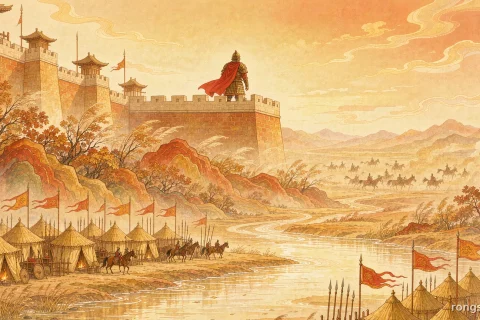
The army marched one day, forty li, and camped at Chenqiao.
Chenqiao lies south east of what is now Fengqiu in Henan, twenty kilometres from Kaifeng. Forty li in a day is not fast.
At night, the talk began.
The talk went like this. The emperor is a child. He understands nothing. We go out and die for the throne, and who will ever know? Better to make the Commander Emperor first, and march north afterwards. There is time.
The words spread, and the camp came alive.
A staff officer named Li Chuyun carried the matter to two men: Zhao Kuangyin’s younger brother Zhao Kuangyi, and his secretary Zhao Pu. These two did not put it down. They put it more plainly. You have done this thing, they said, and the Commander is loyal to the court. He will not spare you.
Some men wavered and drifted away. Most did not.
Just before dawn, Zhao Pu and Zhao Kuangyi led the men into the tent.
The yellow robe went on. The men knelt in the yard and shouted long life, and the sound carried several li.
Zhao Kuangyin let himself be persuaded.
And he set terms.
The Records of the Song gives what he said, and in plain words it comes to three rules. The dowager and the emperor are my former sovereigns; when we enter the city no man is to frighten or touch them. The ministers of the court are my equals; no man is to insult them. The treasury and the houses of the people are not to be plundered. Those who obey will be well rewarded, and those who do not will answer for it, they and their families.
The men said yes.
Three Rules
The army turned round and marched back to Kaifeng.
One day had passed since it left.
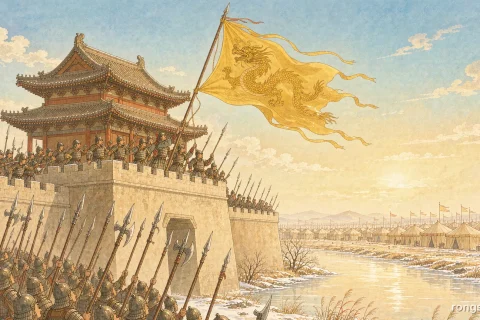
The gates were open.
The officers holding the city, Shi Shouxin and Wang Shenqi, were old friends of Zhao Kuangyin, and they opened up early.
In the whole of Kaifeng that day there was one place where a blade was used. It was the house of Han Tong.
Han Tong was deputy commander of the imperial guard, no small post in the Later Zhou army. When the news reached him he tried to raise men to resist. Before he could gather them, an officer named Wang Yansheng arrived with soldiers.
Han Tong died. That was the only blood spilled in the city that day.
The chancellor Fan Zhi was brought to the hall by force.
Zhao Kuangyin entered and met Fan Zhi and Wang Pu. Fan Zhi meant to ask a question. An officer at Zhao Kuangyin’s side, Luo Yangui, drew his sword and said that the army had no lord, that they had made the Commander Son of Heaven, and that any man who said another word would be killed.
Wang Pu went white and knelt first. Fan Zhi knelt after him. Zhao Kuangyin raised Fan Zhi up and treated him as before.
The abdication document was ready as well.
The story later men wrote down is that the scholar Tao Gu drew it out of his sleeve.
On the fourth day of the new year, the child emperor yielded the throne. Zhao Kuangyin took it, named his dynasty Song, and began a new reign period.
Why Song? Because he had been military governor of the Guide Army, and the seat of that command was Songzhou. He took the word for the name of his state.
Later Zhou ended. Northern Song began.
From the first dispatch of the new year to the change of dynasty: four days.
The Markets Did Not Close
In those four days Kaifeng hardly changed.
The shops opened. The market traded. Later writers boiled the whole thing down to eight characters. The blade was not blooded, and the market did not shut.
What a change of dynasty usually looked like, everyone then alive knew too well.
From 907 to 960, fifty three years, the north of China had five dynasties and fourteen emperors, and eight of those fourteen did not die in their beds. When mutinous troops took a city, the first thing they did was loot, and the rest came after. So when the people of Kaifeng heard that a new emperor was to be made, their first thought was to hide.
This time nobody looted.
Zhao Kuangyin knew what that was worth. The three rules were spoken at Chenqiao, and they were kept on the day the army marched back.
The Records of the Song also set down a small thing. That evening in camp, an officer named Miao Xun, who claimed to know the sky, pointed at the sun in the west and said that there was a second sun beneath it, and that a black light shook between them for a long while. A man named Chu Zhaofu heard it and carried it round the camp.
That is what the official history says. There were probably never two suns. But the entry shows something. Before a dynasty changes hands, a story of heaven’s will has to be laid down first, like planks over mud.
Here it is worth stopping for a moment, because for a reader brought up on European history the strangest thing in this story is not the robe. It is the paperwork.
In England a change of dynasty is usually a battle. Harold takes the crown in January and loses it at Hastings in October, and that is that. In Rome the army made emperors again and again, and in one notorious year the guards even put the empire up for sale and sold it to the richest senator. But Rome was an empire with an army and no fixed rule of succession, and so was China in these fifty years. What is different here is that even a coup wanted the forms. Somebody with a claim had to be seen to give the throne away. A boy of seven had to be brought out to sign, a chancellor had to kneel, a scholar had to produce a document, and the man taking power had to say, twice at least, that he did not want it. The Chinese had a word for this: the mandate of heaven passing on. Heaven could not be robbed. It had to look as though it had changed hands according to rule.
That is why the robe is folded and waiting, and why the paper is in a sleeve.
Two more things belong here.
First, the generals in the field. Murong Yanzhao had already taken the forward troops north, and Han Lingkun was on the frontier. Both had soldiers. Neither rebelled. Zhao Kuangyin sent men to reassure them, and both submitted.
Second, the two revolts. The military governor of Luzhou, Li Yun, and the governor of Yangzhou, Li Chongjin, rose against the new dynasty, one after the other. Zhao Kuangyin took the field himself and beat them both inside half a year. After that no other province tried.
Zhao Kuangyin was thirty three when he took the throne. He ruled sixteen years and died in 976. His dynasty, north and south together, ran from 960 to 1279, three hundred and nineteen years.
The Robe He Feared
He had been Commander of the Palace Guards himself. He had been raised by the army.
Nobody understood better what that post could do.
In the second year of his reign, in the seventh month, he invited his old comrades Shi Shouxin, Gao Huaide, Wang Shenqi and Zhang Lingduo to drink.
Halfway through, he said: this seat of mine, who would not want it? And even if you do not want it, suppose that one day your men wrap a yellow robe round you. Could you refuse?
The men knelt and asked what they should do.
Zhao Kuangyin said: give up your commands. Take posts in the provinces, buy land, build houses, keep singers and dancers, drink, grow old. We will marry our families to one another, and there will be no trouble above or below.
The next day all of them pleaded illness and handed in their commands.
From the yellow robe at Chenqiao to that sentence over the wine, a little more than a year had passed.
Whatever a man rises by, that is what he most fears will come again.
And the fear shaped the whole dynasty.
The palace army was split into three, so that no one man commanded it. A separate bureau held the right to move troops, so that the man who led them could not order them out. Commanders were rotated, so that soldiers and officers would not grow used to each other. Local troops were kept weak and the central army kept strong. Above all, the men who ran the state were to be scholars, and the men who carried swords were to be kept at arm’s length.
For three hundred years no general of the Song ever put on a yellow robe.
The same arrangement cost them dearly. The sixteen prefectures north of the passes, which had been ceded to the Khitan before the dynasty began, were never recovered, and in the end the Song were pushed south of the Yangtze, and then out of the world entirely.
One thing still needs saying.
The official history, written under his own dynasty, has it that Zhao Kuangyin knew nothing of that night in advance. Many historians since have not believed it, for three reasons.
First, the sentence about making the Commander Emperor was already going round Kaifeng before he marched.
Second, the robe was ready, in the right colour and the right size.
Third, once he was on the throne, the Northern Han and Khitan armies that were supposed to be marching south, and that had pulled him out of the capital in the first place, never came.
Put the three together and most readers conclude that this was not an accident. It was a plan, and a thorough one.
How far the plan went, and how much of it he knew, is left blank in the histories.
At Chenqiao, near Fengqiu in Henan, a stone still stands with a few characters cut into it. Here the founding emperor of Song put on the yellow robe.
Who had the robe made, the histories do not say.