The gates of the palace opened before daylight, and five hundred soldiers came through them.
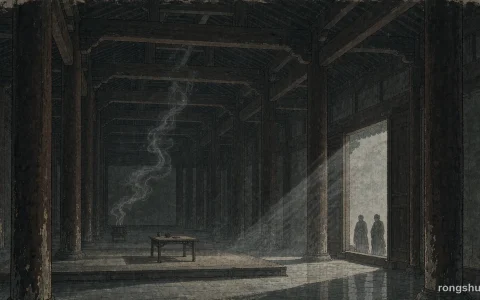
It was the first month of the year 705, in Luoyang, the eastern capital of China. The men moved along the stone paths toward the inner halls, armour ringing in the dark.
At their head was Li Duozuo, a general of the imperial guard. Beside him walked Zhang Jianzhi, the chancellor.
They did not go first to the emperor’s bedchamber. They went to a side courtyard on the east.
Two men were dragged out of bed and killed in the corridor.
Their names were Zhang Yizhi and Zhang Changzong. For some years they had been the two most trusted people in the empire.
Then the soldiers turned toward the main hall.
The woman inside was eighty-one years old. She had been ill for months and could not leave her bed. The state papers had been read out to her by the two men who had just been killed.
When the doors opened, she lifted her head.
Who is causing trouble, she said.
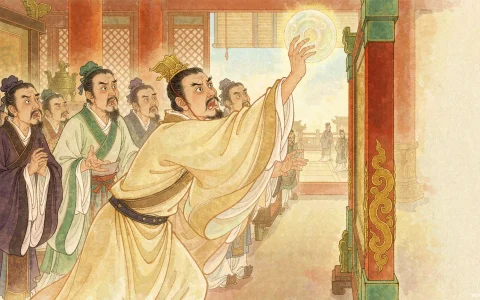
The answer came back: Zhang Yizhi and Zhang Changzong have rebelled. We have killed them. We did not dare report it first, in case the news leaked. We ask Your Majesty to hand the throne to the crown prince.
The hall went quiet.
The woman lying there is one of the most argued-over Chinese historical figures, and the only person in two thousand years to sit on the throne of China in her own right.
Fifty-four years earlier she was a nun in a convent, sweeping a courtyard with a shaved head.
To understand how she got from there to here, you have to go back almost seventy years.
Fourteen, and an Iron Whip
It was 637, in Chang’an, the western capital of the Tang dynasty. A girl of fourteen was brought into the palace.
Her father, Wu Shiyue, had begun life in the timber trade and ended it as a founding minister of the Tang, the dynasty that had ruled China since 618. Her mother came from the Sui imperial family, the house the Tang had replaced.
The emperor Taizong had heard that the girl was beautiful. He took her into the palace, gave her the rank of cairen, and a name to go with it: Wu Mei, Wu the Charming.
A cairen sits low on the ladder. The palace had a whole system of ranks, and every woman in it knew the order by heart. At the top was the empress. Below her came the four consorts, then the nine concubines, then a long descent of lesser titles. A cairen stood in the lower middle. One step up the ladder was a victory worth years.
Her mother wept when she left home.
The girl turned around and said something no fourteen-year-old should have been able to say. Why cry? she asked. How do you know that serving the Son of Heaven is not a piece of good fortune?
She did not become the emperor’s favourite.
For twelve years she stayed a cairen. She did not move one step.
Almost nothing about those years survives in the histories. One small thing does.
Taizong had a horse called Lion Mane, huge and vicious, and no one could break it. Wu Zetian was standing nearby. I can master it, she said, but I need three things.
An iron whip, an iron club, and a dagger.
First I whip it. If it will not obey, I strike its head with the club. If it still will not obey, I cut its throat with the dagger.
Taizong praised her nerve. He did not promote her.
She told that story herself, many decades later. A woman near the end of her life, still remembering what she had said at fourteen, tells you something about what those twelve years had been like.
The Convent
In 649 Taizong died.
By the rules of the court, consorts with children could stay in the palace. The rest were sent to a convent to become nuns.
Wu Zetian had no children. She was sent to Ganye Temple in Chang’an. Her head was shaved.
The convent was an unremarkable nunnery in the western capital. A woman not yet thirty was shut inside it, sweeping floors, carrying water, chanting. Nobody from the palace came to see her. Nobody told her what was happening at court.
By the custom of the Tang, a dead emperor’s consort who entered a convent had reached the end of her story.
But something was already stirring somewhere else.
In Taizong’s last illness the crown prince, Li Zhi, had kept watch at his father’s bedside day and night. Wu Zetian was in the palace then too, serving. Over that year the prince and the cairen, three years older than him, noticed each other.
The histories are vague. Later writers claimed they were already lovers by the dying emperor’s sickbed, but that comes from later records and cannot be checked.
One thing is certain. The new emperor had not forgotten her.
In 650, on the anniversary of his father’s death, Li Zhi came to Ganye Temple to burn incense.
The two of them met.
The New Book of Tang gives the moment three characters: Wu wept. She cried. He cried.
The next year he brought her back to the palace.
The person who arranged it is the strangest part of the story. It was the empress herself.
The empress had no son, and a consort named Xiao was slowly squeezing her out of the emperor’s favour. Bringing Wu Zetian back looked like a way to split Xiao’s hold on him.
She had, in effect, led a wolf into the sheep pen.
Within a year Wu Zetian was promoted to the second rank.
Within two years, she had given the emperor a daughter.
An Unfinished Edict
In 654 the baby died, a month old.
The New Book of Tang and the Comprehensive Mirror say that the empress had visited and played with the child, and that after she left, Wu Zetian smothered the baby under a blanket and pretended to find her dead when the emperor came in.
The Old Book of Tang and the Tang Huiyao do not have that scene. They record only four characters: the little princess died suddenly.
The two accounts are very far apart. Which is true has not been settled in thirteen hundred years.
What is certain is that from this year the emperor wanted a new empress.
It was not simple. The men who ran the court were the old comrades of Taizong’s wars: Zhangsun Wuji, Chu Suiliang, and the rest. An emperor who wanted to change his empress had to get past them first.
He asked. They refused.
And then a third man spoke.
His name was Li Ji, one of the founding generals of the Tang, too powerful for even Zhangsun Wuji to confront. He said one sentence.
This is a family matter for Your Majesty. Why ask outsiders?
That sentence turned the whole board over.
In the tenth month of 655 the emperor issued the edict. The empress and consort Xiao were deposed on a charge of poisoning, reduced to commoners. Seven days later Wu Zetian was made empress.
Then the old ministers began to fall, one after another. Chu Suiliang was sent out of the capital. A few years later Zhangsun Wuji was stripped of his offices and exiled, and died on the road.
She did not spare a single one of the men who had stood against her.
Nine years later, another episode taught the court what she really was.
In 664 Li Zhi fell ill. His head swam, his vision blurred, and he could not get through the state papers. He began letting Wu Zetian read and answer them for him.
Somewhere in that arrangement, the two of them began to split apart.
That year the emperor secretly had a chancellor named Shangguan Yi draft an edict deposing the empress.
The draft was written. The ink was still wet.
Wu Zetian found out. She came into the hall and confronted him face to face.
Li Zhi panicked. And what he did next is revealing. He put the blame on the man who held the brush: Shangguan Yi told me to do it.
Shangguan Yi was executed. His granddaughter, the Shangguan Wanwan who would become one of the most famous women in Chinese literature, was a newborn that year; she and her mother were taken into the palace as servants.
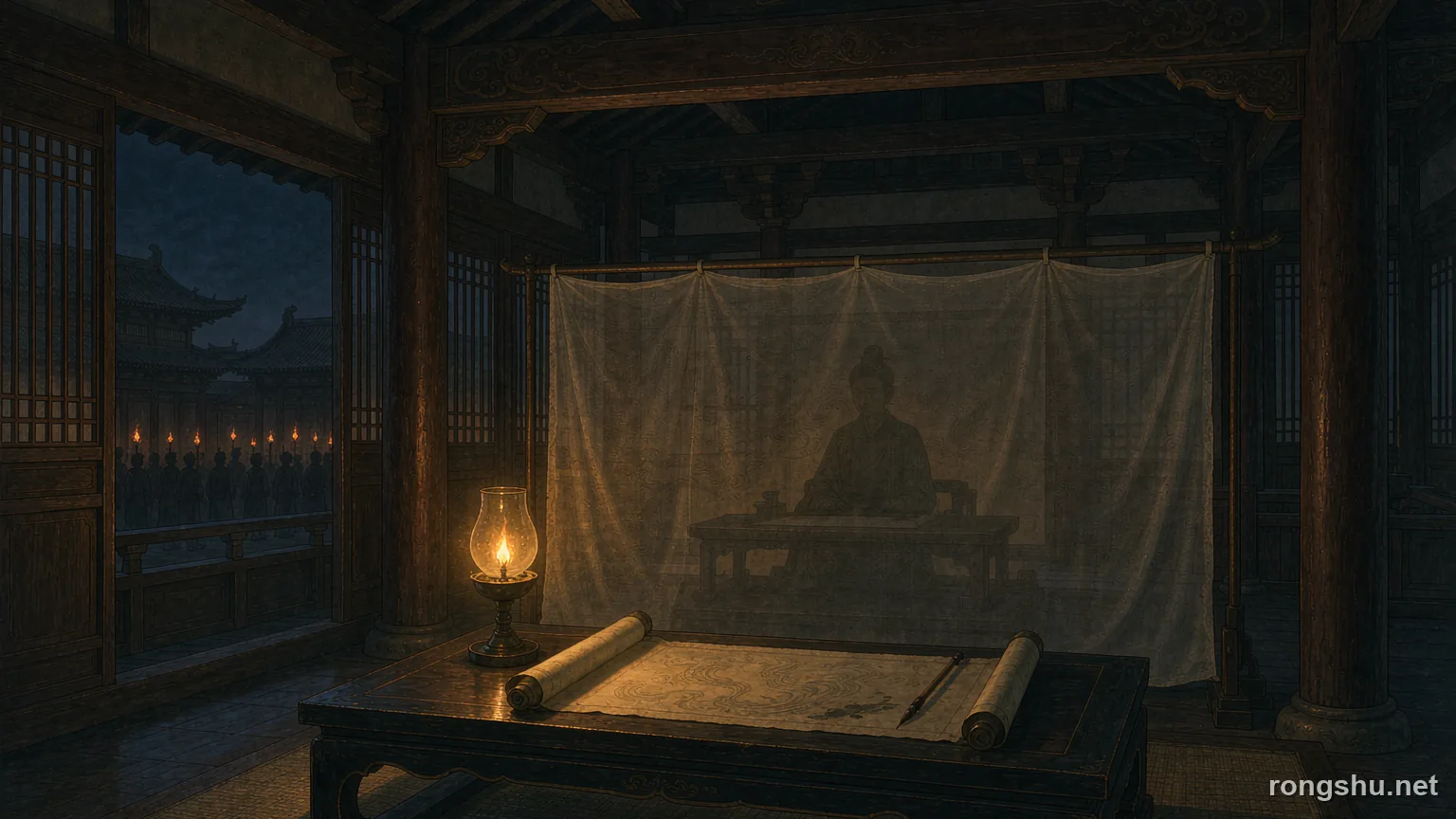
From that year on, whenever the emperor held court, Wu Zetian sat behind him with a screen between them.
The court gave the two of them a name. They called them the Two Sages.
Her Enemies Wrote Her Life
Li Zhi died in 683.
Her third son took the throne. He lasted less than two months. He was deposed over one sentence: he would happily give the whole empire to his father-in-law if he felt like it.
Wu Zetian demoted him to a prince, sent him away, and put her fourth son, Li Dan, on the throne instead. Li Dan was made to sit in the main hall, and forbidden to do anything.
Everything now went through her.
That autumn, an army rose in Yangzhou.
It was led by Xu Jingye, a grandson of the founding general Li Ji. He raised the banner of restoring the exiled prince and gathered a hundred thousand men in a matter of days.
He had a writer with him, Luo Binwang, and Luo wrote him an indictment.
The text reached Luoyang, and Wu Zetian had it read aloud in front of her.
It was savage. It called her a vixen who had bewitched her master, a creature with the heart of a snake, a woman who had killed her own sister and brother. People in the hall shifted on their feet.
Wu Zetian listened. She did not react. She is said to have smiled.
Then the reader came to two lines.
A handful of earth on the late emperor’s grave is not yet dry, and where is his orphan of six feet?
Her face changed.
She asked who had written it. Luo Binwang, she was told.
Such talent, she said, and it was left to drift outside the court. This is the fault of the chancellor.
That reaction comes from Tang dynasty collections of anecdotes, not from a court record. It is also the story everybody remembers.
Three months later Xu Jingye was defeated, and Luo Binwang vanished. The histories give him a few characters: he fled and was never found. Some say he was killed, some that he drowned himself, some that he became a monk.
The year after the rebellion, in 686, she set up a bronze box outside the palace in Luoyang and invited anyone in the empire to drop in a denunciation.
Anyone who came forward to denounce someone was fed and given horses and a place to sleep along the road. If the accusation pleased her, the informer could be given an official post. If it was false, nothing happened to him.
She kept a set of officials known for what they did to prisoners: Suo Yuanli, Zhou Xing, Lai Junchen.
In those years officials said goodbye to their families every morning before leaving for court, because nobody knew whether he would come home at night.
In 688 she tore down a palace hall in Luoyang and built the Mingtang, the Hall of Light, nearly ninety metres high, and called it the Palace of the Myriad Spirits.
Two years later, in 690, at the age of sixty-seven, she abolished the Tang dynasty and declared her own, the Zhou, took the throne herself, and made Luoyang the divine capital.
She also gave herself a new name: Zhao.
The character is made of two pieces, the sun and the moon, stacked one above the other. She had invented it herself. Thousands of people have sat on the throne of China, and she is the only one who made a new character for the occasion.
A Stone With No Words
She ruled as emperor for fifteen years.
In that time she widened the examinations so that sons of ordinary families could enter the government. She sent armies west and recovered the four garrison towns of the western regions. The men she promoted included Di Renjie, and the ministers who later built the great age of the Kaiyuan.
She also killed a great many people she did not trust.
By 698 a question could no longer be avoided. Who would get the empire?
She had nephews, Wu Chengsi and Wu Sansi, who had people tell her constantly that no dynasty had ever passed its throne to a family of a different surname.
She also had a son, the same exiled prince she had thrown out years before.
For a long time she could not decide.
Di Renjie put it to her with one question. Which is closer to you, aunt and nephew, or mother and son?
If Your Majesty makes your son heir, he will honour you in the ancestral temple for ever, as a matter of course. If you make your nephew heir, no one has ever heard of a nephew who became emperor and put his aunt in the temple.
That year the exiled prince was brought back to Luoyang and made crown prince again.
Seven years later, in that first month of 705, five hundred guards came through the gates of the palace.
Three days after the coup, Wu Zetian handed the empire to her son in front of the assembled court, left her palace, and moved to a smaller residence in the west of the city.
At the end of that year, in the eleventh month of 705, she died there. She was eighty-one.
She left an edict behind. Two things in it mattered. She gave up the title of emperor, and took back the title of empress.
She handed the throne back herself.
The next year she was buried at Qianling, in the same tomb as Li Zhi. One husband and wife, two emperors, in a single tomb. Nothing like it exists anywhere else in China.
In front of the tomb stands a stele.
It is seven and a half metres tall and weighs ninety-eight tonnes.
There is not a single character carved on it.
Among the Chinese historical figures of the Tang dynasty, none has left a stranger monument.
Why she left it blank has been argued over for thirteen centuries. One explanation is that her achievements were too great to be written down. Another is that her crimes were too heavy to admit. A third is that the stone was never really hers to fill, and she no longer cared what it said.
All three of them fit her life.