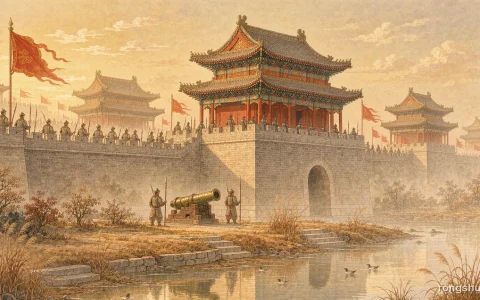
In the eleventh month of 755 AD, a middle aged man walked north out of the capital.
His name was Du Fu. He was forty-four. He had just been given a very small post at court, and he was on his way home to see his wife and children.
Snow began to fall on the road.
When he reached the house he stood outside the door and heard crying inside.
His youngest son had starved to death.
He had no money and no proper office. He had spent ten years in the capital, and what he came home to was his child, dead.
That night he wrote a long poem. In it he set down what he had seen on the road: the hot springs still steaming at the foot of the mountains, the palace banquet still going on, and a man in a ditch who had frozen to death on the way.
He wrote: behind the vermilion gates, meat and wine go to waste; on the road, bones of men who froze and starved.
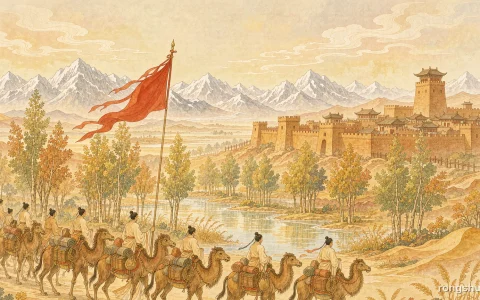
That same month, a general in the north raised his banner.
The general was An Lushan.
The war that followed tore Tang China down from the height of its glory.
The Years of the Light Horse
Du Fu, whose courtesy name was Zimei, was born in 712 in Gongxian in Henan, though his family traced its home to Xiangyang in the south.
He grew up in what the histories call the long years of full bloom.
They were good years. Grain was cheap, the roads were safe, a merchant could travel a thousand miles without carrying a weapon. Poets drank in the capital. The emperor listened to music in his palace. Everyone believed it would go on like that forever.
Du Fu came from a family of scholars. His grandfather had been a poet of some name, and Du Fu was proud of that to the end of his life.
He could write poems at seven. He said of himself that by nine he had already filled a sack with calligraphy.
At nineteen he went out into the world. First to the rivers and lakes of the south, then to the plains in the east, and the travelling lasted more than ten years.
It was not travelling for its own sake. It was how a young man of his class learned the country. He saw the water of the south and the mountains of the east. Years later, looking back, he described those years with four characters: light horses and a light heart.
At twenty-four he sat the examination for the highest degree.
He failed.
He thought little of it and went travelling again.
In 744 he met, in the old eastern capital, a man who had just been dismissed from court with a gift of gold.
That man was Li Bai.
The two of them travelled east together, met a third poet on the way, and spent the autumn hunting, drinking and talking poems on the open plains.
Du Fu later wrote about those days: drunk, we slept under one quilt; awake, we walked out hand in hand.
In 745 they parted in the east.
They never saw each other again.
For the rest of his life, Du Fu wrote poem after poem about Li Bai.
As a young man he climbed the great mountain in the east and wrote a poem about looking down from the summit, where the other peaks seemed small. He did not know then that he would spend the rest of his life at the foot of things.
Ten Years in the Capital
In 746 Du Fu arrived in the capital to find a post.
The next year, his chance came. The emperor ordered that any man with a talent of any kind should come and be tested.
Du Fu went.
In that whole examination, not one man was passed.
The examiner was the chief minister, and he wanted to show the emperor a country running at peace. So he reported that the wise had all been gathered in: there was not a single able man left in the countryside.
Nobody was missed. Which is to say that nobody was taken.
That road was closed.
In those years he was not only worrying about himself. In the capital he watched a war being stoked up, and saw recruiters drag young men out of their homes, and he set it down in a poem. He watched the great spring festival on the riverbank and set that down in another.
Neither poem was about his own life.
From that year, Du Fu lived in the capital for close to ten years.
He had no office and no income. He lived on what friends gave him and on the poems he wrote to powerful men, asking to be recommended.
He described those years himself: in the morning knocking at the gates of rich men; in the evening following their carriages, breathing their dust. Cold scraps from other tables, and bitterness at every turn of the road.
It got harder. While he was in the capital his father died, and the little help from home stopped. He wrote to a friend that he would lie down hungry for ten days at a stretch, and that his clothes had more patches than cloth.
In 751 a small chance appeared. The emperor was to hold three great sacrifices, and Du Fu sent in three pieces of writing in advance. The emperor liked them and ordered the chief minister to test him.
The test was given, and nothing came of it.
Only in 755 did the court finally offer him a post. He refused it. The job meant bowing to superiors all day long.
So the court moved him sideways into a lower place, a clerkship in charge of a store of weapons.
He was forty-four. He took it.
He took the post and went home to see his family.
And then came the scene at the door.
Taken Back to Chang’an
The armies of An Lushan rolled south.
The eastern capital fell that winter. In the sixth month of the following year the great pass fell too, and the capital could not be held.
The emperor fled west in the night.
Du Fu settled his family in a village of caves in the north and set off alone, hoping to join the new emperor at his field headquarters.
Halfway there he was caught by rebel troops and taken back to the capital.
He spent one winter and one spring inside that city.
The rebels did not kill him, and did not pay him much attention. He walked the streets and saw burned houses, courtyards choked with weeds, and people keeping watch over ruins.
He wrote a poem that schoolchildren in China still learn by heart. Spring in a fallen state: the mountains and rivers remain, the city in spring, grass and trees grow deep.
In the fourth month of 757 he found his chance and slipped out through the western gate of the city.
He was in rags, his shoes worn through. He walked all the way to the new court, and was received by the emperor.
The emperor gave him a post: junior remonstrator, a low ranking official whose one duty was to tell the emperor when he was wrong.
It was the closest Du Fu ever came to power.
He held the post for one month.
A chief minister had just been dismissed, and Du Fu sent up a memorial defending him. The emperor was furious and handed him to a tribunal. He was saved from punishment only because others spoke for him, and was sent home on leave instead.
On that visit home he wrote two of his greatest long poems.
In 758 he was posted down to a minor religious office in a provincial town.
He never saw the capital again.
In the spring of 759 the imperial army suffered a catastrophic defeat with six hundred thousand men. Du Fu travelled back through the villages and saw officials dragging men off to serve, and old people and children weeping.
He turned what he saw into six poems, which later readers group together as the Three Officials and the Three Partings.
It is the reporting of a great war correspondent. He simply did it in verse.
That summer the fields around the capital dried up.
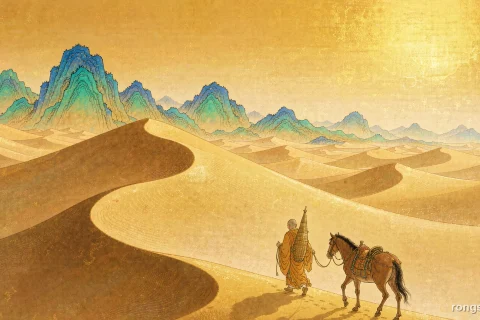
He gave up his office and took his family west. They went first to the far northwest, then to a smaller town, and at last over the mountain roads into Sichuan, reaching the city of Chengdu at the end of the year.
The northwest was too poor to live in. In the smaller town it was worse. The family dug for wild roots in the hills while the children cried in the snow, and Du Fu wrote a set of poems recording how the cold split the skin of his own hands and feet.
In one year they moved four times.
A Roof of Thatch in the Wind
At the end of 759, Du Fu reached Chengdu.
The next spring, with help from friends, he built himself a cottage beside a stream at the western edge of the city.
He had a yard of his own at last. He planted trees, bamboo and vegetables.
He wrote a poem inviting an old neighbour to come and drink with him, calling over the fence, asking him to finish the last cups.
A few years passed like that.
The friend who had helped him most was also the military governor of the region, and an old acquaintance. In 764 he recommended Du Fu for a post on his own staff, with a nominal rank at the ministry of works. That is where the name people still use for Du Fu, the Poet of the Ministry of Works, comes from. He lasted half a year, could not get along with his colleagues, and went back to the cottage.
In the eighth month of 761 a great wind tore the thatch off his roof. The straw blew across the river, and village children ran off with it. He shouted after them and could not stop them, and came back leaning on his stick, sighing.
That night it rained. The roof leaked like a sieve and the family sat up all night.
And that night he wrote a poem.
It was not about himself alone. He asked how a man might get hold of ten thousand great houses, so that every poor scholar in the world could live in one, safe from wind and rain.
If such a day ever came, he wrote, he would be content for his own broken roof to be blown down, and for himself to freeze to death inside it.
In the fourth month of 765, the one friend in Chengdu whom he could truly rely on died.
Du Fu could not stay.
In the fifth month he put his family on a boat and went downriver.
The next year they reached a mountain town on the Yangtze. He lived there less than two years and wrote more poems than in any other stretch of his life, more than four hundred of them. Some of his greatest lines were written there.
The endless falling leaves rustle down; the long river rolls on without end.
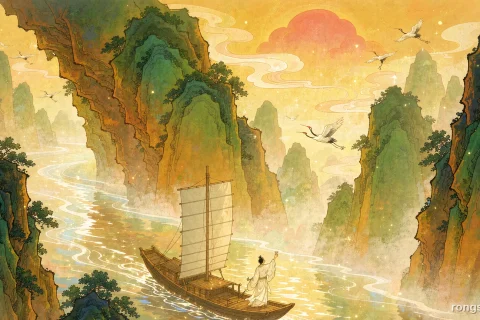
In 768 he came out through the great gorges.
He meant to go home to the north, but the roads there were at war, and so the boat turned south instead.
A Boat on the Xiang River
From 768 to 770, Du Fu spent his last two years on the water.
From town to town, sometimes sleeping on the boat, sometimes in borrowed rooms.
He was old now. His hearing had begun to go, his teeth were gone, and he walked with a stick. In a letter to a friend he wrote that the blood of war still flowed, and the sound of armies was still in the air.
The war was not over, and he could no longer travel.
In the winter of 770 a boat left one river port for another.
It travelled down the Xiang River. The water was cold.
Du Fu lay in the boat and wrote his last long poem. A few days after he finished it, he died on board.
He was fifty-nine.
There is another account that he died inland, after a local magistrate sent him wine and meat and he ate too much in one night. Most later readers doubt it.
His body was kept in a town by the lake. Forty-three years later his grandson moved the bones home to Henan.
While Du Fu was alive, not many people read his poems.
The anthologies of Tang poetry made in his own century collected hundreds of poets. His name is not in them.
About half a century after his death, a poet named Yuan Zhen wrote the inscription for his grave and said: since poetry began, there has never been anyone like Du Fu.
Bai Juyi said he was greater than Li Bai. By the Song dynasty, Su Shi wrote that among all the poets of past and present, Du Fu stands first.
In the end China gave him two titles.
One is the Sage of Poetry. The other is the Historian of Poetry.
The first is about the man. The second is about the poems.
The thing he wanted all his life was to be an official who could set the world right. That he never managed.
The thing he did without meaning to was to write down everything he saw, everything he suffered, and everything others suffered. That he did.
Read him now and the age comes back: spring in the capital, a night in a village by the hills, one hard rain on a thatched roof in Chengdu.
He left behind no office and no fortune.
What he left behind was the shape of an age.
Writing poems was the one thing he treated as his real work. Poetry, he said, is the business of my family. He said something else as well: until the words startle people, I will not rest. If a line came out wrong he would work at it until it came out right.
He wrote poems. Other men wrote histories. Some events are in his poems and nowhere else: when two provincial governors were murdered after the great rebellion, and the province fell into chaos, the official histories are silent and he is not.
That is why later readers gave him the name Historian of Poetry.
Today, beside that stream in Chengdu, there is still a cottage.
It is not his. His own was gone long ago. This one has been rebuilt by admirers, again and again, for over a thousand years.
Inside stands a statue of him: thin, and seated.
More than twelve hundred years have passed, and people still come to see him every day.