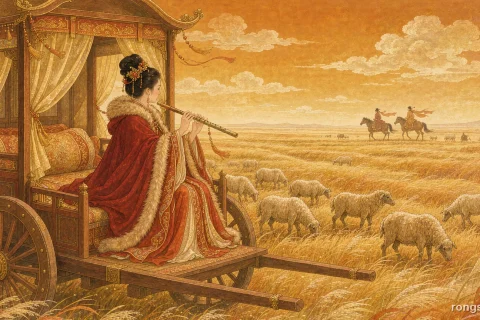
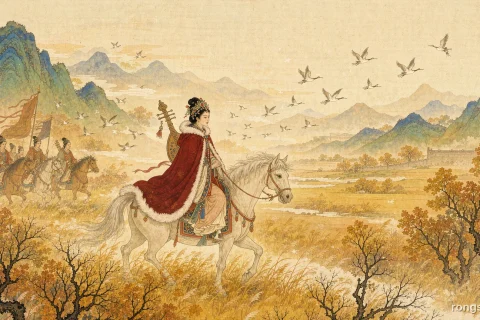
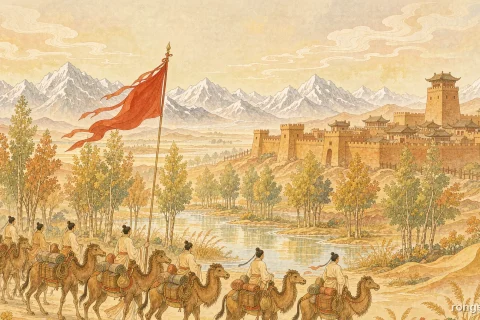
One year into the Zhenguan era, a monk walked west out of the capital with a bundle on his back and a horse on a lead.
He was moving with a crowd of famine refugees. The capital region was in drought that year, and the government had let people leave the city to look for food, so the gates were looser than usual.
The monk was called Xuanzang.
He was going to India.
Tang law required a travel permit to cross the western frontier. Without one, nobody was allowed out.
He did not have one.
So this was how he left. He hid himself in a stream of hungry peasants, got through the gate, and then turned west, toward the desert beyond the Jade Gate.
That first step made him a fugitive.
Most people who know his name know it from a novel. In the sixteenth century a writer took the story of this journey and turned it into one of the great works of Chinese fiction, full of demons and a monkey king and a helpless monk who is forever being rescued.
In the novel he is called Tripitaka. He is timid, and he is always the one in trouble.
The real Xuanzang was neither.
The Monk Without a Passport
His family name was Chen, and he was born in Henan around the year 600, at the end of the Sui dynasty.
He became a monk at thirteen. That year the city of Luoyang was ordaining a fixed number of monks, and he was under the age limit, so his name was not on the list. The official in charge asked him why he wanted to be ordained. He answered that he meant to carry on the work of the Buddha and to keep the teaching alive. The official thought it was a strange thing for a boy to say, and let him in.
For the next fifteen years he did nothing but read.
The more he read, the worse it got.
The problem was the translations. Buddhism had come to China centuries earlier, but the scriptures had arrived in pieces, through different hands, over a long stretch of time. The same text existed in several versions that contradicted each other. The same idea had been rendered with different words by different translators. Every master taught his own reading, and none could settle an argument.
Some questions, he found, could not be answered at all.
He decided the only way to settle them was to go to the source. He would go to India and bring back the original texts in Sanskrit.
In his day there were no maps of the route, no roads to speak of, and nobody who had made the whole journey and come back to describe it.
He would have to walk.
He went first to Chang’an, then south to Sichuan and Jingzhou, visiting teachers, reading whatever he could find, and looking for companions.
Men agreed to go with him. Some turned back halfway. Others changed their minds the day before leaving.
In 629 he set out from Chang’an. He was about twenty-nine.
Five Days and Nights in the Desert
The first stretch ran along the Hexi Corridor, a narrow strip of towns and farmland between mountains and desert.
He passed through one garrison town after another until he reached the last one, at Guazhou, near the edge of Tang territory.
West of that lay the Jade Gate, and beyond it five beacon towers, each with soldiers. The men on those towers had the right to shoot anyone crossing without a permit.
Xuanzang waited at Guazhou for more than a month, looking for a way through.
There he met a merchant from one of the Central Asian peoples, who offered to guide him and took the lay vows from him. Xuanzang bought a horse for the journey.
At night the two of them slipped past the Jade Gate and headed west.
Around midnight the guide suddenly drew a knife and began pacing around him.
Xuanzang understood what was happening and sat up and began to chant.
At daylight the man explained himself. There were five beacon towers ahead. If they were seen, both of them would be killed. He advised Xuanzang to turn back.
Xuanzang refused.
The guide gave him some supplies and walked away.
He went on alone. That night he crept up to the first beacon tower to draw water and was caught by the soldiers.
The officer in command was named Wang Xiang.
Wang Xiang was a Buddhist. He listened to what Xuanzang was doing, and instead of following the rules, he tried to talk him out of it. The road west is too dangerous, he said. Go home.
Xuanzang said: I am going for the teaching. I will not turn back, even if it kills me.
Wang Xiang was moved. He gave him water and dry food and told him how to get around the other four towers.
Ahead lay eight hundred li of desert, the Moheyanqi.
The Chinese of the time called it the River of Sand. No birds overhead, no water or grass underfoot, and when the wind rose, the sky and the ground became one colour.
Xuanzang rode into it alone.
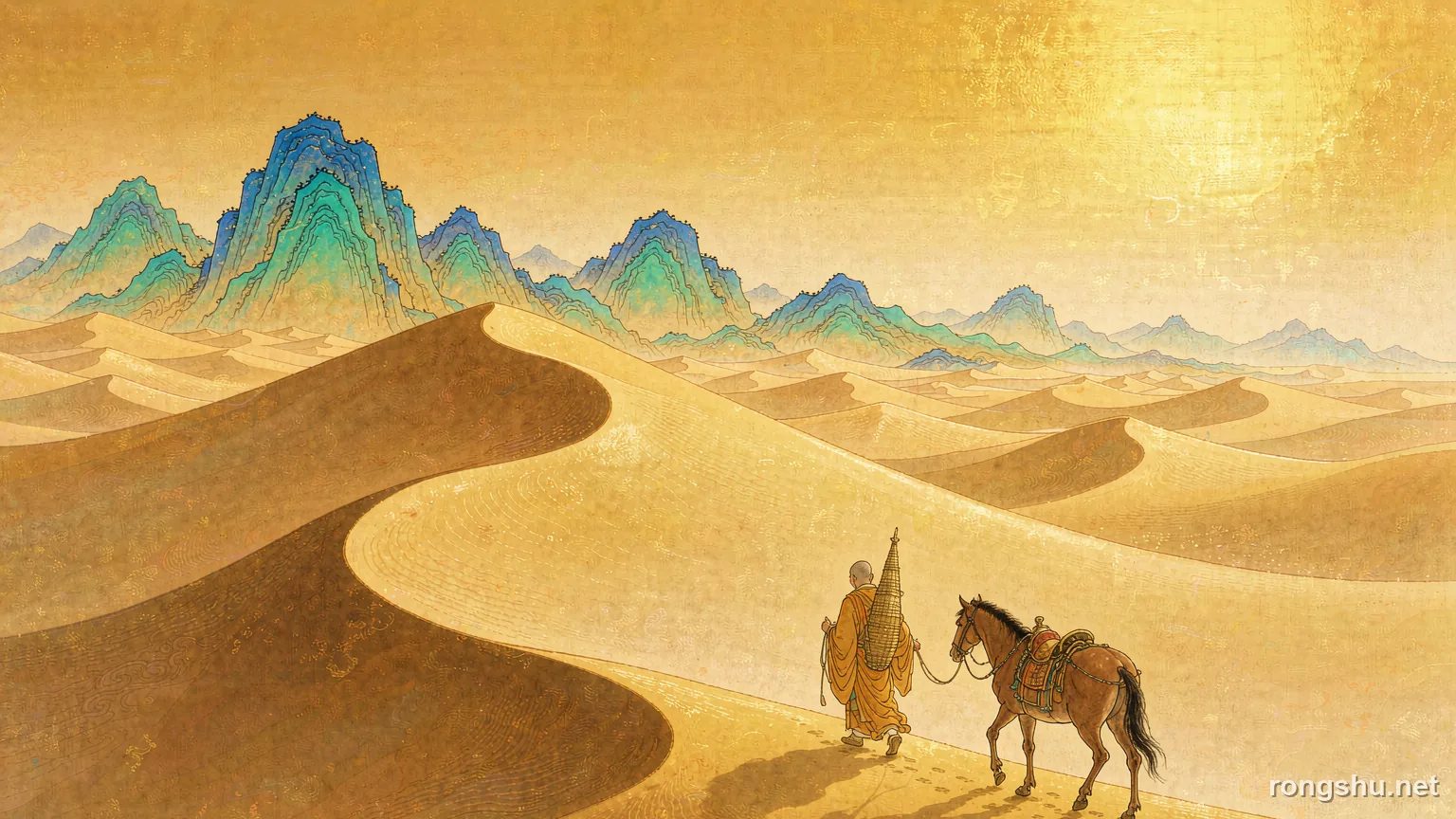
Halfway across, he fumbled with his water bag and spilled it. The whole skin of water sank into the sand.
Without water in that country, a man is already dead.
He turned back toward the east and rode for a dozen li, and then he remembered something he had said when he started: better to go west and die than to go east and live.
He turned the horse around and went on.
For five days and four nights he had nothing to drink.
On the fifth night a cool wind came up. The old horse broke loose from the lead and ran.
Xuanzang followed it.
A dozen li further on there was grass, and there was water.
He lived.
This part of the story comes from an account of his life written by his disciples. The horse, they say, was a gift from an old man at Guazhou, and it knew the way, because it had already crossed that desert fifteen times.
The King of Gaochang
Past the desert was Hami, and past Hami was Gaochang, a small kingdom at the edge of the Taklamakan, near what is now the city of Turpan.
Its king was called Qu Wentai.
He was a serious Buddhist, and when he heard that a monk from China was passing through, he went out of the city gate in the middle of the night to meet him.
He treated Xuanzang with something close to reverence.
Qu Wentai wanted him to stay and become the teacher of the kingdom. Gaochang was a small state squeezed between larger powers, and a famous monk in residence would have been worth a great deal.
Xuanzang refused.
He was going west. He was going to get the scriptures.
Neither of them would move.
So Xuanzang did the hardest thing available to him. He stopped eating.
He sat down and would take neither food nor water, and he stayed that way for three days.
On the third day Qu Wentai gave in. He apologised, kneeling, and agreed to let him go.
And then he did more than let him go.
He made Xuanzang his sworn brother, and sent him on with a large part of the wealth of the kingdom: a hundred ounces of gold, thirty thousand silver coins, five hundred rolls of silk, thirty horses, and twenty-five men to escort him.
He also wrote letters to the kings of twenty-four states along the road, with gifts, asking each of them to let the monk pass and to look after him.
A man wanted by the Tang government for leaving the country without a permit was escorted out of it at the expense of another kingdom.
Xuanzang promised that on his way home he would come back and stay three years.
He never did.
By the time he came back that way, Gaochang had been destroyed by the Tang army, and Qu Wentai was long dead.
The Debate at Kanauj
From Gaochang he went west across Central Asia, over the great mountain passes, and around through what is now Afghanistan. It took years, and the difficulties of it fill a book.
Around 631 he entered India.
At the centre of Indian learning stood Nalanda, a monastic university with thousands of monks, enormous libraries, and the best teachers of the age.
There Xuanzang studied under a master named Shilabhadra.
Shilabhadra was over a hundred years old, the head of the monastery, and the most respected scholar in the country. He had been ill and had given up teaching, but when he heard that a monk had come all the way from China to study, he recovered enough to lecture to him.
Xuanzang stayed five years and worked through the great treatise of the school, from beginning to end.
Nalanda was on a scale that had no equivalent anywhere. The halls were measured in tens of courtyards, and more than a hundred lectures were given on any single day.
He was not only a student there. He lectured, and he wrote two treatises in Sanskrit to answer arguments then dividing Indian Buddhism.
His reputation grew.
Around 641 the most powerful king in northern India, Harsha, held a great public debate in his honour at Kanauj.
It was the highest thing Indian scholarship could offer. Eighteen kings attended, along with three thousand monks of the greater and lesser schools and two thousand teachers from other traditions.
Xuanzang took the platform and had his thesis posted. If a single word of it can be refuted, he announced, let anyone come forward. If I am defeated, I will pay with my head.
Eighteen days passed.
Nobody could refute him.
The Mahayana monks gave him a title meaning Glory of the Great Vehicle, and the others gave him one of their own.
A monk who had left China illegally stood at the top of Indian Buddhist learning.
Everyone wanted him to stay.
He refused, and turned for home.
Nineteen Years of Translation
He did not come back the way he had gone. He crossed the Pamirs, followed the southern edge of the Tarim Basin eastward, and reached Khotan, where he wrote a letter to the Tang emperor.
He explained that he had left the country illegally years before, that he was now returning with the scriptures, and that he would wait for instructions.
The answer came back: come home.
He received it at Dunhuang, and in the first month of 645 he entered Chang’an.
He had left with one horse and one bundle. He came back with a caravan.
Six hundred and fifty-seven Sanskrit manuscripts, plus statues and relics.
The city turned out to see him.
The emperor received him at Luoyang and was fascinated by him. He even suggested that Xuanzang leave the monastery and take office. A man who knew every kingdom of Central Asia and India would have been enormously useful to the court.
Xuanzang refused.
What he asked for instead was help with the translation.
The emperor agreed, and he also asked him to write down what he had seen along the way.
That book was finished the following year. Xuanzang dictated it and a monk named Bianji wrote it down, and it describes more than a hundred kingdoms, their roads, their crops, their languages, and their religions.
More than a thousand years later, when European explorers went looking for the lost cities of Central Asia and India, it was this book they carried with them. It told them where to dig.
For the next nineteen years, Xuanzang did almost nothing else.
He ran a translation bureau, and he worked on it from morning to night. His own schedule was to translate during the day, lecture in the evening on what he had just translated, and answer questions from visitors late into the night. He often slept at the third watch and was up again at the fifth.
In nineteen years he produced seventy-five works in one thousand three hundred and thirty-five scrolls.
The largest of them runs to six hundred scrolls on its own.
An output on that scale, in an age before printing, meant writing every character by hand, over and over.
He set strict rules for the work. Translation was divided among several roles, with men reading the Sanskrit, men writing the Chinese, men checking the meaning, and men polishing the style, and everything was checked repeatedly.
One of his principles is still followed today. Do not paraphrase, do not cut, stay as close to the original as the language allows.
A great many of the Buddhist texts read in China now, including the Heart Sutra, are his versions.
In 664, at a temple in the mountains north of Chang’an, Xuanzang died.
He was sixty-two.
Toward the end he could no longer translate. He put down the scrolls and had his disciples read to him.
A man who left home as a boy, slipped out of his own country in his twenties, walked for years, and translated for nineteen, died at his desk.
He never held office. He had no title, no land, no family.
The characters he left behind, thirteen hundred years later, are still being read one by one.