In 33 BC a Xiongnu chief came to the Han capital to see the emperor.
He had come to ask for something unusual. He wanted to marry a Chinese wife.
The emperor agreed. Five women were chosen out of the palace and given to him.
The records do not say how the five were picked, or who drew up the list.
They say only that one of them was Wang Zhaojun.
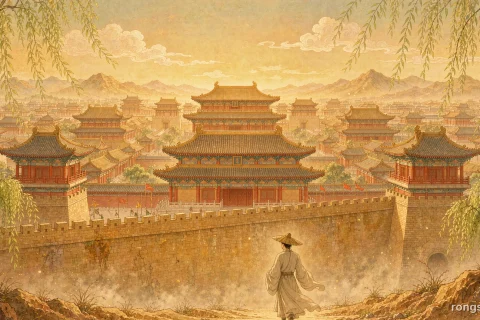
And that once the five left the city wall, none of them had any reason to expect to come back.
This was not an ordinary marriage.
Marriage across the frontier was, in the Chinese phrase, a heqin: a peace made by marriage. The word covers an entire policy, and for two thousand years Chinese writers have argued over whether it was clever diplomacy or a national humiliation. Either way, a woman was the instrument.
The Han and the Xiongnu had fought each other for centuries and had also been marrying into each other for decades. Wang Zhaojun was one person inside that long relationship.
Years in the Inner Palace
Her given name was Qiang. She came from a small county on the Yangtze, in what is now western Hubei.
She was born somewhere around 52 BC.
Her family was respectable but not important, and she was taken into the palace as a girl of good family.
Han China and the steppe already had a long history of these marriages. It began after the founding emperor was surrounded by Xiongnu horsemen for seven days on a mountain and barely escaped. From then on the Han sent women and goods north. In the early years it was tribute dressed up as a wedding, because the Han could not win a war.
That went on for decades. The brides were usually girls of the imperial clan, given the title of princess.
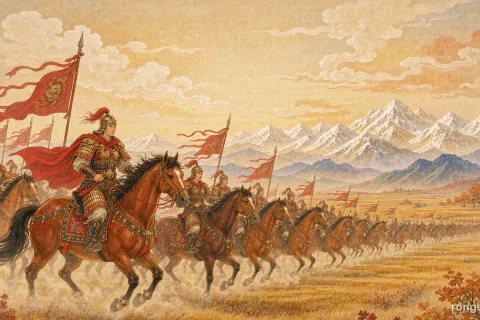
Then a later emperor reversed the policy and attacked. The Han fought the Xiongnu for more than forty years, and for once it was the steppe that suffered.
And then the Xiongnu fell apart on their own.
So by the time of Wang Zhaojun the situation had turned around. It was no longer the Han who sent a daughter to buy peace. It was the Xiongnu chief who came to the court to ask for a bride.
Inside the palace she was assigned to the inner quarters, where the women waited to be summoned.
There is a detail worth remembering about that household. A woman sent into the palace was not told when, or whether, she might ever leave. Some were released after the emperor died. Some never left at all.
There were thousands of women in the palace at its largest. Perhaps fifteen or twenty would ever be raised to the rank of consort. The rest worked and grew old inside the walls.
From outside, a family whose daughter entered the palace was thought to have risen. From inside, it was simply another wall.
The problem was that an emperor cannot meet everyone.
She waited.
She waited several years.
The Book of the Later Han covers it in six characters: she entered the palace, and for years she was never favoured.
A young woman went in through the most honoured gate in the empire, and was forgotten behind it.
The Day in the Great Hall
In the first month of 33 BC the Xiongnu chief Huhanye came to court.
He had reasons of his own for wanting the marriage.
For years the Xiongnu had been tearing themselves apart. Five claimants fought over the title at once, and famine and disease came with the fighting.
In the end the people split in two. The northern half followed a chief named Zhizhi and moved west. The southern half followed Huhanye and moved south, toward the Han, and asked for protection.
The Han helped him.
In 36 BC a Han general named Chen Tang marched far to the west, destroyed Zhizhi, and sent his head back to the capital.
Huhanye was delighted and frightened at the same time. The enemy of his life was gone. But a power that could do that to Zhizhi could do it to him.
He came to the capital three times in all. The first two visits were about survival, and about asking the Han to let him stay alive. The third was about status. A marriage to the imperial house would set him above every other chief of the steppe.
So he came to the capital a third time and asked to become the emperor’s son-in-law. A subject, and a relative.
The emperor agreed.
On how Wang Zhaojun came to be chosen, the two histories do not agree.
The Book of Han says only this: the emperor gave the Xiongnu chief a woman of the inner quarters, named Wang Qiang, as his queen. No story, no dialogue. A line in a ledger.
The Book of the Later Han adds a scene.
It says that after years in the palace without ever being summoned, she had built up a store of grief and resentment, and asked the officer of the inner quarters to be allowed to go.
On the day of departure the emperor had the five women brought into the hall so the Xiongnu chief could look at them.
Wang Zhaojun came in.
She was dressed and adorned as she had never been allowed to be, and the light of her filled the hall. When she turned to look back, the people around her were struck still.
The emperor saw her and was shocked.
He had not known that there was anyone like this inside his own palace. He wanted to keep her.
But he had just given his word to the Xiongnu, and an emperor does not take his word back.
He let her go.
The Book of the Later Han records his reaction in four characters: he saw her and was greatly startled. Then it adds that he wanted to keep her, and could not go back on a promise, and gave her to the Xiongnu after all.
Later writers made a great deal of that moment. It is a rare thing in the written history of China: an emperor who is shown up, in public, by his own neglect, in front of the man he is trying to impress.
A few months later he was dead.
He died in the fifth month of that same year. By then she was somewhere near the Great Wall.
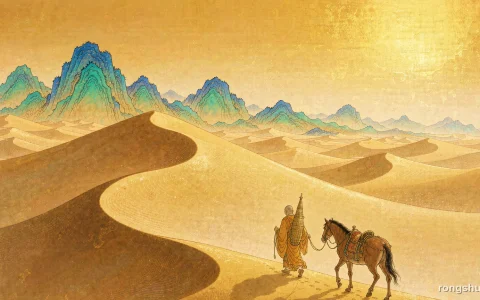
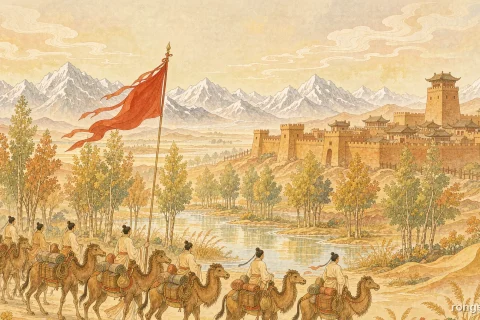
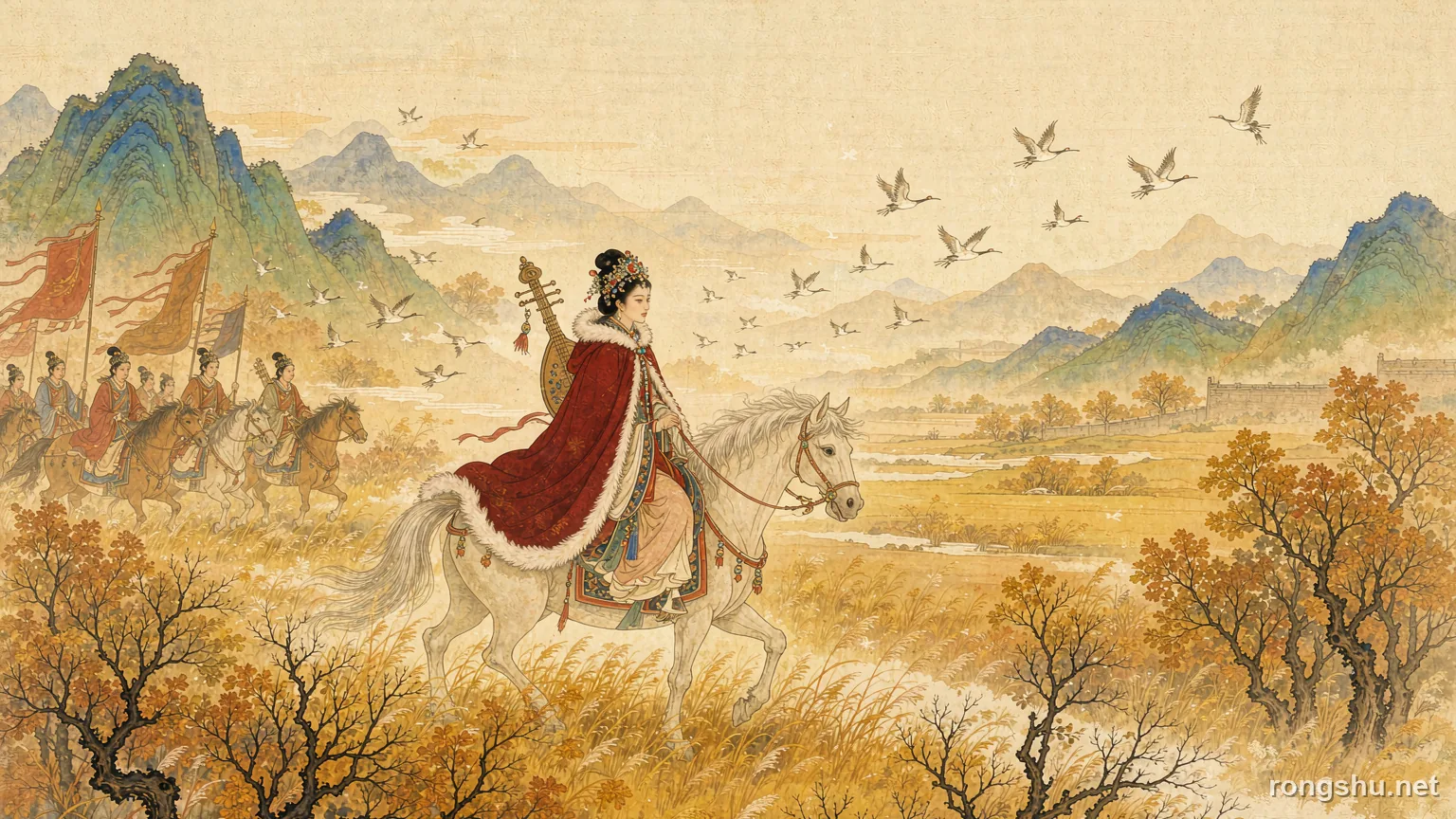
After that day she travelled north, and the journey took months. She went from farmland to grassland, from a language she knew into one she did not.
The title given her was Queen of the Pacified Steppe.
A woman was being sent away to live among strangers, and the court wrote the purpose of her life into her name.
The Order to Follow Their Custom
She married Huhanye and bore him a son.
Life on the steppe was nothing like the palace. She lived in a felt tent, drank fermented mare milk, and learned a new language.
She left behind no complaint about any of it. Neither did the histories.
It did not last.
In 31 BC, two years after she arrived, Huhanye died.
By the custom of the Xiongnu, a son could marry his father’s widow.
This was not an invention of the steppe alone. It was a common practice in that world, and its purpose was practical: to keep a widow, and the people and herds that came with her, from carrying them into another tribe.
Now it was her turn.
Huhanye’s eldest son by an earlier wife wanted to marry her.
She wrote to the Han court and asked to come home.
The answer came back as an imperial order. Three words: follow their custom.
She had not asked for a favour. She had asked to come home to a country she had left in her twenties, obediently, at the order of the emperor who sent her. What came back was three characters long.
The men who wrote them were managing a frontier. She was a line in the account.
The court had done the arithmetic. If she came home, it would mean that a Han woman had been unhappy among the Xiongnu, and that the new chief had failed in his duty to her, and the arrangement that had just been settled would begin to crack.
If she stayed, nothing had to be explained.
So she stayed, and married the son.
She bore him two daughters.
They later married leading men of the Xiongnu and kept up their own contact with the Han court. One of them travelled to the capital and was received at the palace.
Not long after, when the Han throne changed hands and the peace broke down, she and her husband tried to mediate. It came to nothing.
By then her mother was long dead.
The son she had borne to Huhanye came to nothing either. By the rules of succession he should have become the heir. A later chief wanted the title for his own son, and had him killed.
The Han court did nothing.
The Painter Mao Yanshou
The most famous part of her story is not in the official histories at all.
It comes from a book of notes written three hundred years later.
By that account, the emperor had so many women that he could not see them all, so he had their portraits painted and chose from the pictures.
The women bribed the painters. The generous ones paid a hundred thousand coins. Even the stingy ones paid fifty thousand.
Wang Zhaojun refused.
She trusted her own face and would not pay.
The painter took his revenge. He made her plain.
So she was never called.
It was only when she was given away, and the emperor saw her with his own eyes, that he understood what he had lost.
He was furious and had the painter and his colleagues executed, and the painter is remembered as Mao Yanshou.
It is a well-made story. It has a cause and an effect, and a punishment, and it delivers a satisfying lesson: a woman who refuses to bribe her way is buried alive, and in the end it is the emperor who pays.
There is one problem. There is no Mao Yanshou in the official record.
So it can only be told as a story.
And it has been told, over and over.
Because it answers a question that people badly want answered. How does a woman like that disappear inside a palace for years?
If the answer is simply bad luck, it is unbearable. So people invented a villain, and a reason, and kept them.
The Green Grass on Her Grave
She died around 19 BC, at about thirty-three.
The story says she is buried south of what is now the city of Hohhot, in Inner Mongolia, on the south bank of a river.
The grave has been pointed out at that spot for at least a thousand years. Chinese travellers described it in the Tang dynasty. It is still there, in a park outside the city, with a stone tablet in front of it.
Every autumn the grass of the steppe turns yellow, the story goes, except the grass on her grave, which stays green all year.
Whether the grass really stays green is beside the point. The story needs her to be remembered in a particular way, and so the grass stays green.
That is why it is called the Green Tomb.
The poets never stopped writing about her. Li Bai wrote about her brushing the saddle and weeping on the horse. Du Fu wrote about a lute playing music from beyond the frontier, in which her grievance is plain. Wang Anshi wrote two poems about her and asked whether anyone disappointed in life is really better off in the south than in the north.
Ouyang Xiu wrote about her. Mei Yaochen wrote about her. Every generation took her up.
What she left behind herself is almost nothing. Her life was written by other people, and everyone who wrote it was really writing about his own helplessness.
Her story has a great deal in it that was added later: the lute, the portrait, the wild geese, the sleeves soaked with tears.
The name survives in the culture in a way the record does not. There are operas about her, and monuments, and a poem that schoolchildren still learn. Almost everything in the popular version was added afterwards.
Two histories mention her in a few dozen characters. One of them is polite and gives her no voice at all. The other gives her three lines, a motive, and a gesture, and was written two hundred years after she died.
One thing in it is real.
Historians often say that after she went north, there were no major battles between the Han and the Xiongnu for more than sixty years.
After her death the two sides still dealt with each other for a long time. The fighting resumed only when the Han throne was taken and the peace was thrown away, more than twenty years after she died.
Along the frontier, in those sixty years, people planted and herded and lived.
A woman who had come out of the inner quarters of a palace bought that quiet with the second half of her life, and no one put it on a list of achievements.
The grass on her grave comes back green every year.