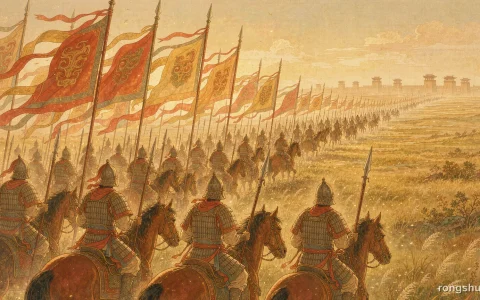
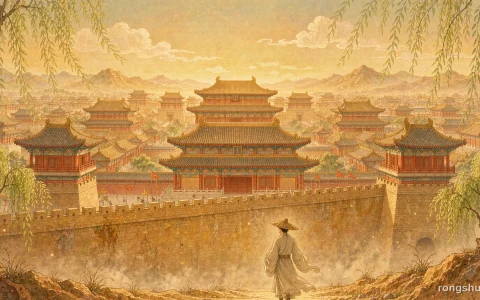
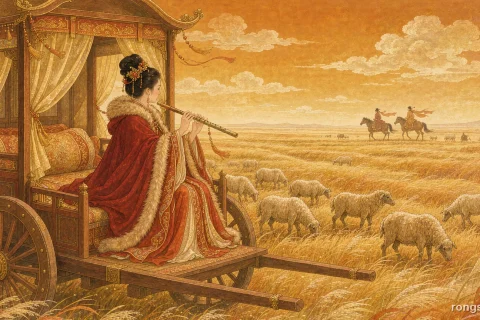
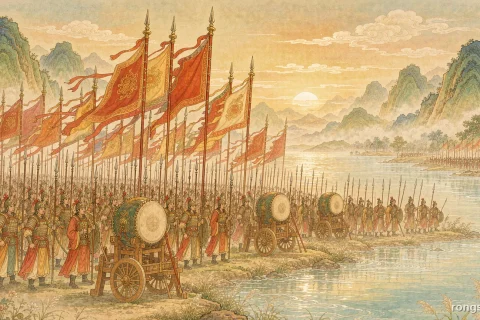
In the summer of 73 AD, late at night, in the little kingdom of Shanshan, a tent caught fire.
The fire was lit from the south side. A south wind was blowing that night, and the wind carried the flames deep into the tent.
Inside, more than a hundred envoys of the Xiongnu were asleep.
As the fire took hold, drums began to beat outside and war cries rose on every side.
The men inside woke and ran for the door, and what waited at the door was a line of swords.
The man leading the attack was a Chinese clerk. His name was Ban Chao. He was forty-one years old, and he had come west with a very small party: thirty-six men.
By morning he had laid the heads of the Xiongnu envoys in front of the king of Shanshan.
The colour left the king’s face.
Throwing Away the Brush
Ban Chao, whose courtesy name was Zhongsheng, was born in Pingling, in the plain west of the capital.
He came from a family of writers.
His father, Ban Biao, was a historian who spent his life trying to carry on the Records of the Grand Historian. His elder brother, Ban Gu, was compiling a much larger work, the Book of Han. His younger sister, Ban Zhao, could read and write as well as either of them, and in time she too would work in the imperial library.
It was a household of brushes and bamboo slips.
By any expectation, Ban Chao should have been one of them.
In 62 AD his brother took a post in the capital, and Ban Chao moved there with their mother. Money was short, and he needed work.
The work he found was copying. He copied official documents for the government, character by character, all day, for a day of food.
He copied for a long time.
Then one day he put down his brush on the desk and said something.
He said that a man of any ambition at all should be like Fu Jiezi and Zhang Qian, who won their honours in distant lands. How could a man spend his life going around and around among brushes and inkstones.
The men beside him laughed.
He said: how would you know the ambition of a strong man.
That scene was later pressed into a four character phrase: throwing away the brush to take up the sword.
The two names he spoke were men who had also left home. Fu Jiezi had walked alone into a kingdom in the west and killed its king. Zhang Qian had spent thirteen years away and had opened the road through the western regions. Both of them had won their honours at the far end of a very long journey.
But ambition is only ambition. After he threw down the brush, he had to wait eleven more years.
For eleven years he went on copying.
Then, in 73 AD, the chance came.
That year the emperor sent a general named Dou Gu north against the Xiongnu. Ban Chao joined the campaign in a junior post, acting as a cavalry commander.
He fought well in a battle by a lake in the far northwest.
Dou Gu noticed him.
Before the campaign was over, Dou Gu gave him a new assignment: take a small party and go out to the city states of the western regions.
Those states lived in a simple situation. They sat between Han and the Xiongnu, and they sided with whoever was stronger. The task was to bring them back to the Han side.
The party Ban Chao took with him numbered thirty-six.
Dou Gu offered him more men. Ban Chao turned them down.
He said that the little states of the west had few soldiers of their own, and that a large party would only be a burden.
Thirty-Six Men
He went first to Shanshan.
Shanshan lay beside the salt marsh of Lop Nur, the first stop on the road in from the east.
At first the king was warm. He asked after their health and their journey.
A few days later, he went cold.
Ban Chao called in one of the men who served them, offered him something, and got the truth: envoys from the Xiongnu had also arrived, more than a hundred of them, and they had been there for days.
Ban Chao said nothing about it in public. He gathered his thirty-six men and gave them wine.
Halfway through the drinking he stood up and spoke to them. He said: you came with me to this far country hoping for great deeds and reward. Now the Xiongnu have been here a few days, and the king has already turned his face from us. If he ties us up and hands us over, not even our bones will be left. What do we do.
All thirty-six answered that they were in his hands, in life and in death.
Ban Chao gave them eight words. A man does not get the tiger cub without going into the tiger cave.
That night, the fire.
When it was over, the Xiongnu party of more than a hundred was gone. Ban Chao had killed three of them with his own hands.
He did not go and report only after the fact. He found his fellow envoy, a civil official named Guo Xun, told him plainly what had been done, and shared the credit with him.
The next morning the son of the king of Shanshan was sent east as a hostage.
Shanshan was settled.
Then came Yutian.
Yutian was a major state on the southern road. Its king had just beaten a neighbour and was feeling his strength, and he was cold to the Han party.
The people of Yutian believed in shamans. One of them held high standing in the kingdom.
This shaman put out a word: the gods are angry, and the Han envoys have a black horse, and the horse must be brought for sacrifice or disaster will fall.
Ban Chao agreed. He said the shaman should come and take the horse himself.
The shaman came. Ban Chao said nothing much, and cut off his head.
He carried the head to the king and set out the matter in plain terms.
The king had already heard about the fire at Shanshan. This time he killed the Xiongnu agent in his own court with his own hand and came over to Han.
Further west lay Shule.
Shule stood at the meeting point of the northern and southern roads. Its king had been put there by another state and was not a local man.
Ban Chao sent an officer into the town alone to offer terms. When the king refused, the officer seized him and tied him up.
Ban Chao came in behind him, gathered the officials of Shule, set the man aside, and put a nephew of the old royal line on the throne.
Someone advised him to kill the deposed king.
He said no. Killing him was easy, but the killing would fix a hatred between two states that would never come out. Better to send him home, and let his own people see how Han behaved.
The man was sent back.
From that year on, the name of Ban Chao began to mean two things in the western regions: a man to fear, and a man whose word held.
They Held His Horse
Nothing in the western regions was ever finished in one stroke.
In 75 AD the emperor died.
As the news spread, the west came apart. One state attacked and killed the Han protector general. Others sent troops against Shule.
The new emperor made a decision: give up on the west.
The protectorate was withdrawn. The garrisons were withdrawn. The frontier gate was closed. An order went out to Ban Chao to come home.
When the people of Shule heard it, the whole state was in terror.
One of their officers said that if the Han envoy left, they would be destroyed by their neighbours. He refused to let Ban Chao go, and in the end he killed himself.
Ban Chao packed and went east.
At Yutian, the nobles and the common people blocked the road and wept aloud.
They clung to the legs of his horse and would not let him pass.
Ban Chao looked at them, and stopped.
The old ambition was still in him. To be made a marquis for deeds far away: he had been saying those words to himself for more than ten years, and he had not said them into being yet.
He turned his horse around and went back to Shule.
He sent the emperor a memorial, setting out the situation in the west point by point, and asked to stay. The emperor agreed, and sent him men: just over eighteen hundred.
With those eighteen hundred, and the troops of the western states, Ban Chao began the work that made his name.
At court there were always men who argued for abandoning the west, calling it a country that swallowed money and gave nothing back. Ban Chao did not argue with them. He did one thing instead: he made the west speak for itself, so that the states came forward and said that they needed Han.
His method was cheap. He did not drag great armies out from China. He fought the wars of the west with the soldiers of the west.
Whoever turned against him was struck. Whoever could be used was bound to him by treaty. When a place was taken, he did not hold it himself; he put a friendly ruler on its seat.
In 87 AD he called out twenty-five thousand men from Yutian and the other states and marched on Shache. The king of the rival state brought fifty thousand to save it. Ban Chao pretended to pull back, drew the relief force away, then turned and broke the main army of Shache. The city surrendered.
In 90 AD a great power to the west moved. The Kushan empire, which the Chinese called the Great Yuezhi, sent seventy thousand men over the high passes toward Shule.
Seventy thousand against the few thousand Ban Chao could raise was no contest at all.
He did not meet them in the field. He had the grain brought inside the walls, and he sat still and let time work.
The Kushan army had come a long way, and its supplies fell day by day. Its commander sent riders to a neighbouring king to ask for help.
Ban Chao caught that party on the road, killed the messengers, and sent the heads to the Kushan camp.
The commander looked at the heads and understood that his road home was cut. He sent men to ask pardon and to beg leave to withdraw.
Ban Chao let him go.
The Kushan empire never came that way again.
In 91 AD the Han court restored the protectorate of the western regions, and Ban Chao was made its protector general.
In 94 AD he called out more than seventy thousand men from eight states and brought the last three holdouts to terms. By the end of that campaign, more than fifty states of the west stood again with Han.
In 95 AD the emperor made him Marquis of Distant Pacification.
He was sixty-three. He had waited twenty-two years for those two words.
After the title came one more thing.
In 97 AD he sent an officer named Gan Ying further west, to find a country the Chinese called Daqin.
Daqin was Rome.
Gan Ying travelled as far as the western edge of Parthia, and came to the sea. Local sailors told him the water was so wide that even with a fair wind the crossing took many months. He stopped there and went no further.
Han and Rome were the two largest powers on earth. They lay at opposite ends of Asia, and each knew the other only as a name. No one from either side had ever seen the other.
For one moment, a man in the service of Ban Chao stood a short step from joining them up.
Beyond the Jade Gate
The title had come, and the road was open.
And Ban Chao was old.
The years he had spent in the west kept adding up, from a man in his early forties to a man past sixty.
In 100 AD he sent the emperor a memorial asking to come home. One line of it was repeated by later writers for a thousand years.
I do not presume to hope for Jiuquan. I only hope to enter the Jade Gate alive.
The Jade Gate was the threshold of China, the last pass before the long road east. Jiuquan lay beyond it, deeper inside the empire. He was telling the emperor plainly that he wanted nothing, that he only did not wish to die out there.
His sister Ban Zhao wrote a second memorial, appealing on her brother behalf.
The emperor was moved.
In the eighth month of 102 AD, Ban Chao reached Luoyang. After thirty-one years, he had passed back through the gate.
The court gave him a rank in the palace guard.
He was seventy when he came home. The sand and the old wounds of the west had hollowed him out, and the trouble in his chest grew worse by the day.
A month after his return, in the ninth month of 102 AD, Ban Chao died.
He was seventy-one years old.
After Ban Chao left, the west fell into disorder again. The man who took up the work was his son, Ban Yong.
Ban Yong had been born and raised in the western regions and spoke the local languages. He spent five years retaking one state, talking another back over, and pushing the Xiongnu away a second time.
The road his father had walked, he walked again.
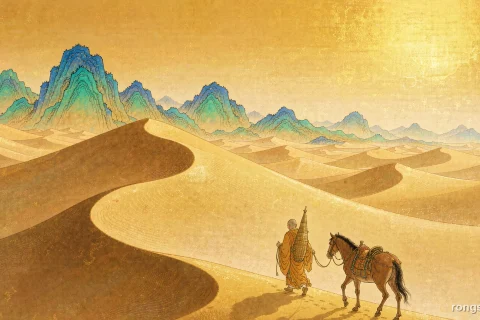
Today, if you go northwest from Dunhuang, there is still a length of earthen wall standing in the desert.
It is all that remains of the Jade Gate.
A man who went out through that gate took one step and was in the western regions. Many of them never came back.
Ban Chao went out at forty-one and came home at seventy-one. He spent thirty-one years on the far side.
The great book that his brother compiled tells the story of centuries, and it is full of the names of other men.
When Ban Chao was young, he copied out words such as those for a living.
The day he threw down his brush, he could hardly have imagined that he would end up as a name inside such a book: not the man who copied it, but one of the men written into it.