The Changle Palace gates opened on a winter morning in 196 BC, and a man was pushed through them with his hands tied.
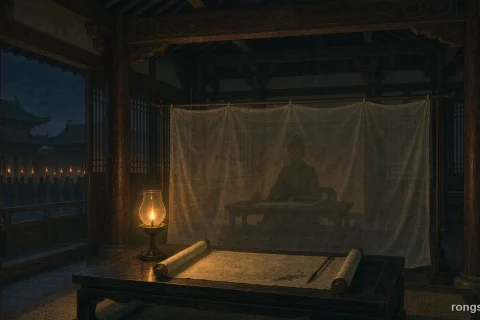
He was led into a room the court called the Bell Chamber, where a great bronze bell hung.
The empress sat waiting, and beside her stood Xiao He, the chancellor. Together they had set the trap.
A few days earlier, word had come from the frontier that a rebel general was dead. The chancellor brought the prisoner an invitation. The emperor has put down the revolt, he said. The court is coming to congratulate him. Come just this once.
He came. The guards took hold of him at the door.
Bound in the Bell Chamber, he understood. He said one sentence, which the historian Sima Qian wrote down word for word. I regret that I did not use the plan of Kuai Tong, and now I have been tricked by a woman and a petty man.
Then he was killed in that room. His whole clan was destroyed with him, because Han law treated a great rebellion as a disease of the family line and cut the line out.
This was one of the finest commanders China has ever produced. And he began as a young nobody in a small town who could not feed himself.
A Bowl of Rice
The Histories, the great record of ancient China, describe the young Han Xin in a few blunt characters. He was poor. He had no good reputation. He was unfit even for a minor clerkship, and had no trade at all. So he ate at other kinds of tables.
For months he turned up at the house of a village chief. The chief’s wife grew tired of it. One morning she cooked early and the family ate in bed, so that when Han Xin arrived the pot was empty.
He said nothing. He turned and walked out, and never went back.
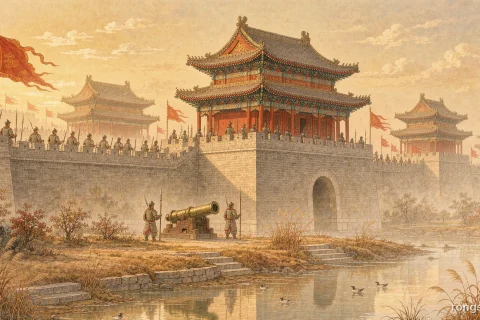
Then he fished in the river below the town wall.
Women were washing silk in the shallows. One saw that the young man was grey with hunger and shared her food with him. Day after day, for weeks, until the silk was washed.
Han Xin was grateful, and told her he would repay her richly.
The woman was angry. A grown man who cannot feed himself, she said, and I took pity on a boy and gave him food. Do you think I did it for a reward?
Han Xin did not argue. He only remembered.
And someone else in Huaiyin had taken note of him. A young man from a family of butchers.
Under a Stranger’s Legs
The butcher’s son stopped him in the market and looked him up and down.
You are tall, he said, and you carry a sword. But I can see what you really are. You are a coward.
Then he made his offer loudly, so that everyone could hear. If you are not afraid to die, draw and stab me. If you are afraid, crawl between my legs.
Han Xin looked at him for a long moment. Then he bent down and crawled through the man’s legs.
The market laughed. They took it as proof that he was a coward.
The episode went into the Histories, and from there into the language. Chinese still uses one phrase for it today.
You have to see the morning he was standing in. He had no office, no money, no name worth defending. If he killed the man, he would die for it. If he failed, he would rot in a cell.
He did not draw. Not because he was afraid, but because it did not pay.
The Runaway and the Chancellor
The Qin dynasty, which had unified China by conquest, was coming apart at the seams.
Han Xin took his sword to a local warlord named Xiang Liang. When Xiang Liang was killed, he moved to his nephew Xiang Yu, the most feared soldier of the age, who gave him a title that meant, in practice, bodyguard.
Again and again Han Xin offered advice. Not once did Xiang Yu take it.
So he left for the camp of Liu Bang. This went worse. He was given charge of a warehouse, then broke a rule, and the punishment was death. Thirteen men from his case were beheaded, and then the executioner reached him.
Han Xin lifted his head and saw the officer in charge. Does the King of Han not want the empire? he called out. Why kill a strong man?
The officer spared him, liked what he heard, and recommended him to Liu Bang, who gave him a post in the supply service. Liu Bang still saw nothing in him.
The one who did was Xiao He, the chancellor.
Xiao He spoke with Han Xin several times and came away more impressed each time. But before he could make his case, Han Xin ran away. Liu Bang had just been posted to a remote western territory, and dozens of his officers had already deserted. The chancellor has recommended me more than once, Han Xin thought, and the king has never listened. Enough.
When Xiao He heard, he did not stop to report it. He got on a horse and rode after him.
Someone told Liu Bang the chancellor had fled. Liu Bang was furious, as if he had lost both his hands.
Two days later Xiao He came back. Liu Bang cursed at him. Why did you run?
I did not run, Xiao He said. I went to bring back a man who did. Who? Han Xin.
Then he said the thing that made the story famous. Those officers can be replaced ten times over, he said. A man like Han Xin cannot be found anywhere under heaven. If you mean to fight for the empire, there is no one but Han Xin to plan it with.
Then make him a general, said Liu Bang. Make him a general, Xiao He said, and he will still leave. Then commander of all my armies.
Good, said Xiao He. But you are careless with men. You hand out the highest rank the way you would call a boy to your table. If you mean it, choose a day, fast, and hold the ceremony properly.
On the day, the officers under the tent were pleased with themselves, each assuming the honour was for him. Then the name was read out, and the whole army was stunned.
It was Han Xin. Two months earlier he had been counting grain in a warehouse and waiting for the axe.
The River at His Back
After the ceremony, Han Xin gave Liu Bang a long private analysis.
Xiang Yu can shout so that a thousand men go weak at the knees, he said, but he will not hand real command to capable generals. He weeps over a sick soldier, yet he turns the seal of office over until its corners wear smooth and still cannot give it away.
Do the opposite, Han Xin said, and the old heartland of Qin will fall to one proclamation.
Over the next few years Han Xin marched north, breaking Wei, Dai, Zhao, and Qi, and bringing Yan over without a fight.
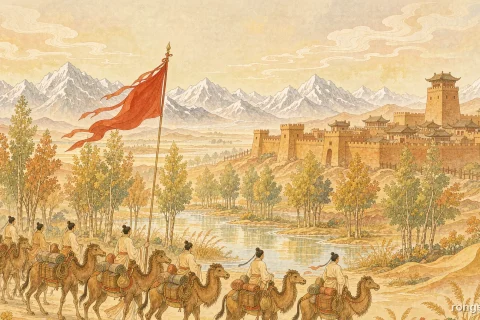
In 204 BC Han Xin and a colleague named Zhang Er led a few tens of thousands of men against the state of Zhao. The king of Zhao met them at the pass with two hundred thousand.
A captured adviser named Li Zuoche had offered a hard plan. The road is too narrow for chariots to run side by side, he said, and the enemy supply train will be strung out behind. Give me thirty thousand men to cut it, and hold your walls.
Chen Yu was a scholar. He believed a righteous army does not use tricks, and refused.
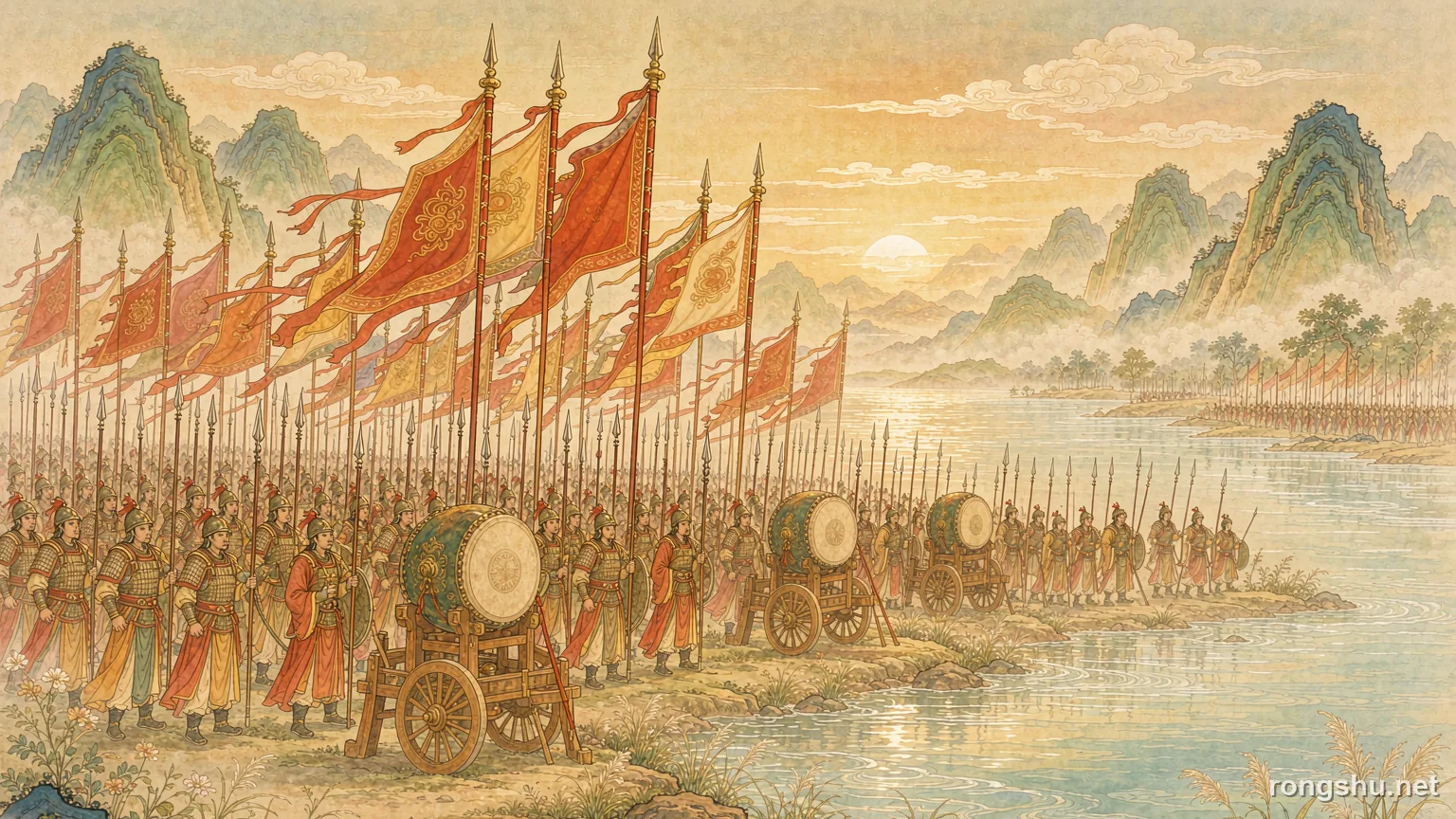
At midnight Han Xin picked two thousand light cavalry. Each man took a red flag and hid on the slopes beside the enemy camp. When the Zhao army sees us fall back, he told them, every man will come out to chase us. Go in then, and put up our banners.
Then he passed the word through the camp. We will eat breakfast after we beat Zhao.
He sent ten thousand men out first, to form up with a river at their backs. Watching from the walls, the Zhao army laughed. To set your line with water behind is to leave your men no way out.
At dawn Han Xin marched out of the pass, banners flying. The Zhao gates opened, and the fighting went on. Then he and Zhang Er pretended to break, threw down their flags and drums, and fell back toward the river. The Zhao army came out for the prizes, exactly as he expected.
The men by the river had nowhere to run, so they fought like men with nothing to lose.
And the two thousand horsemen rode into the empty camp and changed every banner.
The Zhao army turned back to their own walls, and the walls were covered with red Han flags. The formation came apart and the officers could not stop the men from scattering.
Chen Yu was killed at the river. The king of Zhao was taken alive.
They are in the manuals too, Han Xin said. Put men where they must die, and they will live. Put them where they must perish, and they will survive.
The next year he fought on a river called the Wei. He dammed the current with sacks of sand, drew the enemy general across, and broke the dam when half the army was in the water.
The general, Long Ju, was killed. When word reached Xiang Yu, it was the first time in his life he feared another commander.
From King to Marquis
That same year, Han Xin did the thing that cost him the rest of his life.
He had just taken the state of Qi. He sent a messenger to Liu Bang. Qi is treacherous, he wrote, and it borders Chu. Without a strong man to hold it, it will not stay quiet. Let me be made a provisional king here.
Liu Bang was himself under siege, waiting for Han Xin to rescue him. He read the letter and erupted. I am trapped here, he shouted, waiting day and night for you, and this is what you ask.
His two closest advisers, Zhang Liang and Chen Ping, stepped on his feet. Can you stop him now? they whispered. Better to give him what he wants.
Liu Bang understood. He changed his tone mid-sentence and shouted at the messenger instead. A real man who conquers a country should be a real king, he said. What is this provisional nonsense?
So Zhang Liang was sent to make Han Xin king of Qi in full.
What Liu Bang was thinking at that moment is not recorded. Only the two feet are recorded.
His name was Kuai Tong. He read faces, a recognised skill in that world, and told Han Xin that his front showed a man who would rise no higher than a marquis, and who would be in danger.
His meaning was plain. The war now rested on Han Xin. Side with Liu Bang and Liu Bang would win. Side with Xiang Yu and Xiang Yu would win. Side with neither, and he could split the empire three ways.
Han Xin shook his head.
The King of Han gives me his own carriage, he said, his own clothes, food from his own table. If you ride in a man’s carriage, you carry his troubles. If you wear his clothes, you share his grief. If you eat his food, you die for his cause. How could I turn on him for profit?
Kuai Tong argued for a long time. Han Xin would not listen, so Kuai Tong pretended to go mad and became a fortune teller.
Years later, in the Bell Chamber, this was the thing Han Xin regretted.
In 202 BC the last battle was fought at Gaixia. Han Xin commanded three hundred thousand men. In the night, from all four sides of the Han camp, the soldiers began to sing songs from the home country of Chu.
Xiang Yu heard the songs and concluded that Chu had fallen. At dawn he broke out, and at the river Wu he killed himself.
The empire was settled. The first thing Liu Bang did was ride into Han Xin’s camp and take away his seal of command.
The next year he moved Han Xin from Qi to Chu, nearer the capital, where his roots could be pulled up.
A year later someone accused Han Xin of plotting rebellion. By a plan of Chen Ping’s, Liu Bang announced a tour of a lake in the south and ordered the lords to meet him on the way.
Han Xin came. He was seized on the spot, taken back to the capital, and demoted to marquis of Huaiyin, kept where he could be watched.
Han Xin knew what the emperor feared. He pleaded illness, stopped attending court, and stayed home.
One day Liu Bang drank with him and asked how many troops he could command.
No more than a hundred thousand, Han Xin said.
And you?
As for me, the more the better.
Liu Bang laughed. The more the better, he said, and yet here you are, my prisoner.
Han Xin gave a famous answer. Your Majesty cannot command troops, he said. Your Majesty commands the generals.
The flattery did not save him.
In the end the trap was set by Xiao He. The man who had chased him back through the night was the man who led him into the palace.
In 196 BC Han Xin was killed in the Bell Chamber of Changle Palace, and his clan was destroyed with him.
When Liu Bang came back from the campaign and heard that Han Xin was dead, the Histories record five words. He was glad, and he was sorry.
Happy, and a little grieved, at the same time.
Han Xin left behind a list of phrases. Fight with the river at your back. Ambush from ten sides. The more the better. Chinese historical figures come and go, but a few leave words that outlive the dynasties.
But the thing most people remember may not be a victory at all. It is what he did when he was still poor.
His mother died, and he had no money to bury her. So he found a piece of high, open ground and buried her there.
He said that one day the land around that grave would hold ten thousand households, all of them there to tend it.
The Histories put this at the very beginning. Before the woman with the bowl of rice. Before the butcher’s son and the long crawl through the market.
A man with nothing at all was choosing a grave for his mother that could hold ten thousand households.