On the first cold day of that winter, Su Qing went looking for a screwdriver in the toolbox.
Her hand reached the bottom and closed on something hard and cool.
A phone. Not the one he carried every day. The screen was dark.
She sat down on the low stool and held it for ten minutes. In the sitting room the television was still on. In the inner room her daughter was reciting a lesson aloud.
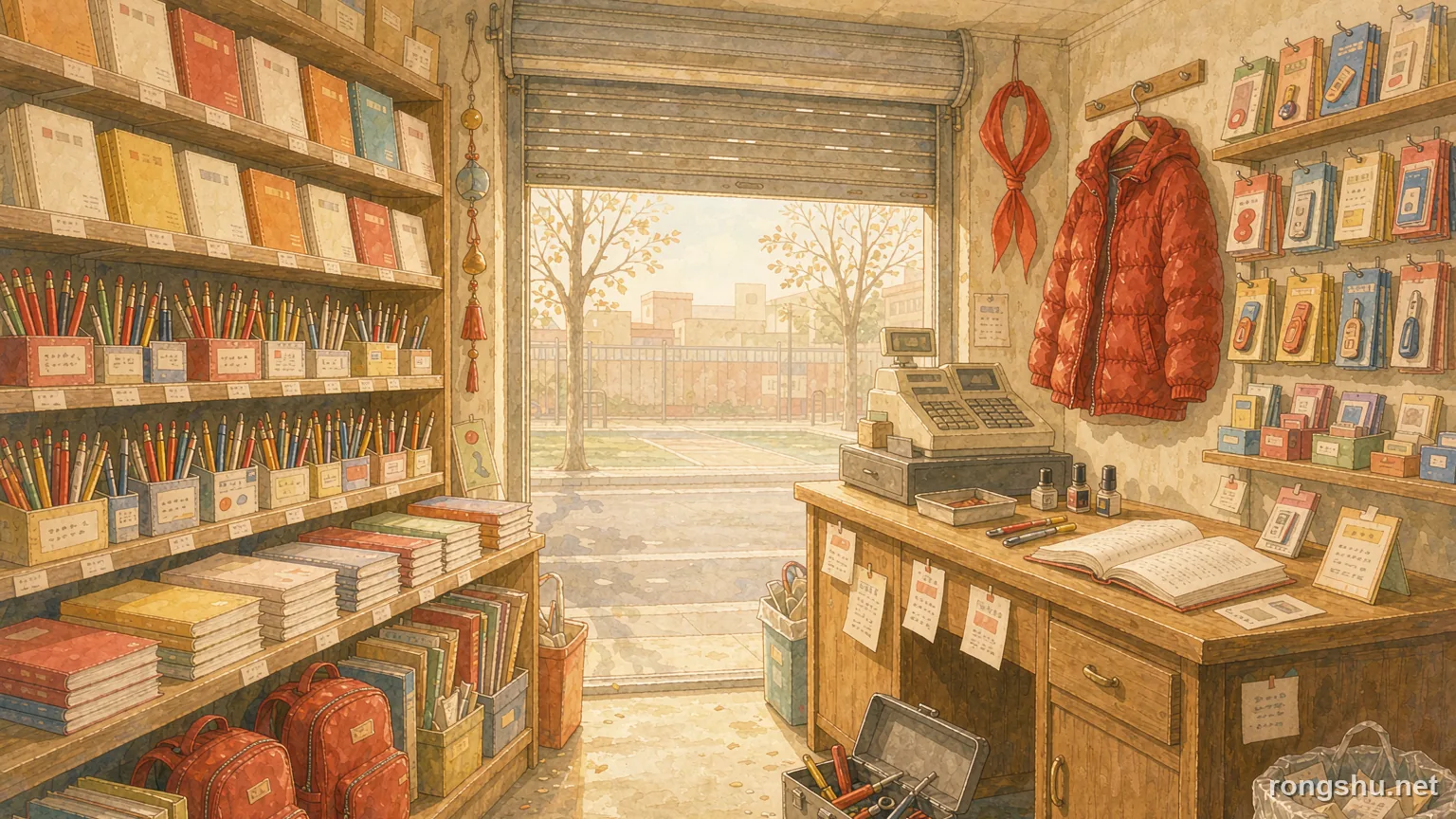
The Shop Across from the School
Su Qing is thirty-six and runs a stationery shop across from the Number One Primary School in a county town.
The shop is ten square meters behind a single roller shutter. She opens at seven and closes at half past six. Exercise books, pencils, red scarves, correction tape. A good day is two hundred yuan. An ordinary day is a hundred and something.
Her husband, Zheng Wei, is thirty-eight. He installs doors and windows for people at the building materials market. He rides an electric scooter held together with tape and is out before daylight and back long after dark.
Their daughter, Duoduo, is nine and in third grade. She crosses the road on her own after school and does her homework at the small table at the end of the counter.
They have been married eleven years. The flat is two rooms in an old compound. Eight years left on the mortgage.
They bought it the second year they were married. They borrowed thirty thousand for the down payment and cleared it in two years. Zheng Wei worked in a factory once. When the factory closed he learned to fit doors and windows from a man from the same village, and he has been doing it for ten years.
Su Qing opened the shop the year Duoduo started first grade. The rent is eighteen thousand a year. She keeps it alone, and she does not close at noon. Lunch is usually a bowl of noodles or two buns, eaten behind the counter. In winter her hands get cold and she tucks them in her pockets to warm them.
Their days are made of small things. The soy milk stand in the morning. Duoduo school uniform. The credit notebook in the shop, where the children who owe a few yuan are written down, one name after another, some crossed out and some not.
The neighbours all know her. The woman who runs the bun shop across the street, Old Li the shoe repairer next door. Everyone calls out as they pass. Stocking, sorting, keeping the books, closing up, she does it all. When Zheng Wei finishes work he comes by to carry the new deliveries up onto the shelves, then sits a while before he goes.
Zheng Wei does not talk much. He used to come home in the evening and sit on the little folding stool outside the shop with a cigarette, watching her bring the shutter down. These past two years he comes home later and later.
He Comes Home Later Every Night
The change came in pieces.
First, clothes. He bought two new shirts, brighter than what he usually wore. When she asked, he said a client had given them to him.
Then a smell. Under the cigarettes, something else, like shampoo.
Then the phone. The one he had used for years started to lie face down on the table. At meals he kept it by his hand. One night it rang at two in the morning and he rolled over and silenced it and said it was a nuisance call.
Then money. What he brought home each month went from four thousand to twenty-five hundred. The market is slow, he said. Fewer jobs.
Duoduo asked why Papa had not eaten dinner at home three nights running.
One evening, doing her homework, Duoduo looked up. Mama, she said, does Papa not like us any more.
Su Qing was putting price stickers on exercise books. Do not talk nonsense, she said. Papa is out earning money.
Duoduo said oh, and bent her head and went on writing. After a while she said, quietly, Wang Xiaoyu in our class, her parents are not together any more. She lives with her grandmother.
Su Qing hand stopped on the sticker. Do your homework, she said.
Su Qing tried once. Washing up after the meal, she said, Is something on your mind lately.
No, he said. Busy time. Year end.
Then he switched on the television.
Both sets of parents called to ask whether the two of them were all right. She said they were.
Once she took out the bank passbook. At the start of the year it had held sixty-three thousand. These last months it had hardly grown.
She put the passbook back, under the bottom layer of the wardrobe, next to Duoduo birth certificate.
One rainy afternoon, washing his jacket, she felt something in the pocket. A parking ticket. The car park was on the west side of town. He never went to the west side.
She opened the ticket and looked at it and folded it back along the same creases and put it in the pocket again.
She did not cry, and she did not call to ask. She washed the jacket and hung it up and sat back down in the shop and watched the lights come on across the road, one by one.
The next day Zheng Wei went out as usual. At the door he crouched to tie his laces. I might not be back for dinner, he said.
Understood, she said.
After the door closed she sat behind the counter a long time. The credit notebook lay open by her hand. On the last page was the day entry: two boxes of exercise books, one box of pencils.
She picked up the pen and added a line under it: today, Zheng Wei did not come home for dinner.
Then she looked at what she had written, and crossed the line out again.
That night he came home after she was in bed. She lay in the dark with her eyes open and listened to him go quietly into the bathroom, where the water ran a long time.
She asked nothing.
The Phone Under the Tools
On the first cold day, the socket in the sitting room stopped working. She went through his toolbox for the screwdriver.
At the very bottom her hand found the phone.
She sat on the low stool and held it a long while. The television was still going. In the inner room Duoduo recited her lesson, line by line, slowly.
She got up and looked in on the inner room. Duoduo had fallen asleep over the table, the exercise book open, the pencil still in her hand. Su Qing put her own jacket over the girl, switched off one lamp, came back to the sitting room, and turned off the television as well.
The flat went quiet.
Then she pressed the power button.
The screen lit up and the light fell across her face. What she saw there, she has never repeated to anyone. She read the one thing. Then she turned the phone over, screen down, and laid it on her knees.
The screen dimmed, and went dark. She could hear her own heart.
She did not delete anything and she did not take a picture. She put the phone back at the bottom of the toolbox, in exactly the same place.
She sat for a long time. The kettle came to the boil on the stove and she did not get up.
After a while she put her hand back into the bottom of the toolbox.
Under everything lay a plastic bag. Inside was a stack of paper.
Bank statements, hospital statements, and several handwritten IOUs. The dates ran from spring to winter.
She read them one by one. She did not understand all of it. But she understood three numbers: how much he had borrowed, how much he had paid back, and how much was left.
The largest single slip said thirty thousand.
She carried the stack over to the lamp and read the thirty thousand one again. The paper had gone soft and the corners were furred. She pressed her finger on the figure.
Some of the IOUs carried names. Two of them she knew. They belonged to relatives back home.
She stacked the papers the way they had been, put them back in the bag, and set the bag mouth upward, just as he had left it.
When the last slip was back in place her hand was shaking a little.
She thought about how much thinner he had grown these six months, his belt pulled in a notch tighter. Back then she had asked and he had said it was hard work.
I Wiped It Clean
Saturday, she took Duoduo to her mother and said she had stock to count at the shop.
After she dropped the girl off she called her mother from downstairs. Her mother asked whether they had quarrelled.
No, she said. I just wanted to ask whether Duoduo has been good.
A marriage is something you get through, her mother said. Do not be headstrong.
I know, she said.
She stood downstairs a moment after the call, and then walked back.
Then she cleaned the phone. The body, the screen, wipe after wipe, until it held the light. She set it in the exact middle of the dinner table.
That evening Zheng Wei came in and saw it and stopped in the doorway with his shoes still on.
He looked at her.
The food is in the pot, she said. Sit down first.
He did not sit. Su Qing, he said, let me explain.
Hear me out first, she said.
This family, she said, does not get to come apart on your say so alone while you are out there deciding everything by yourself.
He opened his mouth and nothing came out.
For a long time neither of them spoke. Then he picked the phone up and put it down again. How much did you read, he said.
Enough, she said.
He lowered his head and his shoulders went down with it. In spring I went in with someone on a shop unit, he said. It failed. I did not dare tell you. I have been paying the loans back a little at a time and I cannot keep up. The fifteen hundred that stopped coming home went into that hole.
I could not face you with it, he said.
You could face me with the other thing, she said.
He said nothing.
She startled herself a little, saying it. She had held that sentence in for the better part of a year.
The flat was very quiet. Through the wall came the sound of the neighbours television, in waves.
After a while she said, Are you hungry. There is noodles in the pot.
Not hungry, he said.
Neither of them moved.
They sat in the living room until it grew light, and neither of them turned on the television. Outside it began to snow. Flakes stuck to the glass and slowly turned to water.
She did not say she would leave. She did not say she would stay.
She said a few things only. She had gone through what they had saved. What she had put by over the years, plus the stock money tied up in the shop, would cover half the debt. The other half he would account for himself, with whoever he had borrowed from.
From today, she said, every yuan that moves in this house goes in the book. If you want that, we go on. If you do not, pack your things.
She got up and found a hardcover notebook in the cupboard, left over from a delivery the year before, a paper crane printed on the cover.
She opened it to the first page, wrote the date, and under it: mortgage, three thousand two hundred. Shop rent, fifteen hundred. Duoduo, four hundred eighty.
Then she pushed the notebook across the table to him. Check it, she said. Is that right.
He looked at it a long time and nodded.
And those IOUs of yours, she said. No more hiding them. Whose they are, how much, which day you pay. All of it goes in here.
All right, he said.
The next morning, when he left, he took the phone with him.
The plastic bag, he left behind.
Two Buns in My Pocket
That winter she still opened at seven.
The hardcover notebook lived under the counter. Every evening before she closed, she took it out and added the day figures. Page after page, the writing small but neat.
Duoduo still crossed the road after school to do her homework. The credit notebook still held the same names. At the end of term a boy came in to pay back two yuan, running, his forehead wet with sweat.
In the last month of the year a delivery of spring couplets and red envelopes came in. A mother brought her child to choose, and the child held the red envelopes squeezed fat in her hands and said she was going to put lucky money inside.
Su Qing smiled and pressed the flap shut for her.
Zheng Wei came home a little earlier each week. One evening he came early and stood at the shop door waiting for her to close. She brought the shutter down and locked it and they walked home one behind the other. Neither of them spoke, but they walked slower than usual. In the last month of the year he was home by six one evening, sitting on the folding stool outside the shop, watching the street, not smoking.
On the twentieth day of the last month it was bitterly cold. She pulled the shutter down and went to collect Duoduo, and on the way she bought two buns from the breakfast stand.
One for Duoduo. The other she put in the pocket of her padded jacket and kept her hand over it so it would not go cold.
When she reached the door, Zheng Wei was already there, bent over, brushing the snow off his shoes.
She took the bun out of her pocket and held it out. Still hot, she said. Eat it while it is hot.
He took it and squeezed it and said something. The wind was loud and she did not catch it.
Inside, Duoduo called out that the food was ready.
She answered, and went in.
This is a work of narrative writing based on real situations in Chinese family life. All names have been changed.