Outside a shop on a shopping street, a line of about sixty people has formed an hour before opening. Most of them are in their twenties or thirties. A few are holding phones up to film the queue itself. When the doors open, the first group walks straight to a wall of identical square boxes, picks up four or five, shakes each one gently, and takes them to the till.
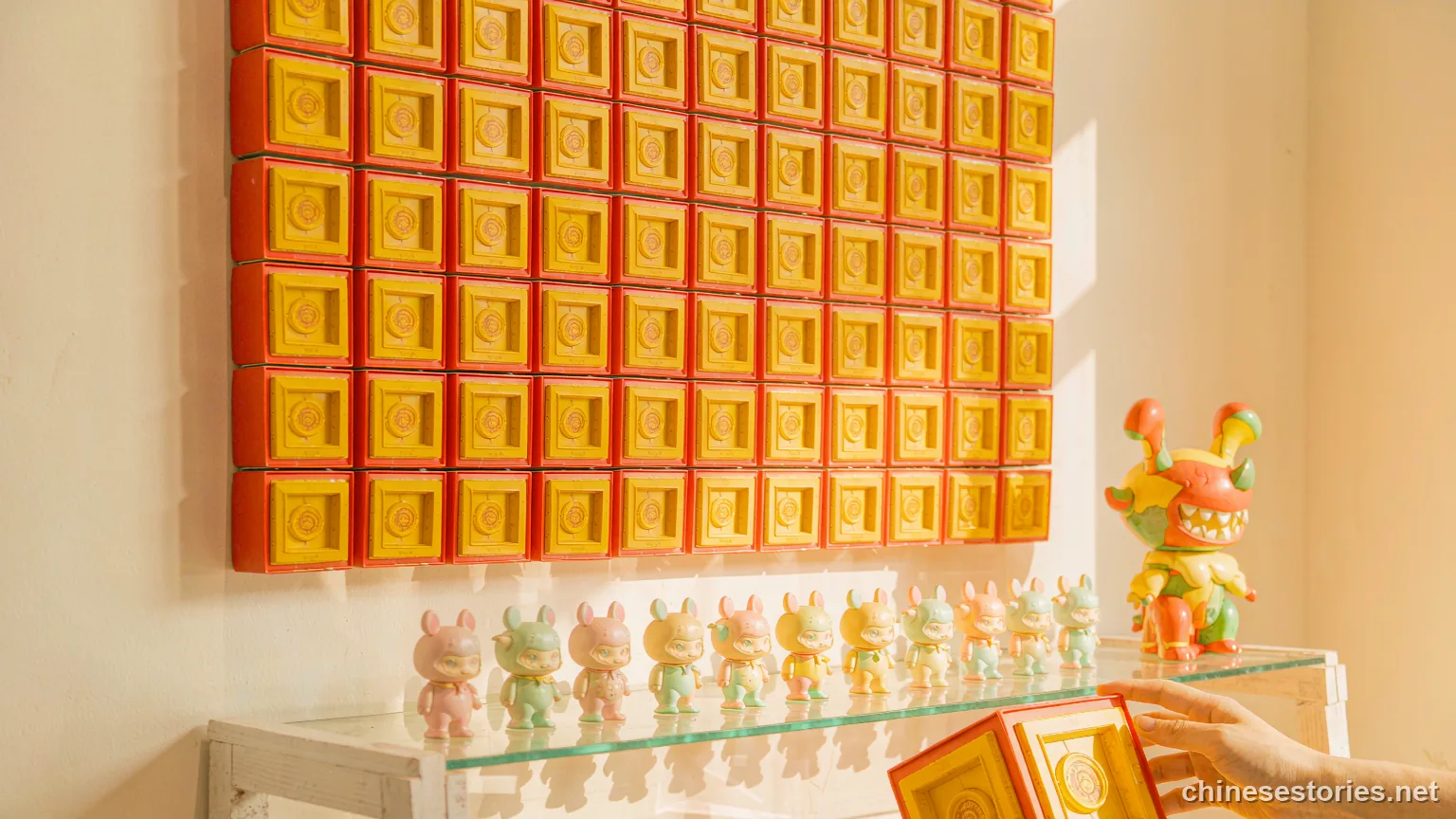
The boxes cost about as much as a cinema ticket each. What is inside is a small painted figure, and which figure it is has been decided at random. Nobody in the line will know until the plastic is off.
This is a blind box, and over the past few years it has turned a niche hobby into one of the most discussed consumer stories in China. It has produced queues, resale prices that run into thousands of yuan, and a design that spread around the world. It has also produced a great deal of argument about what people are really buying.
What a Blind Box Is
The object itself is simple. A manufacturer designs a set of figures, usually twelve or so, around one theme. Each figure goes into an identical sealed box, and the customer buys the box without knowing which one is inside. Collectors open them at home, trade duplicates with friends, and gradually assemble a full set.
The design is what sells it. The figures are not toys in the sense that a child plays with them. They are small sculptures with a consistent style, often slightly strange rather than conventionally cute. Some have sharp teeth, some have wide blank eyes, some are animals dressed in unexpected clothes. Buyers display them on a shelf, in a glass case or on a desk, arranged by series, and photograph the arrangement.
Prices are deliberately low at the entry point, which is the engine of the whole model. A single box costs between about fifty-nine and ninety-nine yuan in the brands that dominate the market, roughly the price of two or three cups of milk tea. That is cheap enough to buy on impulse, and cheap enough to buy five of.
The sets are also released at a pace. A brand may bring out a new series every few months and retire the old one, which keeps collectors permanently behind. Somewhere in each series sits a rarer figure, a hidden one, produced in much smaller numbers and never shown on the printed sheet. The chance of finding one in a sealed box is often around one in a hundred and forty-four.
Why Adults Queue for Toys
The first explanation is the oldest one in retail: uncertainty.
A purchase that might produce something ordinary or something rare is more exciting than a purchase that produces exactly what was chosen. The moment of opening a blind box is a small, private lottery, and it is repeatable for the price of a meal. Buyers describe the same sequence every time, the weight of the box in the hand, the small shake to guess, the clean tear of the seal.
The second explanation is collection behaviour, which adults are just as prone to as children. A set has a defined end point, and an unfinished set is uncomfortable to own. People who begin with one box find themselves buying another to fill a gap, then another, and the shelf acquires a logic of its own.
The third is display and identity. The figures are designed to be photographed, and social platforms reward photographs. A shelf of them says something about taste, humour and the kind of culture a person follows. In a country where a large number of young people live in rented rooms, a small collection is also a way of making a temporary space look like a home.
The fourth is that the brands have become skilled at turning shopping into an event. New series go on sale at a stated hour online and in store. Buyers know the date. Some travel to a flagship store on the day, meet other collectors, swap duplicates, and stay for the photographs. The queue outside the shop is not an inconvenience. It is part of the product.
The Business Behind the Box
The company that built this market is a Chinese one, and its numbers show how large the format has become.
In 2025 the biggest player in the sector reported revenue of about 37 billion yuan, roughly triple what it took the year before, with most of the growth coming from a single character family. That family alone earned about 14 billion yuan, close to four in ten of the company’s sales, and sales in the Americas grew several times over as the figures reached shops in the United States and Europe.
That concentration reveals both the strength and the fragility of the model. A blind box is not valuable because of the plastic. It is valuable because of the character painted on the figure, and the character is a piece of intellectual property that has to be written, illustrated, filmed and licensed. Designers invent a small universe, producers build it into dozens of products, and the marketing department keeps it in the public eye.
The commercial structure has spread well past its origin. Blind boxes now carry film characters, museum paintings, food packaging mascots and regional tourist themes. A city may commission a set of figures based on its own landmarks. A traditional craft may be turned into a series. What began as a toy habit has become a way of packaging anything at all, and the queue outside the shop is the simplest proof that the packaging works.
The Second-Hand Market
What turned the hobby into an investment story was the resale platform.
Duplicates have always been a problem for collectors, and Chinese trading apps solved it. A figure that sells in a sealed box for ninety-nine yuan can be listed online within minutes of opening, and its price reflects what other buyers think it is worth. Rare figures climb. Ordinary ones fall.
The result is a second price for every product, visible to anyone with a phone. On days when a new series is released, the trading apps light up with listings, and a hidden figure can be worth many times its box. One widely reported case in 2025 involved a rare piece from a popular series changing hands for more than four thousand yuan, roughly forty-five times the price of the sealed box it came in. A single oversized early figure was sold at auction for more than a million yuan.
The second price does something unusual to the first. When a shelf of sealed boxes contains a chance of something worth thousands, buying begins to look less like shopping and more like a lottery ticket with a keepsake attached. Some buyers deliberately buy sealed boxes to resell, and the market acquires a speculative layer that has little to do with the figures themselves.
The trading apps also act as a scoreboard. Without a visible resale price, a collector has only a private sense of whether a figure is desirable. With one, the whole community shares a public ranking, and value becomes a daily conversation.
The Habits of the Hobby
Day to day, the hobby has a rhythm that looks a little like a club with no meeting place.
Buying a sealed box is called drawing, and drawing has etiquette. Serious collectors avoid weighing boxes or shaking them for too long, and shops in some cities now sell sealed boxes from behind the counter so that nothing can be guessed. A small number of people do try to identify the contents by weight, but most treat the gamble as the point.
Buying a whole case is the shortcut. A case of twelve usually contains a complete set, though not always, and the buyer who takes the case accepts the duplicates in exchange for a guarantee. Cases are shared between friends, and a group chat will divide a case before it arrives.
Swapping is the social heart of it. Shops and online groups host trade days where collectors bring duplicates in small cases, meet in person, and exchange figures at a table. The trading apps do the same thing at scale, but the in-person table is where the hobby feels like a community rather than a market.
Display has its own craft. Figures are kept in dust-proof cabinets, lit from above, arranged by series or by colour. Some collectors photograph a new arrival against a plain background with a small lamp, and post the result with the series number. When people move home, the collection travels packed in foam, box by box, and the unpacking becomes an afternoon of its own.
Spending varies enormously. Many collectors limit themselves to a set budget each month and a rule about which series they will follow. Others describe periods of buying far more than they intended, and then a deliberate pause while the shelf is reorganised and the duplicates are cleared. A small shelf can hold several thousand yuan worth of plastic, and its owner may know the price of every piece on it to the yuan.
When the Magic Fades
By the middle of 2026 the fever had cooled, and the reasons are instructive.
A new series from the most popular character family arrived in June and did something no release in that line had done before. Several of its ordinary figures fell below their official retail price on the second-hand market within hours of the sale. Prices dropped by a quarter or more on the trading platforms, and even the hidden figure traded at only a few times its box, far below the multiples seen a year earlier.
Several forces produced the change. Supply increased as brands released more series and more units. The audience stopped growing as fast as the catalogue. Buyers who had bought to resell found that the resale price no longer covered the box, and they stopped buying in bulk, which removed a layer of demand that had never been about the figures.
For collectors who had stayed in the hobby for the characters rather than the prices, the cooling was almost a relief. The figures they had wanted were suddenly available at their official price, and a queue was once again a queue rather than a scramble. For the brands, the lesson was harder. A character has a life cycle, and a market built on scarcity has to find something other than scarcity to stand on, which is why the same companies are now selling clothing, desserts, toys, games and household goods under the same names.
Compared With the West
A Western reader will recognise most of the machinery here, because the taste for collectible figures is not Chinese in origin.
Western collectors have chased limited edition toys for decades, from model cars and comic figurines to designer vinyl figures that sold in small galleries. Trading cards operate on the same principle, and so do many of the mechanics of a modern video game. Blind packaging is an old idea that has appeared in cereal boxes, sticker albums and vending machines for generations.
What differs is the integration of the whole system in one place. In China, manufacturing, design, retail, resale and social media sit inside a single fast loop. The factory that makes the figures is a few hours from the design studio, a new character can go from sketch to a shop wall in months, and the trading apps report what it is worth the day it arrives. In most Western markets those functions are spread across companies and countries, and the loop turns more slowly.
There is also a cultural difference in how the hobby is regarded. Western collectors often keep their interest semi-private, and buying toys as an adult still carries a hint of embarrassment in some circles. In China the shelf of figures is often displayed openly and discussed as a matter of taste, and the queue outside a store on a release day carries no apology.
The Box on the Shelf
At home, the collector sits at a desk with four boxes and a phone set up to film. The first three produce duplicates, which are set aside for trading. The fourth produces the figure that had been missing, and there is a small involuntary sound of satisfaction.
It goes on the shelf with the others, in the order the series was released. The duplicates are listed on an app before lunch and will be traded for two figures from a different set by the weekend. The plastic wrappers go in the bin. On the desk there is a row of small painted animals and people, standing in a line, costing together more than the furniture they stand on, and meaning something to their owner that no price list can capture.
This story is based on publicly documented practices and on reporting in the Chinese and international press. The families described are illustrative, and no individual is identified.