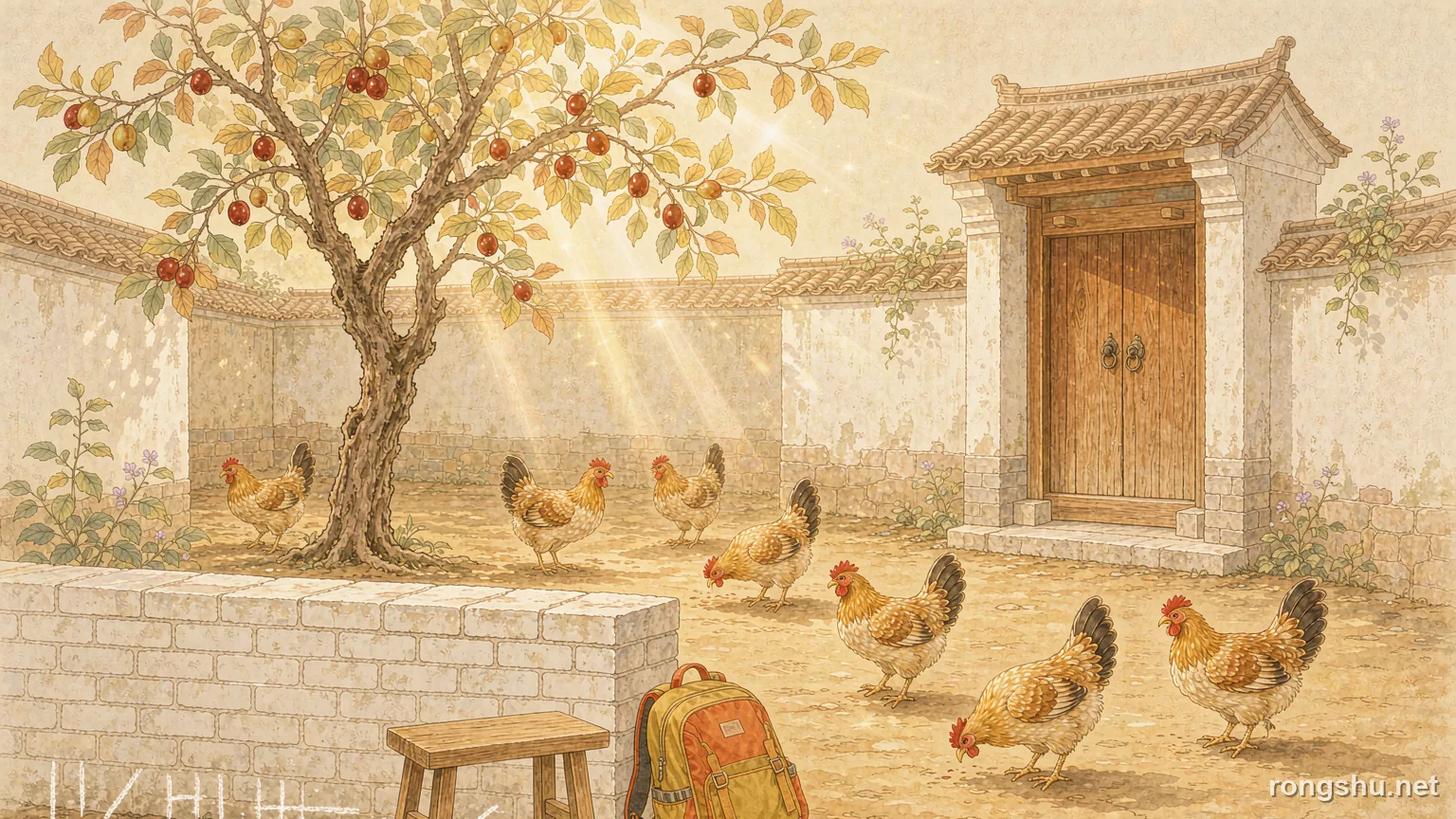
Xiao Yu came home from school, dropped his bag on the doorstep, and crouched by the wall to make one more chalk mark.
His grandmother saw him. She said nothing.
The wall already carried several rows of them, tally marks made the Chinese way, five strokes to a set. She had tried to count them once and stopped halfway.
Grandma’s Courtyard
Wang Xiulian is sixty-three. She lives in a courtyard at the east end of the village.
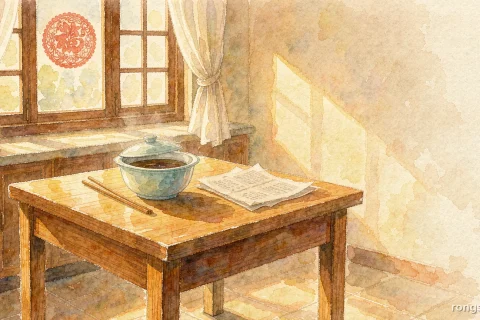
The courtyard is small, three tiled rooms in a row. The room on the east side is the kitchen, where a black wok sits on the stove and never moves. The room on the west side is hers. The main room is kept for her son and his family, though all year round it stands empty.
Her son is Jianjun, a migrant worker in a factory in the south, making phone cases. His wife, Xiao Min, works at the same factory, on the same assembly line. They have been away eight years. The first two years they came home once a year; then Xiao Yu was born, and still they come home once a year, at the new year.
Xiao Yu is eight, in second grade.
From the beginning, Wang Xiulian has raised him. She fed him formula and changed him and carried him three li to the village clinic at night when he had a fever. His first steps, his first word, which was Grandma, his first written character, all of it happened with her. His parents have only ever seen these things on a screen.
Her days are long. She rises at half past five to light the stove and cook. At six she wakes Xiao Yu and watches him finish breakfast. At seven she walks him to the school bus stop at the mouth of the village. Then she comes back, feeds the chickens, sweeps the yard, and walks out to the fields once. At noon she eats alone. At half past three she stands at the mouth of the village on the dot. The moment the bus stops, Xiao Yu comes running down the steps and calls out to her.
That is the loudest sound in her whole day.
Xiao Yu is not the only child here like this. In his second-grade class of eleven students, seven have parents working away from home.
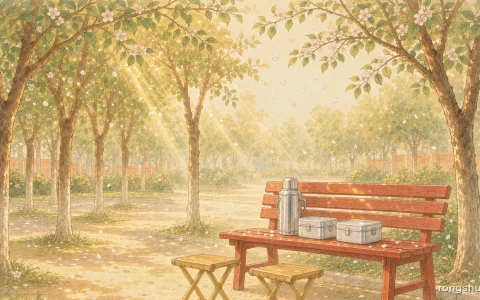
During the day those houses are all locked. Xiao Yu plays with the yellow dog in the yard and the jujube tree by the gate.
Wang Xiulian’s husband died young, before Jianjun was married. All these years she has kept the courtyard on her own. She rents out half the land and keeps a small plot for vegetables. Her son sends home fifteen hundred yuan a month. She tells him it is enough. It is not enough, so she makes it stretch. Meat comes into the house once a week, for Xiao Yu. She does not touch it.
Xiao Yu was sensible early. Once she put the last piece of meat in his bowl, and he put it straight back. Grandma, you eat it, he said. Your teeth are bad, meat is good for you.
I do not like meat, Wang Xiulian said.
He looked at her. Grandma, he said, you are lying. Last time you said it was good.
Wang Xiulian bent over her bowl and took two mouthfuls of rice and did not answer.
Xiao Yu hardly ever asks about his parents. He knows that if he asks, his grandmother will feel it too. Once a television drama showed a whole family eating around one table, and he watched for a long time and then said, Grandma, when will our family eat together.
At the new year, Wang Xiulian said.
How many days is the new year, he said.
She could not answer.
One Phone Call
It began with a phone call.
That evening her son called by video. On the screen Jianjun wore his work uniform. Behind him was the assembly line, and the noise was loud. He raised his voice. Mom, he said, I want to talk something over with you.
Wang Xiulian leaned toward the camera. Go on, she said.
Xiao Min thinks we should bring Xiao Yu here, he said. The schools are better. We cannot leave the boy in the village forever.
Wang Xiulian held the phone and said nothing.
Mom, are you listening, he said.
I am listening, she said.
So do you agree, he said.
It is your family, she said. You two decide.
The call ended. Beside her, Xiao Yu was doing his homework. He looked up suddenly. Grandma, he asked, are my parents going to take me away.
Nothing of the kind, Wang Xiulian said. Do your homework.
He bent his head, and his pencil pushed a hole through the paper.
That night Wang Xiulian could not sleep. She lay on the kang and turned from side to side. She had thought about this day many times, and she knew it had to come. The boy belongs to her son and his wife. To take him is their right. What claim does an old woman have to hold him back.
Still she could not sleep.
She thought about what would become of her if the boy went. Three empty rooms, and whether she would still manage to get up at half past five. She thought about the boy arriving there, with two adults working opposite shifts, and who would cook his breakfast, and who would wait for him at the mouth of some lane.
Who was she supposed to say all this to. To her son, it would only be, Mom, do not worry about it.
The next day Aunt Zhang from next door came by. Xiulian, she said, I hear you are going to the city to look after your grandson.
Nothing is decided, Wang Xiulian said.
Well, that would be nice, Aunt Zhang said. Go to the city and enjoy yourself.
Wang Xiulian smiled and did not answer. She knew in her heart that going to the city is not enjoyment. She is an old woman who cannot find her way, and over there she would not even know which way the market faces.
After Aunt Zhang left she swept the yard. When she reached the wall she paused. The half-used chalk was still lying on the windowsill.
She picked it up and held it a while, and did not have the heart to throw it away.
The Tally Marks by the Wall
She found the marks after that.
One afternoon she went to the village mouth early, and when she came back she saw Xiao Yu crouching at the base of the wall with half a stick of chalk in his hand.
She walked over quietly.
On the wall, starting from under the eaves, there were rows and rows of tally marks. The first set, at the front, was from last December.
Then she understood. One stroke was one day. He had started the day his parents left after the new year, and every day he drew a stroke.
She crouched beside him. Xiao Yu, she said, what are you drawing these for.
He hid the chalk behind his back. Nothing, he said.
Are you counting how many days until your parents come back, she asked.
He said nothing, and stared at his shoes.
After a while he said, Grandma, I am up to one hundred and fifty-three. Mom said she would come back at the new year. How many days until the new year.
Wang Xiulian worked it out. More than a hundred, she said.
Oh, he said. He crouched again and drew one more stroke. Today.
Wang Xiulian sat on the doorstep and watched him. She thought about when she was young, when her husband was sent away to build a reservoir, and how she had waited one day at a time just like this. There were no phones then, no video calls, and a letter took half a month. She had carved the days into the doorframe, one notch for one day. By the time the doorframe was full of notches, her husband had come home.
And now, she thought, in this same courtyard, this small grandson of hers had turned into the very same kind of person she had been thirty years ago.
She reached out to pat his head. Her hand stopped halfway and came back down.
That night she dug out her sewing basket and found a box of white chalk, the box Xiao Yu had brought home from school, nearly used up.
She took a low stool and sat by the wall and counted from the beginning. One hundred and fifty-three strokes. Thirty full sets, and three strokes besides.
As she counted, her hand stopped in the air. It was not the chalk she minded. It was the boy. So young, and he had already learned to count the days.
She put the chalk box back in the sewing basket and pressed it down under the thimble.
That Small Room
Last summer Wang Xiulian went south to see them.
Jianjun had asked her to come. Xiao Min was not well, he said, and she should visit and stay a few days.
She rode the high-speed train for the first time. All the way there she peeled boiled eggs out of a plastic bag and handed them to Xiao Yu one by one. Jianjun met her at the station, and they rode the bus for more than an hour before they reached where the family lives.
It is one very small room in a village inside the city, the kind that migrants crowd into. Downstairs someone sells spicy hot pot and it is noisy past midnight. Inside there are two beds, an induction cooker, and a plastic basin. A row of work badges hangs on the wall.
The two of them work opposite shifts. Jianjun on days, Xiao Min on nights, and the only time they see each other is the half hour of the handover. The lunch boxes are stacked on the table, and whoever comes in heats one up.
Wang Xiulian asked, if you two are both at work, who looks after Xiao Yu.
Jianjun said nothing. Xiao Min’s eyes went red. We would find a place, she said. They pick children up after school. Eighteen hundred a month.
Wang Xiulian said nothing. Then she asked, and school.
He would need a residence permit for this city, Jianjun said. Or years of social insurance payments. Right now we do not qualify.
Wang Xiulian did not really understand all of it. She understood one thing only. For a child to go to school in the city, it is not simply a matter of wanting to.
At dinner, Jianjun took her downstairs for noodles. He ordered two dishes, one meat and one vegetable, and kept putting the meat into her bowl. I do not want it, she said. Mom, eat, he said. The noodles cost eight yuan. He ate fast, because he had to go back to overtime work.
Wang Xiulian looked at her son’s hands. There were small cuts all over them, worn in by the assembly line. She remembered Jianjun as a boy, when those hands were smooth and pale, and could shape clay figures.
She said nothing. She simply took the meat from her bowl, piece by piece, and put it back into his.
She stayed six days. On the seventh she said, I am taking Xiao Yu home.
Mom, let us talk about it some more, Jianjun said.
There is nothing to talk about, she said. You two cannot even look after yourselves here. Leave the boy with me. We have few people in our village and the school is not as good as the city, but he gets a hot meal and someone to tuck the quilt around him at night.
Xiao Min began to cry. Mom, she said, it is because we are useless.
Wang Xiulian patted her hand. What nonsense, she said. You go out to earn money, and it is for him. When he is in middle school we can talk about it again.
No More Marks
This spring, Wang Xiulian did one thing.
She went to town and spent a little over three hundred yuan on a secondhand phone, one with a big screen and big characters. She asked a young man in the village to teach her how to make video calls, how to zoom in, how to prop the phone up.
After that, every evening at half past seven, she set the phone on the dish rack on the table and pointed it at Xiao Yu. On the other end were Jianjun and Xiao Min, sometimes at the factory gate, sometimes by Xiao Min’s dormitory.
At first Xiao Yu would not talk. Slowly he began to. He scored ninety-eight today. He quarreled with somebody today. Grandma put too much salt in the stew today.
Wang Xiulian would sit beside him, sewing soles, and listen.
It took her three days to learn the video call. The first day she held the phone upside down. The second day she had the camera turned on her own face and could not find Xiao Yu at all. On the third day the young man said, Auntie, you just have to prop it up. She found a bowl and propped it.
Mom, thanks for the trouble, Xiao Min said on the phone.
No trouble, she said. Take care of yourselves out there.
Once Xiao Min began to cry on the video. Xiao Yu, she said, I miss you.
Mom, do not cry, Xiao Yu said.
He brought his face close to the camera. Mom, he said, I am up to two hundred and one.
That night it rained hard.
The next morning Wang Xiulian opened the door and saw that the tally marks along the base of the wall had been washed into a blur. Some were only half a stroke. Some had left nothing at all.
Xiao Yu came out with his school bag on his back and stood at the wall for a long time.
Wang Xiulian took a stick of chalk from her pocket and held it out to him.
He took it, weighed it in his hand, and gave it back.
Grandma, he said, no more marks.
This is a work of narrative writing based on real situations in Chinese family life. All names have been changed.