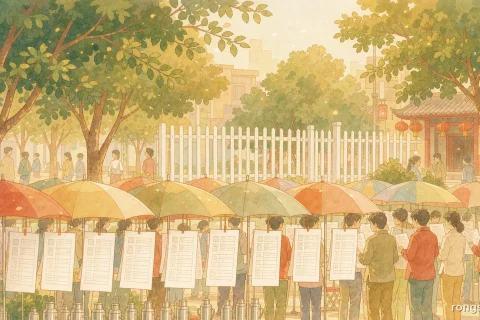
The stationery shop where Lin Qiuping works stands opposite the gate of the middle school.
Just before ten to six every afternoon the bell goes, the children pour out, and her doorway fills at once. Pens, exercise books, a bottle of water.
She stands behind the counter taking money and giving change. By the end of the day her voice is gone and her legs ache.
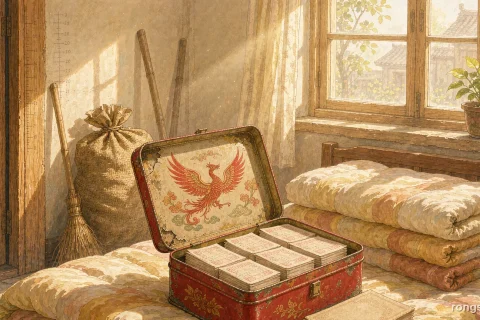
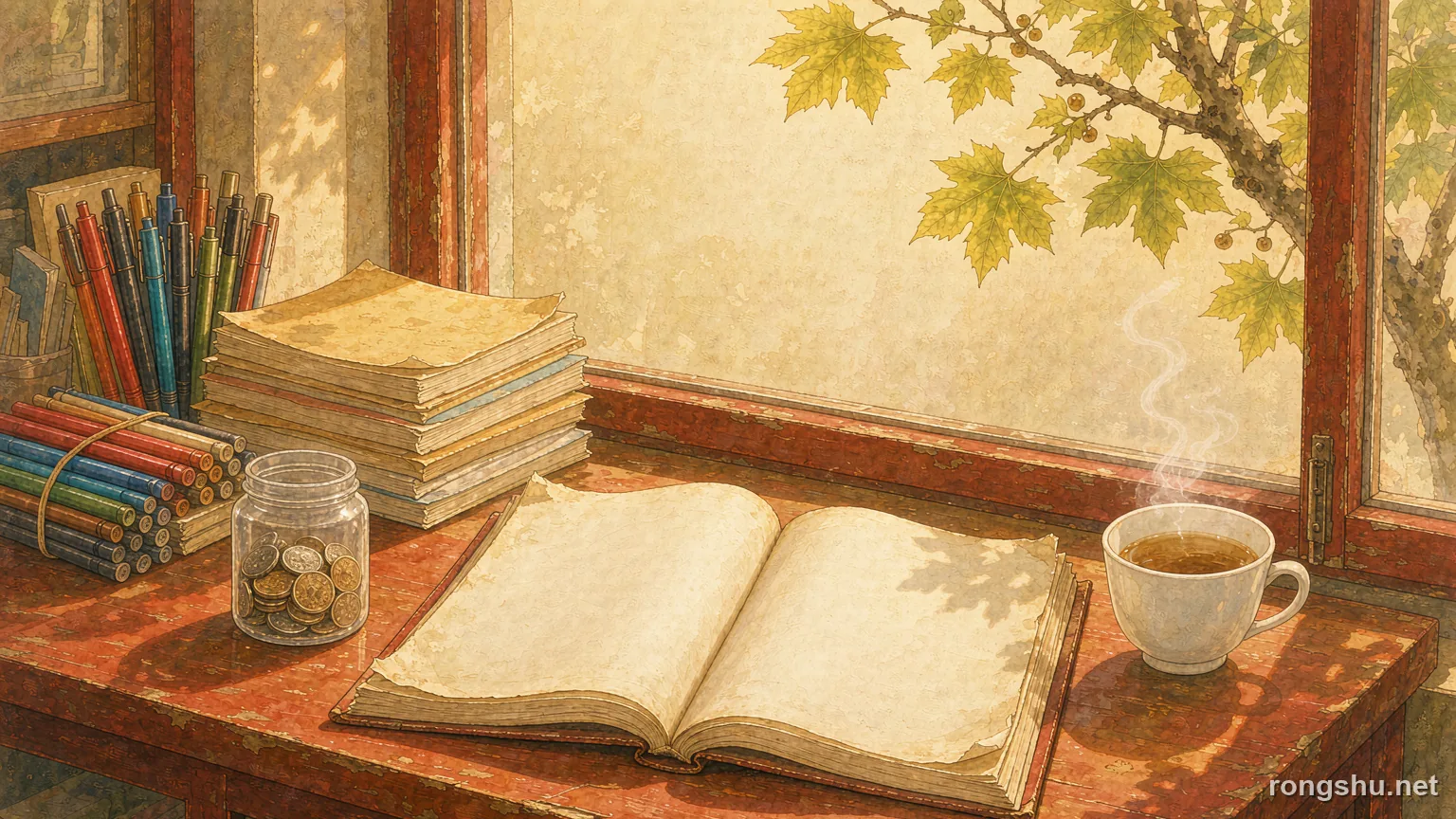
On top of the cabinet in the shop is a stack of old books. At the bottom of the stack is one with a soft cover, worn pale.
It is a class keepsake book, the kind Chinese students pass around in their final year, each classmate writing a page for the rest.
The Shop by the School Gate
Lin Qiuping is forty-nine.
She has run the stationery shop for twelve years. It is not large, two rooms knocked into one. Pens and exercise books at one end, exam papers and study guides at the other. A price list is taped to the wall, one sheet of paper, the corners curling.
She opens at seven and closes at nine. At noon, when the students are in, she is in. On holidays, when they stay away, she comes in anyway.
She has been divorced for twelve years. Her daughter lives with her, and is now in her third year at a university in the provincial capital. She comes home twice a year.
Her former husband went to another province. He does not even call once a year. She does not talk about him. If someone asks, she says she was divorced long ago.
The divorce came when her daughter was in the third year of primary school. The flat is an old one in a low block that her own family helped her buy, two rooms, and she has lived there ever since.
She never married again. It is not that nobody suggested it. She always said she was fine on her own.
There is a plastic jar on the counter for coins. Students are often a few cents short for an exercise book, and she says never mind. Some pay it back the next day. Some do not. Most do.
She knows the faces of her students and of their parents. Some families come in generation after generation, the younger brother after the older sister graduates.
There is only one middle school in the town, and most of the students board. What sells best is black refills and loose-leaf paper. She restocks twice a week.
The years in the shop are marked out in blocks. The start of term is the busiest time, three thousand yuan in a day, and by evening her hands ache from counting. In the winter and summer holidays she takes under two hundred, and she sits and watches the plane tree outside the door.
There are seven or eight shops along the street, milk tea, pancakes, fried skewers, and the owners all know one another.
Zhou Xiaohong and she grew up together. Zhou Xiaohong sells insurance in the city and talks a blue streak. They call each other once a month, and every time Zhou Xiaohong tells her to find someone. She says, forget it.
In the afternoon, when there is nobody in, she turns on an old radio low. The announcer reads the weather in different places, and when he comes to the south she listens a little closer.
Thirty Years Later
The reunion was arranged in the spring.
Someone set up a chat group for the class. At first only a few people talked in it, then more and more names lit up. Someone posted an old photograph, too blurred to make out any face.
Zhou Xiaohong called from the city. Qiuping, she said. You have to come. Thirty years. There will not be another.
I am not going, she said. Too many people.
Then I will come to the shop and drag you there, Zhou Xiaohong said.
She watched the group for two days. Someone tagged her. Qiuping, you are in the county town, you get there early and help set out the tables.
She replied, all right.
Someone posted a photograph from a sports day, the whole class lined up on the field. She looked for a long time before she found herself in the third row, with two braids.
Underneath, someone asked, which one is Lin Qiuping. Someone else answered, the one crouching in front is Lu Mingyuan.
She zoomed in. The boy in the picture was thin and wore a white shirt. His face was a blur.
In the end she went. The restaurant was on the east side of the county town, two tables in a private room. About twenty came, half of them white-haired and heavier and impossible to place.
At the door someone shouted her name. Someone took her hand and said, you have not changed. She laughed and said, we all have.
She recognised a few. Most she did not. The boy who used to sleep through the back row now runs a company and has the loudest voice in the room. The girl with the best marks in the class hardly spoke, and sat pouring tea for everyone.
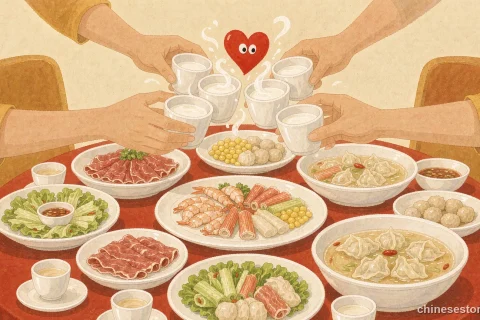
The food was the usual county-town spread. Braised chicken, pork belly, a fish, a soup. Two bottles of liquor on the table and a few of soft drink.
Someone suggested two hundred yuan each, with whatever was left over going to buy something for the class teacher. She transferred hers the same day.
Once the money was in, the group filled with red envelopes. She opened one and got three yuan eighty.
The dishes came and the glasses were filled. People told stories about who had hidden whose books, and who had climbed the wall and been caught. She sat toward the back and listened and laughed and said little.
At the third dish someone called the class teacher. The man is over seventy, and on the phone he went through the class name by name. When a name was called, that person stood up and answered.
When it came to her she said, teacher, it is Lin Qiuping.
Qiuping, he said. Are you still in the county town.
I am, she said. I have a little shop by the middle school gate.
Good, he said. Good. That is close by.
She hung up and took a mouthful of soup.
Just after eight the door of the room opened.
The man who came in wore a dark jacket. His hair had gone grey at the sides, but he still stood straight.
Someone stood up and called out, Old Lu is here.
Lu Mingyuan.
He shook hands with the people near the door and came down the room, and he stopped at her table.
He looked at her for a moment. Lin Qiuping, he said.
Lu Mingyuan, she said.
You still sit by the window, he said.
She blinked. This is not by a window, she said.
I meant the classroom, he said.
And they both laughed.
He sat diagonally across from her. Over the meal someone asked where he had been all these years. The south, he said. Construction work. Someone else asked about his family, and he said his wife had passed away a few years ago.
The table went quiet for a moment, then loud again. She reached for some food and did not grip it well, and it fell onto the tablecloth.
The dinner ran past ten. Afterwards they stood at the door and talked, and someone proposed a photograph, and the twenty of them squeezed into two rows. She stood at one edge and he at the other.
It began to rain lightly as they broke up. People waited at the door for their cars. He stood on the step with small beads of water in his hair.
He asked for her WeChat before they left. She gave him her number, and when he had saved it he said, I have a few things to do in the county town tomorrow.
Oh, she said.
The Book on Top of the Cabinet
After the reunion the group talked every day. Photographs, old songs, the bill for the dinner split between everyone. She rarely replied. She only looked.
Zhou Xiaohong called her. Did you see, she said. Lu Mingyuan asked in the group who drove you home that night.
I did not see it, she said.
He was only asking, Zhou Xiaohong said.
Oh, she said.
That afternoon a delivery of pen refills came, and she carried the boxes up to the top of the cabinet, one after another. Halfway through, the stack of old books toppled and came down one by one.
She picked them up. When she reached the soft-covered one at the bottom, her hand stopped.
A class keepsake book.
The cover was worn pale, the corners frayed. She wiped off the dust and opened it.
Tucked at the front was a slip of paper from the year it went round. Pass it on when you have finished. The handwriting was the class monitor.
The first pages were names and addresses, in all sorts of handwriting. After that came the messages, one page each. Bright futures. Long friendship. Remember to write to me.
She turned to her own page and read what people had written her, and laughed twice, and closed the book.
She was about to put it back.
Her hand stopped.
She wanted to see who had written the last page.
The Line in the Binding
The book was not full. A little under half of the pages were blank. The last page was his.
His handwriting was good. It had been good then, too. One line, no more.
I wish you a place at the school you want.
She looked at that line for a long time.
She remembered that year. The book reached her just before the exams. She turned the pages one by one, and when she came to his there was only that one line. Something in her went cold, and she closed the book and pushed it into a drawer.
What she thought at the time was, so that is all.
Back then there was something in her, like a shadow, that she never dared touch. She had assumed it belonged to her alone.
Now she held the page and was about to close the book when the plastic cover lifted.
A split had opened in the cover and the corner had curled back. She pressed it down, and under her fingertips she felt something rough.
She peeled the cover back.
Against the binding, there was a line of writing.
Not ink. Pencil, very faint, pressed between the page and the cover, pressed there for thirty years. Some of the strokes had rubbed away, and she had to bring her face close.
What it said was: the first of September, I will wait for you at the bus station, until ten.
She sat behind the counter. There was nobody in the shop.
At three in the afternoon a water truck went past on the street, its music playing all the way down. She did not move.
Then she remembered. On the first of September that year she was at home helping her mother pull corn, on the family plot east of the village. She was in the field the whole day, and the leaves cut red lines into her arms. Her mother told her to rest. She said she was not tired.
That autumn the family was arranging a place for her at a textile mill in the county town. On the second of September she went to report for work.
She had not gone to the bus station. She had not known that anyone was waiting there.
He had written the line and then stuck the cover down over it. When the book came back to her, the last page was closed.
In thirty years she had never lifted that corner.
She took the book home and put it at the back of a drawer.
By the Reservoir
That night she called her daughter.
She talked about the reunion, and the old classmates. Her daughter asked, mother, did you meet someone.
I met an old classmate, she said.
Are you happy about it, her daughter said.
I do not know, she said.
Her daughter laughed on the other end. Mother, she said. You are forty-nine.
That is right, she said.
Then I am certainly not going to stop you, her daughter said.
She hung up and sat on the edge of the bed for a long time. There is a thing in China that parents of her generation know well. Most families have one child, and when that child leaves for university and for work in another city, the house is left empty and the parents are left in it.
The next day she sent Lu Mingyuan a message. She wrote it and deleted it and wrote it again, and what she finally sent was this: on the first of September that year, I was at home pulling corn.
Then she turned the phone face down on the counter and went to tidy the shelves. Halfway through she could not help turning it over.
Two messages came back.
The first was: I know.
The second was: you never turned up.
She looked at those two messages all afternoon.
That day a few students came in for pens, and she gave the wrong change, and they pointed it out, and she apologised.
When she closed up that night she sat in the shop half an hour longer than usual before going home.
A few days later he came back from the south for a visit. He said he wanted to settle here again, that there was work at home too.
Someone in the group said, Old Lu is back. She did not reply.
They met by the reservoir and walked half the way round. There was wind on the water, coming across in layers.
She had brought him a bottle of water. He unscrewed it, drank, and said, this water is sweet.
It is the same water, she said.
No, he said. It is not.
The wind came off the water and lifted the hair from her forehead. She raised a hand to press it down, and then let the hand fall.
The two of them stood on the bank and said nothing, and looked at the water for a while.
This is a work of narrative writing based on real situations in Chinese family life. All names have been changed.