A manager has to tell a colleague that a report is not good enough. In a Western office the meeting might open with the problem. In a Chinese office the manager may first praise the effort, then lower the voice, then find a private moment later to explain what went wrong.
The report is the same in both cases. What changes is where the criticism lands. In the second version the goal is to fix the work without making anyone feel diminished in front of others.
That instinct has a name. It is mianzi, usually translated as face, and it runs through offices, family dinners, friendships and even the way a stranger refuses a request. Once you can see it, a great deal of daily behaviour stops looking mysterious.
For a visitor the concept can sound like vanity, or like an exotic rule that foreigners can never learn. It is neither. It is closer to a shared currency of respect, and like any currency it has rules for when it is given, spent, saved and lost.
Two Words for the Same Face
Chinese uses two different words where English uses one, and the difference matters.
The first is mianzi. It points to reputation, standing and the respect a person holds in the eyes of others. It is social, earned and easily damaged in public. When someone has mianzi, they are taken seriously in their circle.
The second is lian. It points to moral character, to whether a person is decent and trustworthy. A person can lose mianzi by being embarrassed and still keep lian. But the reverse is harder. To lose lian is to be seen as someone without integrity, and that is a deeper fall.
The distinction explains why some slights feel small and others feel serious. Being corrected in a meeting costs mianzi. Breaking a promise or cheating a friend costs lian. The first can be repaired with a gesture. The second follows a person around.
An early study of the idea traced it to the 1940s, and scholars have been refining it ever since. One widely cited definition describes face as the respect a person can claim by virtue of their position and by how well they are seen to behave in it. Face is not something a person simply owns. It is granted by others.
Why Public Shame Stings
The clearest way to understand mianzi is to watch what happens when it is damaged in front of a group.
A student is scolded by name in class. A worker is blamed for a delay in front of the whole team. A guest is told the food they brought was unnecessary, with a tone that suggests it was not wanted. In each case the person loses standing in the eyes of people whose opinion matters.
The sting is not only personal pride. In a society where reputation circulates through networks of family, neighbours and colleagues, being shamed in public changes how others treat you. Face is relational. When it drops, the whole web around a person feels the tug.
That is why so much everyday politeness is aimed at avoiding public correction. A teacher may speak to a student after class. A boss may hint rather than announce. A friend may pull another aside. The point is rarely to hide the truth. It is to deliver it in a way that leaves the person standing.
For outsiders this can look like indirectness or even dishonesty. In practice it is a negotiation about where a difficult fact is allowed to land.
Giving Face as an Investment
If face can be lost, it can also be given, and giving face may be the part that surprises visitors most.
Praising a colleague in front of their manager gives them face. Inviting someone to sit in a respected position at a banquet gives them face. Accepting a gift with obvious pleasure gives it to the giver. Even a well-timed compliment to a parent about their child does the same work.
Giving face is not purely generous. It creates a small debt, a sense that the kindness should eventually be returned. In that way it is like adding to a shared account. The person who gives face today may need a favour tomorrow, and the relationship holds the balance.
This is why face and the wider idea of connections sit so close together. People build and maintain networks of mutual obligation, and face is the visible measure of standing within them. A person with a great deal of face can call on more help. A person who has been given face feels a quiet pull to reciprocate.
The exchange does not need to be spoken. It lives in gesture, tone and the small choices of who is seated where, who is introduced first and whose toast is answered.
The Dinner Table Rules
Nowhere is the machinery of face more visible than at a Chinese banquet, where almost every choice carries meaning.
Seating follows a kind of hierarchy. The most honoured guest sits facing the door, the host sits in the position that lets them serve and watch, and the arrangement around the table reflects who matters most and who is being welcomed.
The host is expected to order generously, often more food than the table can finish, because abundance signals respect. To leave a host looking stingy would cost them face. To finish every plate too quickly can seem as if the guest was not satisfied.
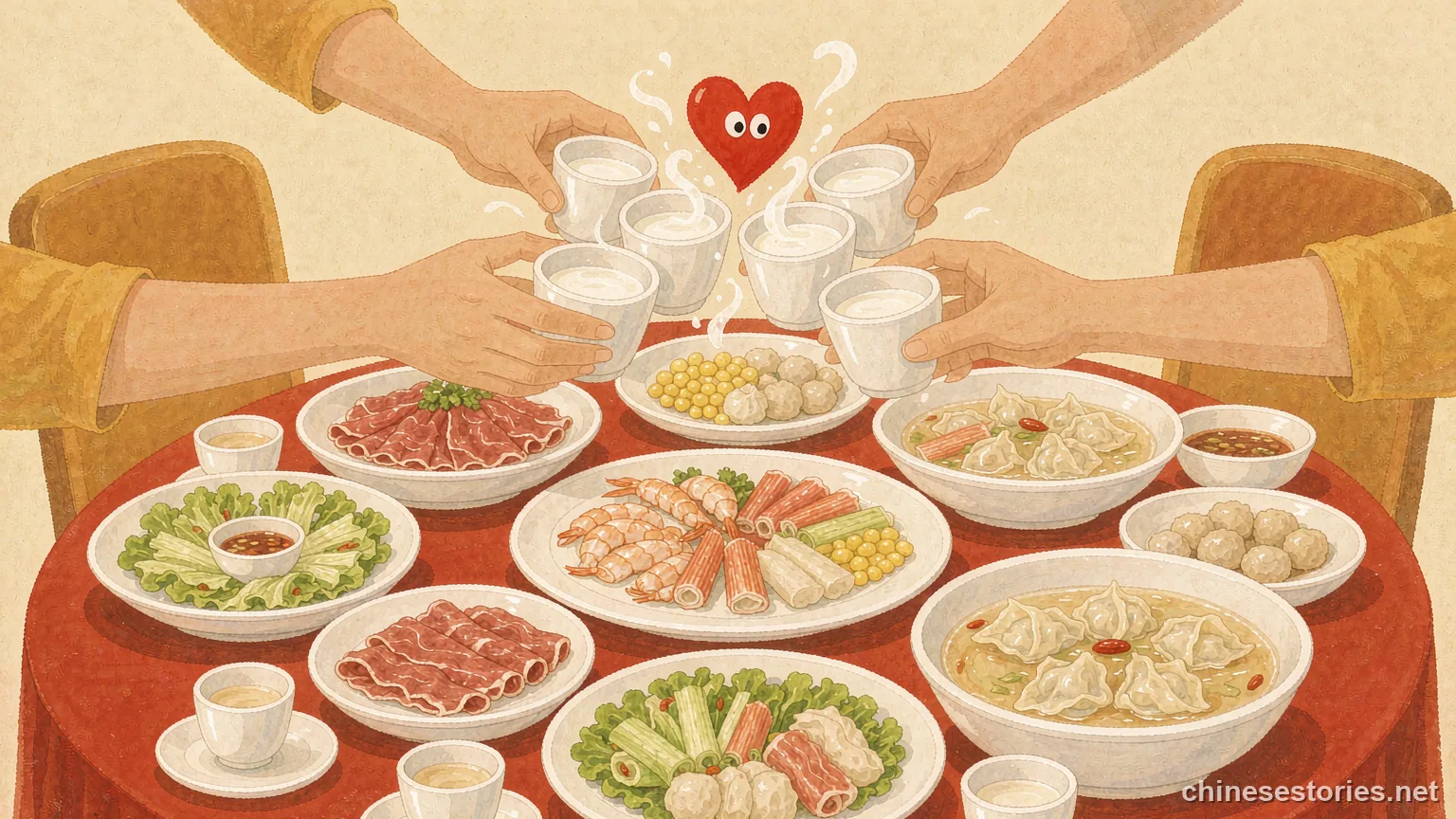
Toasts carry their own grammar. A guest standing to toast the table, a host returning it with the right words, a younger person drinking after an elder: each move acknowledges standing. Refusing a toast outright can read as a small rejection of the relationship, so people often accept more than they want.
Gifts work the same way. A gift that is too cheap can embarrass the giver, and one that is too expensive can put the receiver in an awkward debt. The art lies in choosing something that shows thought rather than price, and in the ritual of offering and politely declining before it is finally accepted.
None of this is unique to China. Every culture has table manners that encode respect. What stands out is how much of the ranking is still read aloud by these small signals.
A foreign guest at such a table often feels the weight without knowing the rules. Someone stands before they do, someone insists on paying, someone waves away a thank you as if it were too much. The safest instinct is to accept gracefully, to offer once or twice before giving in, and to let the host win the small contest of generosity. Being a good guest, in this setting, means letting the host have face too.
Why a No Sounds Like a Maybe
One of the most practical effects of face is on the word no.
In many situations a direct refusal feels like a blow to the other person. Saying a flat no can suggest that they were unreasonable to ask, which damages their face and the relationship. So people often wrap the answer.
The famous example is the reply that a proposal is difficult, or that it will be studied, or that the timing is not ideal. To a foreign ear these sound like openings. To a Chinese listener they usually mean the door is closed, said gently enough to leave everyone standing.
The same logic shapes how people ask. A request is often framed so that refusing is easy, and a person who wants to say no may blame the circumstances rather than the requester. Both sides are protecting each other’s standing, and the real answer travels underneath the words.
This can lead to genuine confusion in business and friendship. A visitor who hears maybe and waits for good news may wait a long time. The lesson is not that Chinese people lie. It is that a soft answer can be a complete answer, and that reading it well is part of the skill.
Where Face Comes From
Face did not appear from nowhere. It grew out of a view of society in which a person is first a member of a family and a community, not a lone individual.
In that view a life is lived in relation to others. A child owes respect to parents, a younger sibling to an older one, a guest to a host and a host to a guest. Each role carries duties, and each duty is watched by the people around. Standing is something you hold with others, not apart from them.
That is why face reaches into the family so deeply. A child who behaves well brings face to the whole household. A public failure is felt by parents and grandparents too, because the family is treated as a single name. The consequences of a person’s conduct are not only their own.
The old etiquette books were full of rules about this, from how to greet an elder to how to serve tea. Most of the exact forms have gone. What survives is the underlying instinct, the sense that how you treat a person in front of others is part of treating them well at all.
Modern life has not removed the logic. It has simply moved it into new rooms: a group chat, a company review, a wedding hall, a classroom. The setting changes. The question of who is watching does not.
Compared With Western Politeness
Readers from other countries will recognise pieces of this, and the comparison is worth making carefully.
Western politeness also protects feelings. Someone says I will think about it, or makes a gentle suggestion instead of an order. The words saving face are used in English too. So the raw materials are not foreign.
The difference is one of emphasis and stakes. In many Western settings politeness smooths a conversation, but directness is still valued as honest, and a frank no is often respected. In a face-heavy setting, the protection of standing can matter as much as the message itself.
There is also a question of audience. Western politeness is often about the two people talking. Face is about the room. It involves who is watching, what they will think, and how the exchange will be remembered by a wider circle. That is why the same sentence can be fine in private and costly in public.
None of this makes one system better. It makes each one legible. A visitor who learns the rules of face does not become more polite in a vague way. They learn where to put a difficult fact so that it can be heard.
An Ordinary Afternoon
Face is easiest to see in the small moments that never make it into a textbook.
A grandmother refuses the money her son offers to help with the house, then accepts it when he says it is for the grandchildren, so that she keeps her dignity and he keeps his care. A young worker covers for a colleague who missed a deadline, then mentions it later in private, without ever naming the fault to anyone else. A neighbour praises a new car not because they mean it but because the owner should be seen to be doing well.
None of these people is pretending. They are choosing where a fact should land so that no one is left standing smaller in front of others. That is the whole idea.
There is a cost to the system too, and it is fair to name it. When everyone is busy protecting standing, real problems can hide. A manager may hesitate to raise a serious issue, afraid of embarrassing a colleague. A family may paper over a disagreement rather than speak plainly. Face keeps the peace, but peace is not always the same as honesty.
The skill is knowing when to protect and when to be direct. Most people who live inside the system are fluent in both modes. They can soften a message at a banquet and still be blunt with a close friend, because they know which relationships can carry plain speech.
For anyone trying to understand China from the outside, mianzi is often described as a mystery, a kind of national sensitivity too delicate for foreigners. The truth is plainer. It is a way of handling the fact that people care how they are seen, and that a group can be kinder, or crueller, than any single person in it.
Once a visitor sees face as a shared system rather than a strange habit, the daily scenes start to make sense. The softened no, the generous table, the praise in public and the correction in private all belong to one logic. They are all ways of minding where the weight of a moment falls.
This story is based on publicly documented practices and on reporting in the Chinese and international press. The families described are illustrative, and no individual is identified.