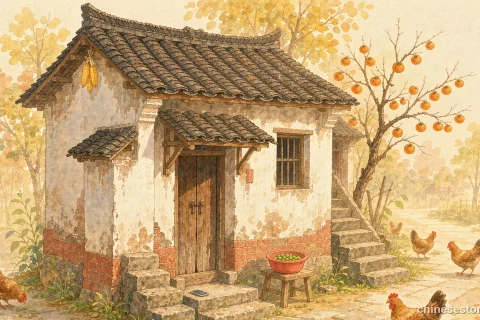
On a summer evening in the mountains of Guizhou, a concrete court fills with more people than the village has residents. Wooden benches are packed. Ladders lean against the fence so latecomers can watch over the heads of the crowd. Somewhere a plastic basin is beaten like a drum, keeping time with the chants.
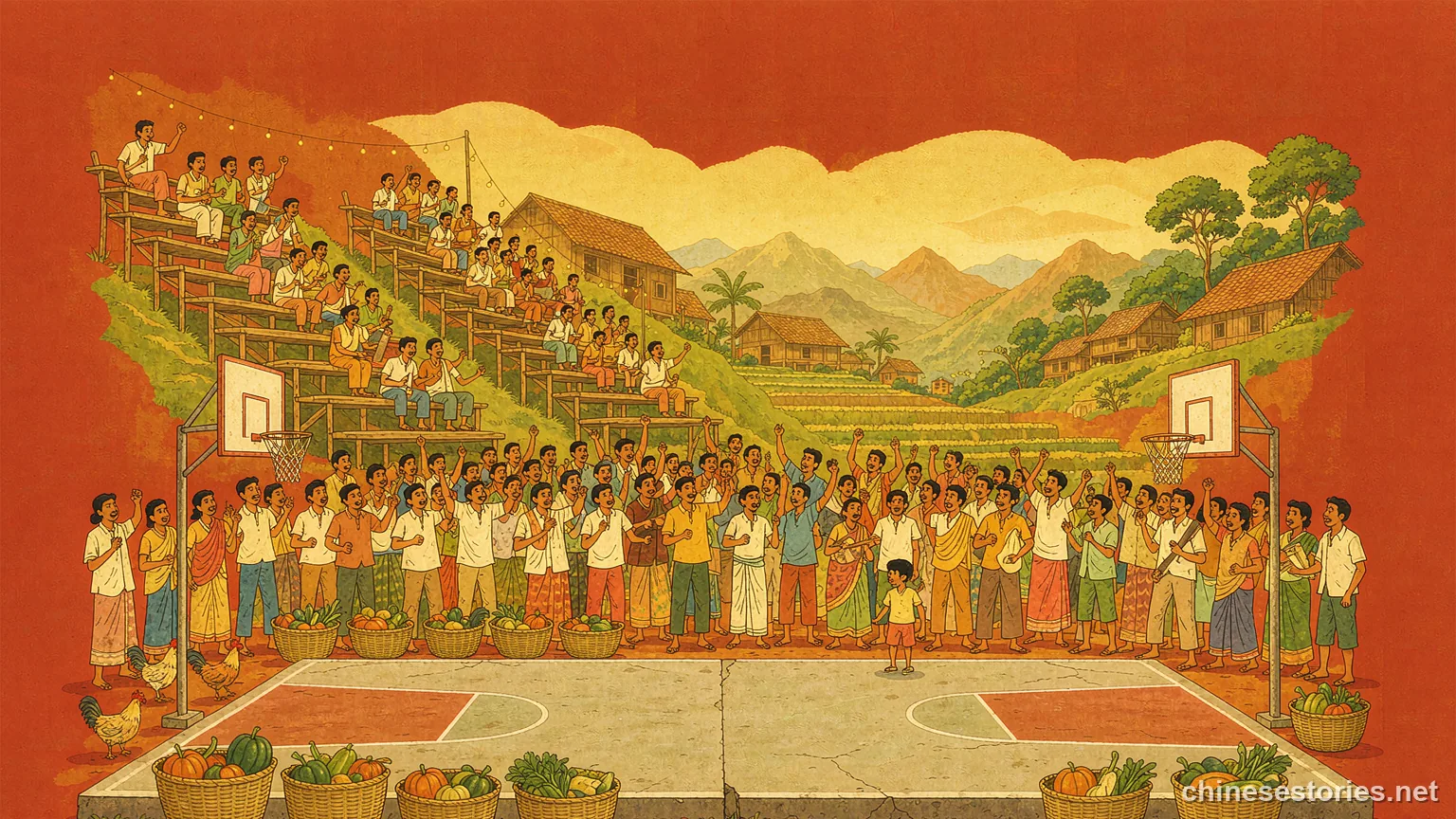
Down on the court the players are farmers, drivers, cooks and shopkeepers. The scoreboard is lit. The stands behind the hoop are so close that a missed shot can land in someone’s lap.
This is Village BA, a rural basketball tournament that has grown from a village festival into one of the most-watched sporting events in the country. To outsiders the name sounds like a joke version of a professional league. To the people in the stands it is simply the biggest night of the year.
The pull is easy to feel but hard to explain. Part of it is the scale, a game that fills a valley. Part of it is the opposite, the way the whole thing stays small and local, run by neighbours for neighbours. Both things are true at once, and that is the heart of the story.
A Court Behind the Terraces
The story begins in Taipan, a village of roughly a thousand people tucked into a valley in the Miao and Dong mountains.
The court sits in the middle of the community, close to houses, fields and shops. It is not a stadium in the usual sense. There are no corporate boxes and no giant screens. There is a hoop, a line-marked floor and a slope of terraced seating that turns a whole hillside into a grandstand.
Like a village square anywhere, the court is where things happen. It is where children learn to shoot, where neighbours meet after work and where, on festival days, an entire valley gathers in one place.
The remoteness makes the scene more striking. Reaching Taipan means winding roads through green hills, past rice terraces and wooden houses. Yet on a match night the same fold in the mountains holds thousands of people, and the sound of the crowd carries across the valley.
Because the court is so central, the tournament is woven into village life rather than set apart from it. Shops close early on match nights. Grandparents bring grandchildren. Teenagers who would normally be on their phones put them away to watch. A game here is not an event people attend. It is an event the whole place attends.
Ninety Years of Pickup Games
Basketball did not arrive in Taipan with the cameras. It was already there, and it had been there for a very long time.
Villagers trace the game back to the 1930s, when young men put up a makeshift hoop beside a threshing ground and began to play. There was no gym and no proper ball court, only a wooden backboard and the flat ground that was free.
From that beginning grew a local tradition tied to the harvest. On the sixth day of the sixth lunar month, the village marks a festival that welcomes the new rice. Part of the celebration became a basketball game, and the game became as fixed a part of the festival as the food and the music.
Over the decades the tournament hardened into habit. Teams formed around villages and townships. Older players passed the ball to younger ones. A phrase sums up the local appetite: whenever there is a festival, there is a game.
By the time smartphones arrived, the village already knew how to put on a match. All that was missing was an audience outside the valley.
The long history explains a detail that surprises visitors. Nobody here treats the event as a novelty. The elders remember earlier finals, earlier heroes and earlier rivalries, and they will tell you which team used to be unbeatable and why. When the world discovered Village BA in 2022, it discovered something the village had been building for generations.
The Night It Went Viral
That audience arrived in the summer of 2022, and it arrived almost by accident.
A visitor filmed the packed stands and the roaring crowd, and posted the video online. The clip spread fast, because it showed something viewers had never seen: a rural game with the intensity of a major final, played in front of a crowd that spilled up a hillside.
Netizens gave the tournament its nickname, Village BA, a play on the letters of the big professional league. The name stuck because it captured both the ambition and the humour of the event. It was grassroots basketball, and everyone knew it.
Within a year the attention had changed everything and nothing. Funds arrived and the court was rebuilt. Media came from across the country. National television broadcast the finals. Through all of it the core stayed the same: amateur players, local teams, and a crowd that treats every game like a reunion.
The village learned quickly how to handle the crowd. Volunteers direct traffic and keep order. Residents open their homes to guests. Officials have worked to keep the event feeling local even as the audience grows, because the charm that drew the cameras is exactly the thing that would be lost if the tournament became a pure spectacle.
A Prize That Is Not a Trophy
Ask what a champion wins here and the answer is part of the charm.
There is prize money, but there is also a cow. In some years the winning team has been awarded a live ox, led onto the court for the celebration. There have been local goats, pigs and baskets of rice as rewards, and in the more recent national finals the champions have also received a handmade hat and a ring bearing local craft designs.
That list tells you what kind of event this is. The prizes are drawn from country life, not from a sports marketing catalogue. A cow is useful, memorable and local, and it says more about where the game comes from than a silver cup ever could.
The teams reflect the same world. The rules are built for villagers, not professionals. Current professional players are not allowed, so the squads are filled with people who play after a day of real work. Some have travelled back from jobs in distant cities just to take part.
That rule matters more than it might seem. It keeps the standard of play honest and uneven, and it keeps the crowd invested, because the players are the same people they buy vegetables from. A tall outsider who turns up expecting a big contract would be out of place. This is a league of neighbours.
The Stands That Never Empty
What the videos capture best is the crowd, and the crowd is not only local.
Farmers come in after the harvest. Older people bring folding stools and arrive hours early for a good spot. Returning workers plan their trips home around the schedule. In recent years fans have come from provinces far away, and the stands have drawn visitors from around the world.
The seating is famously hard to hold. Once a good place is taken, people guard it for hours, and there are stories of spectators refusing to step away even briefly. Vendors sell small chairs and snacks; the smell of grilled food drifts over the court. Outside, market stalls and food stands turn the whole evening into a fair.
The atmosphere leans on local culture. Between games there are performances of Miao song and dance. Drums and reed pipes sound across the ground. The half-time show can be as lively as the match itself, with the crowd joining in.
For a visitor, the surprise is how warm it feels. Nobody is a stranger for long. The crowd cheers good play on both sides, and the celebration continues long after the final whistle.
The noise is part of the memory. Chants start in one corner and roll across the slope. When a player scores, the whole hillside seems to move at once. People who came for a single match often say they stayed for the feeling of being part of something, a crowd that is loud and welcoming at the same time.
From Village Game to National Stage
Success carried the tournament far beyond one village.
A national competition was built on the same idea, bringing teams from many provinces together to play in Taipan. The fields grew from a handful of local squads to dozens from all over the country, and the finals became a fixture of the rural sports calendar.
The most recent national championship, held in late 2026, drew teams, thousands of fans and a wall of cameras. Officials describe the event as among the largest grassroots sporting gatherings in the country, and the numbers behind it are enormous by any measure.
The stage grew, but the setting did not move. The biggest games are still played in the village that started it, on the same patch of concrete that hosted the first tournament. Champions are still crowned with a nod to the harvest festival that gave the game its home.
The growth has also carried the idea to other villages. Similar tournaments have appeared in other provinces, each with its own local flavour, and the model has spread because it is easy to repeat: a court, a festival and a crowd that shows up. What began as one village tradition has become a template for rural sport across the country.
The attention has brought side effects. Tourism has grown, homestays have opened, and stalls selling local food and crafts are busy on match days. Villagers talk about the pride of being seen by the outside world. For a place that once had to travel to find attention, that is its own kind of win.
Why It Feels Different
Why does a village league, of all things, move so many people? The answer lies in what it is not.
This basketball is not built around money. Spectators do not buy tickets. There are no courtside advertisements, and when a business once offered to put a board on the court, the villagers turned it down. They wanted the game to stay theirs.
It is not built around stars. The players are neighbours and relatives, people the crowd knows by name. When a farmer pulls down a rebound, the stand is not applauding a brand. It is cheering for someone they will see again the next morning.
And it is not built around distance. Big sport is watched from a sofa, on a screen, at a remove. Here the crowd is close enough to hear the players talk, and the players can hear the crowd. The gap between performer and audience has almost disappeared.
Put together, those three things explain the pull. The event feels real in a way that polished entertainment rarely does. Watching it, people see a version of sport that seems to belong to them, whether or not they have ever set foot in Guizhou.
There is a lesson in it for anyone who thinks sport needs money and glamour to matter. Village BA has neither, in the usual sense, and it draws more attention than many leagues that have both. What it has is belonging. The game is inseparable from the place, and the place treats the game as its own. That is a harder thing to buy than a stadium.
After the Final Whistle
When the last game ends, the court does not empty all at once.
Fans stay to take photos with the players. The winners lift their prize and parade it around the ground. Children run onto the concrete to shoot at the hoop before it gets dark. Vendors pack up slowly, and the smell of food lingers in the mountain air.
The next morning the village returns to its ordinary rhythm. Farmers go back to the fields. Some players will head out again to their jobs in the cities, keeping an eye on the calendar for the next festival. The court sits quiet in the middle of the community, waiting.
That is the quiet secret of Village BA. It is not famous because it is remote or because it looks exotic to a screen. It is famous because it shows something people recognise everywhere: a town that loves a game, a crowd that shows up, and a winner who gets a cow.
The cameras will keep coming. The rules will keep changing. But the fixture that matters has already been set for a century, and it belongs to the people who show up to play.
Villagers put it simply when they are asked why the tournament matters. A court is where a community sees itself, they say, and a good game is a reason to come home. That is why the stands are full long before tip off, and why nobody leaves early. For one evening, the whole valley is in the same place, cheering for the same thing.
This story is based on publicly documented practices and on reporting in the Chinese and international press. The families described are illustrative, and no individual is identified.