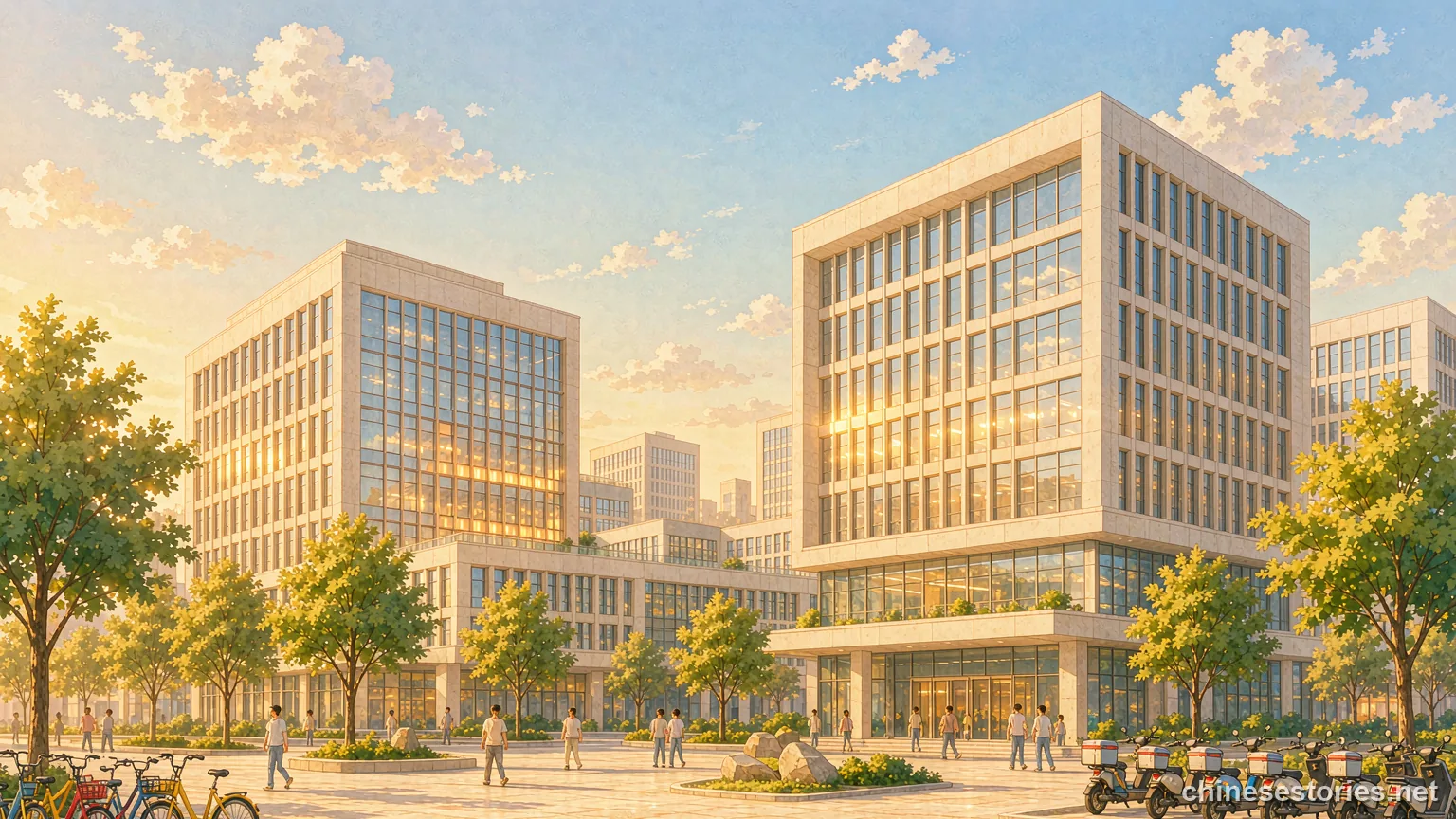
At nine in the evening, the office towers of a technology park in Shenzhen are still lit up, floor after floor, like a vertical grid of small windows.
Down at the gate, a row of delivery riders waits with insulated bags. A line of young workers in hoodies stands at a food cart, buying noodles. Others sit in a company shuttle bus that will not leave until the last desk is empty.
Inside, on a normal Tuesday, most people have been at their desks since a little before nine in the morning. That is twelve hours, and it is only Tuesday. They will do the same tomorrow, and the day after, and on Saturday as well.
Step outside at midnight and the street is not empty. Riders are still moving between the buildings, and a security guard sits at every gate. This is not a crisis week or the run-up to a launch. It is simply how an ordinary month looks in parts of the industry.
What 996 Means
The number 996 is shorthand for a working pattern that became common in China’s technology industry: start at 9 in the morning, finish at 9 at night, six days a week.
Add it up and it comes to 72 hours a week. China’s labour law sets a standard week of 8 hours a day and 44 hours a week. The 996 pattern runs well past that line, and for years it was discussed in companies as an unwritten rule rather than a formal one.
The pattern is not limited to programmers. Product managers, designers, marketers, and support staff in the same companies keep the same schedule, because the teams ship together. Over time the habit spread into advertising, finance, media, and parts of manufacturing, wherever a project could be pushed forward by adding hours.
The term entered the wider conversation in early 2019, when a developer posted a page on a code-sharing site under the name 996.ICU. The joke in the name was grim: work 996, and you will end up in intensive care. The page invited workers to document the companies that used the pattern, and within days it had been read by millions.
It also started a national argument. Company leaders were asked about it in interviews. Newspaper columnists wrote about it. For a few weeks that spring, the phrase was on every dinner table in the big cities.
There are smaller variants with names of their own. Some companies ran what they called a big week and a small week, one with six working days and the next with five. Others expected what employees called invisible overtime, the late-night messages and quick calls that never show up on a timesheet. The hours were real, but they were not written down.
The pattern did not begin in 2019, and it did not end there. The page simply gave an old habit a name and a number. Every year or two since then, a fresh story has brought the word back: a young worker who collapsed after a long stretch, or a company quietly restoring the six-day week. Each time, the same argument starts again, and each time it stops without a clear answer.
A Week in the Life
A typical day inside a company that runs on this schedule has its own rhythm.
The morning starts with a short meeting, the kind where each person says what they did yesterday and what they will do today. Then the desk work begins and runs, with a break for a quick lunch, until early evening.
Around six, the canteen serves subsidised dinner. Many offices also offer a free ride home, but only after a certain hour, often nine or ten. Lunch and the ride are real perks, and they are also gentle reasons to stay.
After dinner, the office fills again. There may be a training session, a review, or simply more work. Colleagues look around to see who is still at their desk. Leaving early is not forbidden. It is just noticed.
Saturday is a working day. Sunday is not, in most of these companies, but a project that runs late can take part of it too. Vacations exist on paper, and employees often say they are hard to take without falling behind.
One worker described the week in a way that many others recognised. It feels like running on a treadmill that is set slightly faster than a person can walk, and no one wants to be the first to step off.
The office itself is built for the pattern. Canteens stay open late, and there are nap rooms and showers on some floors. Snacks are free and plentiful, and a gym may sit off the lobby. What looks like care for employees is also a set of small reasons not to go home.
The week is also full of checkpoints. There are stand-up meetings in the morning, review meetings in the afternoon, and sometimes a training session in the evening that everyone is expected to attend. Each one is short. Together they stretch the day out, so that even an ordinary Tuesday ends long after dark.
The commute is the quiet cost. Many workers live an hour or more from the office, because housing near the technology parks is expensive. A twelve-hour day plus two hours of travel leaves little room for anything else. Dinner, a shower, and sleep fill the gap, and then the alarm goes off again.
Why the Hours Grow
The pattern grew out of a specific moment. In the 2010s, China’s internet companies were competing at extraordinary speed, and speed was measured in shipping products before rivals did.
Company founders talked about the value of hard work, and long hours became one way to show it. Some leaders publicly praised the model, calling long hours a blessing that young people should welcome while they have the energy. Those comments were widely reported, and widely disagreed with.
There is also the simple arithmetic of supply and demand. China produces more university graduates each year than any other country. The number of very well-paid jobs at the top companies grows much more slowly. When a hundred qualified people want one seat, the seat is expensive.
Money pushed in the same direction. In the years when the industry was growing fastest, a company that shipped a feature two weeks before a rival could win a whole market. Investors rewarded that speed, and speed came from people. The human cost of the race was easy to postpone, which is exactly why it was postponed so often.
That competition shapes behaviour in small ways. Effort becomes visible. Someone who leaves on time can look less committed than someone who stays, even when the work is identical. Managers notice presence, and presence is easy to measure.
So the hours feed themselves. If one team stays late, the next team stays later. No single person decides this. It emerges, week by week, from a thousand small choices about who looks serious and who does not.
The pay structure pushes in the same direction. A large part of many salaries comes as a year-end bonus, and managers decide that bonus. Someone who leaves at six every day is not breaking any rule, but they are also reducing the number of people who see them working. In a system where effort is judged by eye, going home on time has a price, and it is paid quietly.
The result is a strange kind of equality. Graduates arrive with different degrees and different plans, and within a year most of them are keeping the same late hours. The differences that mattered at hiring fade into a shared schedule that everyone complains about and everyone follows.
The Word Neijuan
There is a Chinese word for what this feels like, and by 2020 it was everywhere. The word is neijuan.
It is usually translated as involution, which is a clumsy English term for a simple idea. Involution describes competition that gets more intense without producing more. Everyone runs harder, and no one moves forward.
The common picture is a crowd at a concert. The people in front stand up to see better. Then the people behind them stand up too. Soon everyone is on their feet, and everyone can see exactly as well as they could while sitting. The effort went up. The view did not change.
Neijuan is used for much more than work. Parents use it for schools, where children take more classes to win places that do not increase in number. Companies use it for price wars that leave every seller poorer. And workers use it for the office, where the extra hours become the price of keeping a job that has not changed.
The word caught on because it named a feeling that many people could not quite describe before. It was not exactly that they were lazy or that they were ambitious. It was that the effort had stopped paying off, and everyone could see it, and no one could stop.
It has since become an ordinary part of the language. Friends say they are being neijuan at the office, or that a whole neighbourhood is neijuan over school places. English speakers might reach for something like a rat race or a vicious circle. Neijuan is sharper than either, because it points at effort that everyone shares and no one is rewarded for.
The word has also travelled. Similar terms have appeared in South Korea and Japan, and English writers have borrowed the Chinese one as involution. A piece of academic vocabulary, once used by economists to describe farming, has become, in a few years, everyday slang for the feeling that everyone is running and no one is arriving.
A quieter companion phrase arrived in 2021. Some young people said they were going to tang ping, or lie flat, meaning they would do the minimum and stop chasing. It was less a plan than a sigh, but it spread quickly, which suggested how tired the audience had become.
Compared With the West
To an English-speaking reader, parts of this will feel familiar.
Finance and consulting in London and New York have their own punishing hours, and the phrase hustle culture was invented to describe something similar. The idea that a job can quietly consume a whole life is not a Chinese invention.
The difference is partly in the shape. In many Western firms, the extreme hours belong to a narrow band of highly paid roles, and they come with a clear story about paying your dues before a comfortable senior career.
In China, the pattern has been broader, reaching across much of the technology sector and into other industries. It is also less of a career stage and more of a standing condition. People are not waiting for the hours to end after a few years. They are waiting to see whether they ever do.
There is one more difference worth naming. In both places, the person who works the longest hours is often the one with the least power to refuse them. The pattern is described as a culture, and it is also just a negotiation, in which one side can say no and the other cannot.
The two countries also talk about the problem in different words. In the West, long hours are usually treated as a failure of work-life balance, a private matter for a person to manage. In China, the conversation has often been framed as a collective puzzle, a question about how a whole economy shares out its chances. The two vocabularies describe the same tiredness, and they point to quite different places as the source of the problem.
Leaving the Building
Change has been slow, but it is visible around the edges.
Some of the largest technology companies have adjusted their schedules, cutting out the six-day week or ending the latest meetings. Recruiters talk about on-time departure as a selling point now, which would have sounded strange a decade ago.
Younger workers are more willing to ask what the hours are for. Many grew up comfortable enough to weigh a higher salary against a shorter week, and some are choosing the week. A smaller number are leaving the big cities altogether, trading a high salary for a slower life near their parents.
For companies, the change is not only about kindness. Long hours are expensive, and a tired team makes more mistakes. Some managers have decided that keeping people longer does not produce more work, only more presence. That is a different argument for the same shift, and it may travel further than any appeal to fairness.
None of this has settled. The competition for good jobs has not eased, and the treadmill is still running for anyone who wants a place on it. The lights in the towers are still on at nine.
But on some floors now, the last person out does not feel the need to check whether anyone noticed. That is a small thing, and in a culture built on being seen to work, small things move slowly.
This story is based on publicly documented practices and on reporting in the Chinese and international press. The families described are illustrative, and no individual is identified.