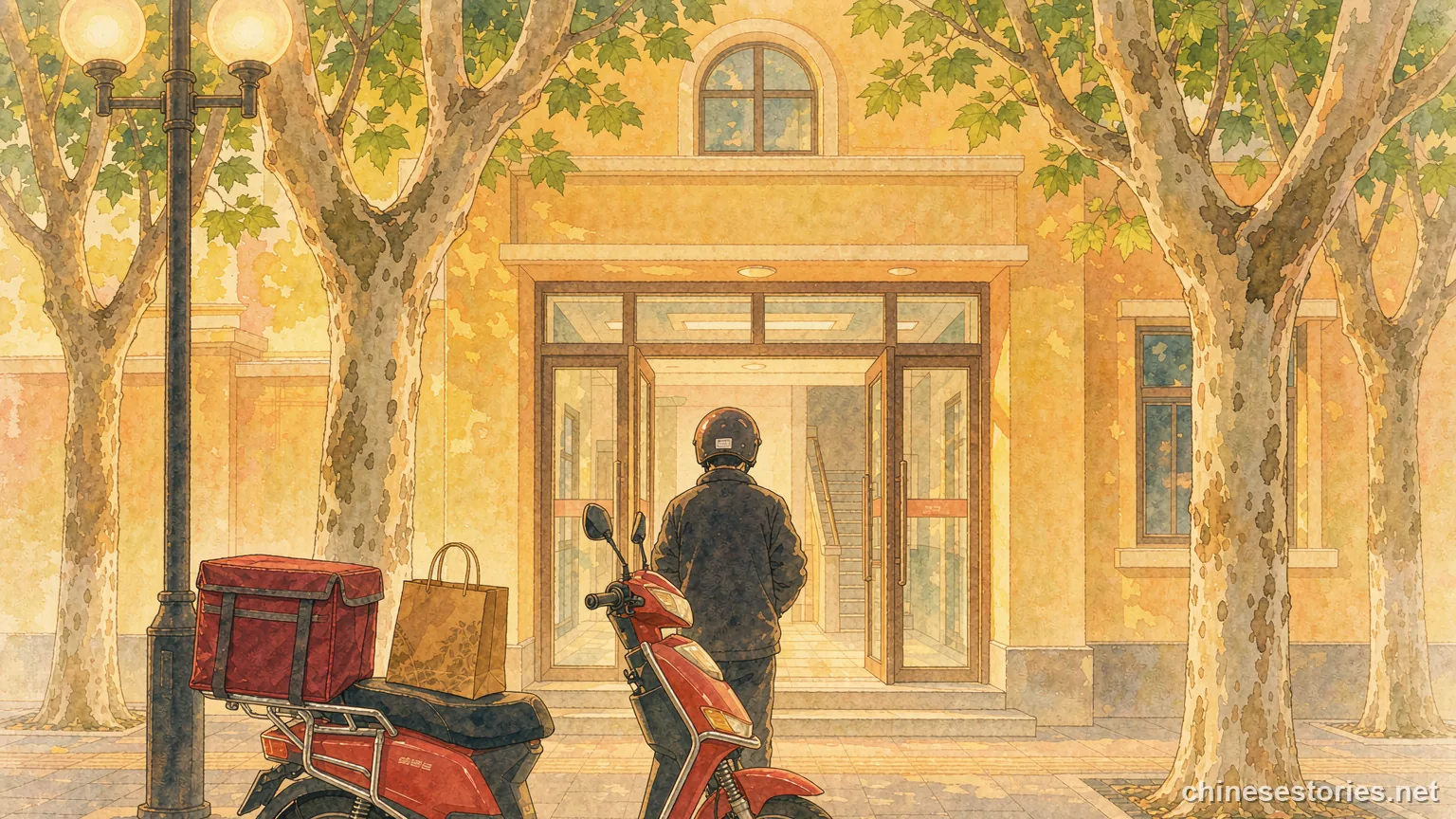
At half past six on a weekday evening, a small speaker by a kitchen door buzzes twice. A voice comes through the intercom, quick and polite, and a minute later the lift opens on the ninth floor. A young man in a helmet steps out carrying a square insulated bag, hands over a paper parcel of hot noodles, taps his phone against a scanner, and is gone again before the door has closed.
This is dinner in a Chinese city, and it arrives in about half an hour. The order was placed from a sofa, paid with a thumb, and cooked by a restaurant that may be several streets away. The person who carried it up nine floors is one of more than ten million delivery riders, and the habit he serves has quietly rearranged how the country eats.
The Chinese call the service waimai, a word built from two characters meaning outside and to sell. Start with one order moving through one evening, and the whole system comes into view.
What Waimai Means
Waimai is the Chinese term for takeaway, and it now almost always means delivery ordered through a phone app.
The word is used as a noun and a verb at once. A person says they will waimai dinner, meaning they will order it in. A rider is a waimai qishou, a waimai rider. The term is so common that it needs no explanation in any city.
The market is dominated by two big platforms, one of them tied to the country’s largest shopping ecosystem and the other to its biggest messaging app. Between them they cover restaurants, grocery shops, pharmacies, convenience stores and, increasingly, almost anything a person might want within an hour.
The service began as a way to get cooked food to a home, and it has grown into something wider. On the same app a customer can order a bowl of noodles, a bag of apples, a phone charger, medicine, or a birthday cake, and expect the same rider network to carry it. In this sense waimai is less a restaurant service than a city-wide errand system, and food is simply its most common cargo.
The habit is not evenly spread. It is strongest among young office workers and students in big cities, who order often and know the apps well. Rural areas and older users came later, and their share is smaller, though it is climbing.
How an Order Travels
The journey of a single order shows the machinery at work.
A customer opens the app, picks a restaurant, adds dishes to a cart and pays. The order lands on a screen in the restaurant kitchen. Someone packs the food into a sealed container and a paper bag, and a button marks the food as ready.
At the same moment, an algorithm offers the job to a nearby rider. The rider accepts, rides to the restaurant, collects the bag, and follows a route on the phone to the customer. The app shows the customer a countdown, and everyone in the chain is timed.
The timing is not only for the customer. The restaurant is judged on how fast it packs, the rider on how fast he rides, and the platform on how often the promise is kept. Every link is scored, and the scores feed back into who receives the next job.
That countdown is the engine of the whole thing. It creates a promise of speed, and the promise is what makes the habit so easy. An order that would once have required a phone call, a wait and a trip now takes three taps, and the food appears at the door while a person stays where they are.
Payment is simple too. Almost every order is prepaid inside the app. No cash changes hands at the door, and no tip is expected. The rider is paid by the platform, not by the customer. That single design choice removes the small awkwardness that hangs over delivery in many other countries.
The Riders on the Road
The riders are the most visible part of the system, and the hardest to classify.
They are not employees in the old sense, nor entirely freelancers. Most work through platforms that send them individual jobs, and they choose when to switch on and when to stop. The pay is per delivery, with bonuses for busy hours and long days, and a rider can, in principle, work as little or as much as they like.
The kit is easy to spot. A coloured jacket, a helmet, a phone clamped to the handlebars, and a thermal bag strapped to the back. Two colours dominate the streets of any Chinese city, because the two big platforms dress their riders differently, and people often refer to them by colour alone.
That flexibility draws people in. Many riders came from factories, construction sites or small shops, and they say the same thing: the money can be better, and no manager stands over them. A rider who wants to stop at four in the afternoon can simply close the app. For people between jobs, or supporting a family, the door is easy to walk through.
It is also a demanding way to earn. A rider who wants a full income works long days, often through rain and summer heat, and lives with the clock on the screen. The app rewards speed, the roads are crowded, and a single late order can cost both money and a rating. Most riders treat the work as flexible but temporary, and many join and leave within a season.
Riders have their own routines. In the quiet hours they wait outside malls and housing estates, charging scooters and trading advice. The busy times are lunch and dinner, and a rider may take a long break in the early afternoon. The day has a rhythm, and experienced riders learn to read it.
The Boxes and the City
Look closely at a rider and you see a small piece of city infrastructure.
The square bag on the back of the electric scooter is insulated, and some are heated, so that soup stays hot and ice cream stays cold for the length of a trip. The scooter is the second key piece. Cheap, quiet and easy to park, it slips through traffic that a car could not cross, and it is what makes a thirty-minute promise possible in a city of millions.
Scooters also need care. Riders charge them at home, at shops, or at roadside swap points. A flat battery can end a shift. Range, not speed, sets the shape of a working day, and a rider plans the route partly around where the next charge will come from.
The system reaches into the hours as well as the streets. Convenience stores stay open late, kitchens run through the night, and riders work around the clock. At midnight a customer can still order a late supper, and a hospital patient can still order a hot bowl of porridge. The service has quietly become part of how the city keeps running after dark.
Even the packaging has adapted. Sealed lids, spill-proof bowls and paper bags with handles are now standard, built to survive a scooter ride. The container is part of the promise rather than an afterthought.
The Numbers Behind the Habit
The scale of the habit is hard to picture without figures.
According to official and industry data from recent years, more than five hundred million people in China use online food delivery, roughly half of everyone online. The market is measured in trillions of yuan a year. More than ten million riders carry the orders, with the largest platform reporting several million who have taken at least one job.
The service has also spread far beyond the biggest cities. It has reached more than two thousand counties, and the fastest growth in recent years has come from smaller towns, where a delivery habit that began in Beijing and Shanghai has become ordinary in places a visitor might not expect to find it.
Behind the totals are a few telling details. Many riders take the work as a stopgap rather than a career, and on the biggest platform only about one in ten stays active for most of the year. The rest cycle through, drawn by the ease of starting and released by the difficulty of staying.
Not every order is food either. Groceries, medicine and small household items now travel through the same network, and the share of non-food orders keeps rising. The platforms call this part instant retail, and it is growing faster than the restaurant business that started it all.
What It Changed
The delivery habit has left marks on daily life that go well beyond dinner.
For restaurants, it opened a second dining room with no tables. A small kitchen in a back street can now serve customers across a whole district, and a new kind of shop has appeared, a kitchen with no seats at all, cooking only for delivery. Rents and menus have adjusted around a customer who may never walk in.
For households, it removed a chore. A tired parent who comes home late no longer has to cook, and a student living alone can eat a hot meal without learning to cook. It has also changed the shape of family time, because dinner can now arrive while everyone is busy, instead of gathering people around a table.
For older people, it has been a quiet convenience. A grandparent who finds cooking hard can order a meal on a phone, or have one ordered for them by a child in another city. It is a small example of how a service designed for the young has ended up helping people of every age.
The change reaches into small rituals too. Families may order a dish they cannot cook, or send a meal to a relative as a small gift. A treat that once meant going out can now arrive at a doorstep in a paper bag, and the gesture is understood by everyone involved.
In some neighbourhoods the change is visible late at night. Streets that used to go quiet now stay busy, lit by the small headlights of scooters. A few shops stay open only for delivery, and the city has grown a night shift it did not have before.
Compared With the West
A reader from Europe or North America knows this scene, because delivery apps are everywhere.
Uber Eats, Deliveroo and similar services have made restaurant delivery ordinary in Western cities, and the same appetite for food that arrives without leaving home has taken hold. The basic idea, an app, a courier and a doorstep, is shared.
The difference is in the density and the price. Chinese cities pack enormous numbers of people, restaurants and customers into a small area, so a rider can carry many orders a short distance. Cheap electric scooters keep the cost of each trip low. The result is a service that is faster, cheaper and far more woven into daily routine than in most Western cities, where delivery often remains a treat rather than a default.
There is a cultural difference too. In much of the West, ordering in still carries a small sense of indulgence or defeat. In China it is simply one normal way to eat, sitting beside cooking at home and eating out, with no particular judgment attached.
One more contrast stands out. In many Western cities, delivery fees and tips can add a large share to the bill, so ordering in feels expensive. In China the extra cost is small, and the app shows a single price before the customer pays. That small gap in cost is a large part of why the habit became a default rather than a luxury.
The Rider at the Door
The lift closes, and the rider is already back on the street, checking the next address on his phone. Rain has started, and the light of the screen falls on the visor of his helmet. Somewhere across the district another customer is watching a countdown, and the system is moving him toward it.
Inside the flat, the noodles are still hot, and the family sits down to eat. They will not remember the rider, and he will not remember them. In a city of millions, their paths crossed for about twenty seconds at a doorway, in a small exchange that now happens hundreds of millions of times a day.
That brief meeting is one of the quiet marvels of modern Chinese city life. A promise of hot food in thirty minutes, kept by a network of kitchens, scooters and people in motion, is now so ordinary that almost no one stops to notice it. The rider at the door is just how dinner arrives.
This story is based on publicly documented practices and on reporting in the Chinese and international press. The families described are illustrative, and no individual is identified.