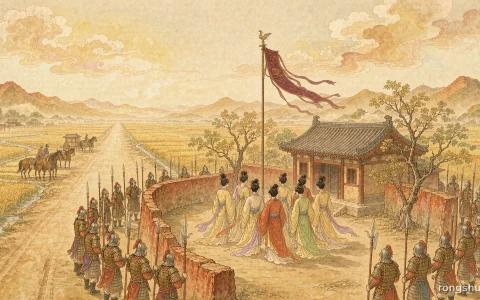
In the winter of 1873, in Shanghai, a bridal chair arrived at a new house in the city and a wedding ceremony began.
Then the county runners came, together with police from the foreign concessions. They took away the groom and a seventeen year old girl. The groom was Yang Yuelou, one of the most celebrated actors of his generation. The girl was the daughter of a tea merchant from Xiangshan in Guangdong, and her family called her Abao.
The marriage had followed every proper step. Her mother had approved it. There were matchmakers, a written marriage contract and a betrothal payment. It was nonetheless judged to be a kidnapping. The groom was sentenced to distant exile, and the girl was handed over to a charitable hall for the authorities to marry off.

One. An actor and a tea merchant’s daughter
To understand the case you have to see where each of the two stood.
Yang Yuelou was among the best known performers of the young man or xiaosheng role in the Peking opera of his day, and he would later be named among the thirteen great artists of his era. He was tall, handsome, and accomplished both as a singer and as a martial performer. He played at the Jingui theatre in the foreign concession, and Shanghai was captivated by him. Among his audience were large numbers of women, which was a Shanghai phenomenon: in Beijing at that time women were still not allowed into public theatres.
Abao was seventeen, the daughter of a tea merchant from Xiangshan in Guangdong. She lived in the concession with her mother, and her father was away on business for most of the year.
According to the Shenbao, the newspaper that followed the case from beginning to end, it started with a letter. Mother and daughter went to the theatre three days in a row. Afterwards Abao wrote a letter herself, setting out her feelings and asking to be betrothed to him, and sent it with her horoscope, asking him to meet her.
When the letter reached him Yang Yuelou was both suspicious and afraid. He was afraid of being set up. And he was afraid of the distance in rank between them.
Two. The statute against marrying across rank
That second fear was the root of the whole affair.
The penal code of the Qing dynasty, in the section on marriage, stated plainly and categorically that a commoner and a person of base status could not marry. The clauses dealt with a householder who married a servant to a commoner, and with a servant who passed himself off as a commoner, and each prescribed a number of strokes and an order to separate. Which people were of base status? The official history of the dynasty answers without hedging. The four orders of society, the scholar, the farmer, the artisan and the merchant, were commoners. Servants and actors were base.
An actor, then, no matter how famous or how adored, remained in the official registers what he had always been. Yang Yuelou could not legally take a commoner’s daughter as his wife.
This was not a matter of custom. It was a matter of statute.
Abao got no answer, and she fell ill, and grew worse by the day. Her mother, seeing it, sent word to Yang Yuelou to tell him the truth and to instruct him to send matchmakers.
Her attitude untied half the knot. The two families then completed the entire procedure: matchmakers engaged, contract written, betrothal payment made, engagement settled. The matchmakers were the manager of the opera troupe and a clansman of the girl.
Three. The abduction that was arranged
That was when the trouble began.
Part of the girl’s clan opposed the marriage flatly, on the ground of the statute. In their view a daughter of the family marrying an actor was not a private matter at all. It touched the face, the reputation and the standing of the whole lineage. The most determined of the opponents was her uncle.
Under that pressure the mother and Yang Yuelou agreed on a device, a local custom known in Shanghai as seizing the bride.
It was not a kidnapping. It was a workaround, used when a marriage had been agreed but the clan would not allow it, by which the groom removed the woman with a set of forms and the ceremony was completed afterwards. Its whole nature depended on both parties consenting. Only the clan did not.
That is what they did, intending to marry quietly.
On the day of the wedding the uncle joined with the Xiangshan merchants and gentry in Shanghai and laid a complaint against Yang Yuelou for abduction and theft. The county runners and the concession police arrived together.
When the couple were taken away, the Shenbao recorded that seven chests of clothes and jewellery belonging to the mother and daughter were seized, said to be worth four thousand taels. As Abao was taken towards the court building she sat in a small cart with the red bridal robe still on her back, the robe in which she had worshipped heaven and earth and her ancestors. The crowds along the road were enormous.
Four. The day of the wedding
The first hearing went to the county magistrate of Shanghai, a man named Ye Tingjuan.
From Yang Yuelou’s point of view this was the worst stroke of luck in the case. Ye Tingjuan, like the girl’s family, came from Xiangshan in Guangdong. According to the Shenbao, his attitude to the case was that he detested Yang Yuelou for his loose conduct.
Questioning began that same night. The actor was strung up and beaten for the whole of it.
Asked for her answer, Abao said that having married him she would follow him, and that her resolve would not change. In return she was slapped across the mouth two hundred times.
Later reporting gave the arithmetic of the punishment. Yang Yuelou was struck one hundred and fifty times on the shins. Abao was slapped two hundred times.
Unable to endure it, Yang Yuelou changed his account and confessed. The version he gave was a different story altogether. He had seen the girl while performing, found her attractive, bribed the nurse who attended her, and carried on with her. The police then searched his house and found a box of dark powder with a strong sweet smell, which was treated as an aphrodisiac, and the girl was examined and found not to be a virgin.
Those two things, the confession and the exhibits, became the basis of the verdict at first instance.
Her mother fought on. She went to the clan uncle for help and he refused. She carried the evidence to the court herself and stated that she had consented to the marriage. Ye Tingjuan was unmoved. His reasoning was that the girl’s father had purchased an official rank, and a man in that position could not have been ignorant of the statute.
The case sat there, with both of them in custody.
Not long afterwards the mother fell ill and died, worn down by grief and anger.
In the twelfth month the father returned to Shanghai and stated publicly that he had known nothing about the marriage.
At that point the balance tipped for good. The only person willing to take responsibility was dead. The only person who could have vouched for the marriage had disowned it. Under the rule that a marriage required the command of the parents and the words of a matchmaker, a wedding to which only the mother had agreed turned into an abduction.
The Xiangshan merchants added their names to a further complaint, accusing Yang Yuelou of lewd and unlawful conduct.
Five. The newspaper
What kept the case from ending quietly in a county file was a newspaper.
The Shenbao had been founded in Shanghai in April 1872 by British merchants, and within a year or two it was the most influential Chinese language paper in the country. When the Yang Yuelou case broke it was just over a year old, and it followed the case from the first hearing to the last.
On December 29, 1873, it printed a letter from a reader signing himself the impartial one. The letter challenged the official handling of the case. To the men of Guangdong, it said, the treatment of the couple looked like satisfying justice. To everyone else it looked sickening. Yang Yuelou was not blameless, but he was no robber, so why the beating on the shins? The letter went through the marriage step by step, noting that it had been made at the mother’s command, with matchmakers, a written contract and a betrothal payment, in accordance with proper form. Even if the girl had taken up with the actor of her own accord, the letter argued, that was a matter for her father, not for the clan and not for the magistrate.
The letter enraged the faction that wanted him punished. They answered in print, citing the statute, insisting that the man was nothing but an actor and therefore utterly base, and arguing that on the principle that lewdness is the worst of sins, the punishment he had received was not heavy but lenient.
The Shenbao printed both sides, appearing even handed. Its own views came out in a companion piece in question and answer form. That article quoted the foreign press in Shanghai. Before the questioning even began, it said, the actor had been hung up by his thumbs for the better part of a night, so that the bones of his shoulders were wrenched and he could not move them. A wooden collar had been pressed against his neck until he could barely breathe, and it was released only after money changed hands. The article ended with a sentence meant to land hard: no western country has punishments like these.
On May 27, 1874, the Shenbao carried a translation of a piece from a London paper. In Shanghai, the London paper said, it was being whispered that persons of influence had asked the magistrate to put Yang Yuelou to death, and had offered twenty thousand taels for the killing. In the same period, a man named Qu Maohe, accused of consensual adultery, had been given a hundred strokes and released. The Shenbao added that this was perhaps only idle talk among troublemakers, and that the magistrate of Shanghai would surely never stoop to such a thing.
That was how it was written. The message had been delivered all the same.
Six. The retrial at Songjiang
In May 1874 the Shenbao reported what happened when the case came up for review at Songjiang.
Yang Yuelou was transferred from Shanghai, and when the prefect questioned him he knocked his head on the ground and begged for justice. The prefect was moved and sent the case back to the magistrate of Lou county.
The magistrate of Lou county gave him two hundred strokes, warned him not to retract his confession, and convicted him of abducting a commoner’s daughter. The code prescribed exile at hard labour for that offence.
The verdict stood. Yang Yuelou was sentenced to be sent far away.
Seven. Two endings
The outcome divided between the two of them, and the two directions had nothing in common.
Yang Yuelou was the lucky one. Not long after the sentence a general amnesty was declared on the accession of the emperor Guangxu, and his punishment was remitted. On July 26, 1875, the Shenbao reported that the sentence of exile had fallen under the amnesty, that the provincial judicial commission had reviewed it, and that although he had deserved punishment he could be pardoned and released once the paperwork came back.
About Abao there are two accounts, and neither is good. The Shenbao reported that she was sent to a charitable hall to be found a husband, and that an old man surnamed Sun, over seventy, with no wife and with property of his own, came to the hall and asked to marry her. That was how the authorities disposed of a woman with no household to take her in. The other account says her father turned her out of the family home and nothing more was heard of her. Neither account records a single word of her own.
The case closed, and Yang Yuelou went back to the stage. His fame, and the notoriety of the lawsuit, had if anything enlarged his audience. The theatre had him perform three nights running, and the house was full every time.
That annoyed the authorities again. The magistrate, angry at the display, ordered his arrest. Yang Yuelou heard in time and fled.
He never performed in Shanghai again on a proper footing. On April 30, 1879, the Shenbao reported that he had gone north at the invitation of Cheng Changgeng, the most famous actor of the age, and that he became a star in Beijing, ending his career as one of the great names of the tradition.
Eight. What the crime actually was
Looked at from more than a century afterwards, the thing that was written up as a crime was very small. An actor, by the rules, had married a merchant’s daughter. There were matchmakers, a contract, and a betrothal payment. The only thing wrong with it was that the man’s status placed him among the base.
What is genuinely heavy in the case is the process by which a marriage became a crime. A clan wanted its face preserved and laid a complaint of abduction. A magistrate with a stake in the same native place began with torture. The torture produced a false confession, and the false confession was joined to two exhibits, and the case was thereby made.
In a Shanghai county office of the 1870s one man ran the investigation, the trial, the verdict and the punishment. There was no jury, no separation of prosecutor from judge, no independent defence. Whether the wedding was a crime therefore turned entirely on one man’s judgment.
Readers who know Chinese judging through the Judge Dee novels of Robert van Gulik will recognise the figure, because it is the same one. The magistrate in those books investigates, tries and sentences, all in one person. The magistrate of Shanghai was playing that part, with two additions: police from the foreign concessions, and a newspaper.
It is worth adding that this case came to be grouped, in popular retelling, with the assassination of Ma Xinyi and with the case of Yang Naiwu and Little Cabbage, as one of the four great scandals of the late Qing. Its plot is not in fact mysterious. There is nobody to identify in this Chinese criminal case, and no culprit to hunt. In the vocabulary of Chinese true crime the interesting question is not who did it, but who decided that it was a crime at all. What repays attention is the way a wedding conducted according to custom was converted into an offence in the gap between the written statute and the customary law of the clan.
The course of the case, in the end, was not decided by the government but by a newspaper barely more than a year old. It laid the confession from the courtroom, the account from the foreign press, and the sentence about punishments in countries abroad, side by side in front of the reading public of Shanghai. The officials went ahead and sentenced him anyway, and Abao was sent to the charitable hall regardless. But the case had stopped being a page in a file.