Shortly after two in the morning on May 6, 1923, a northbound train on the Jinan-Pukou railway crossed into Shandong.
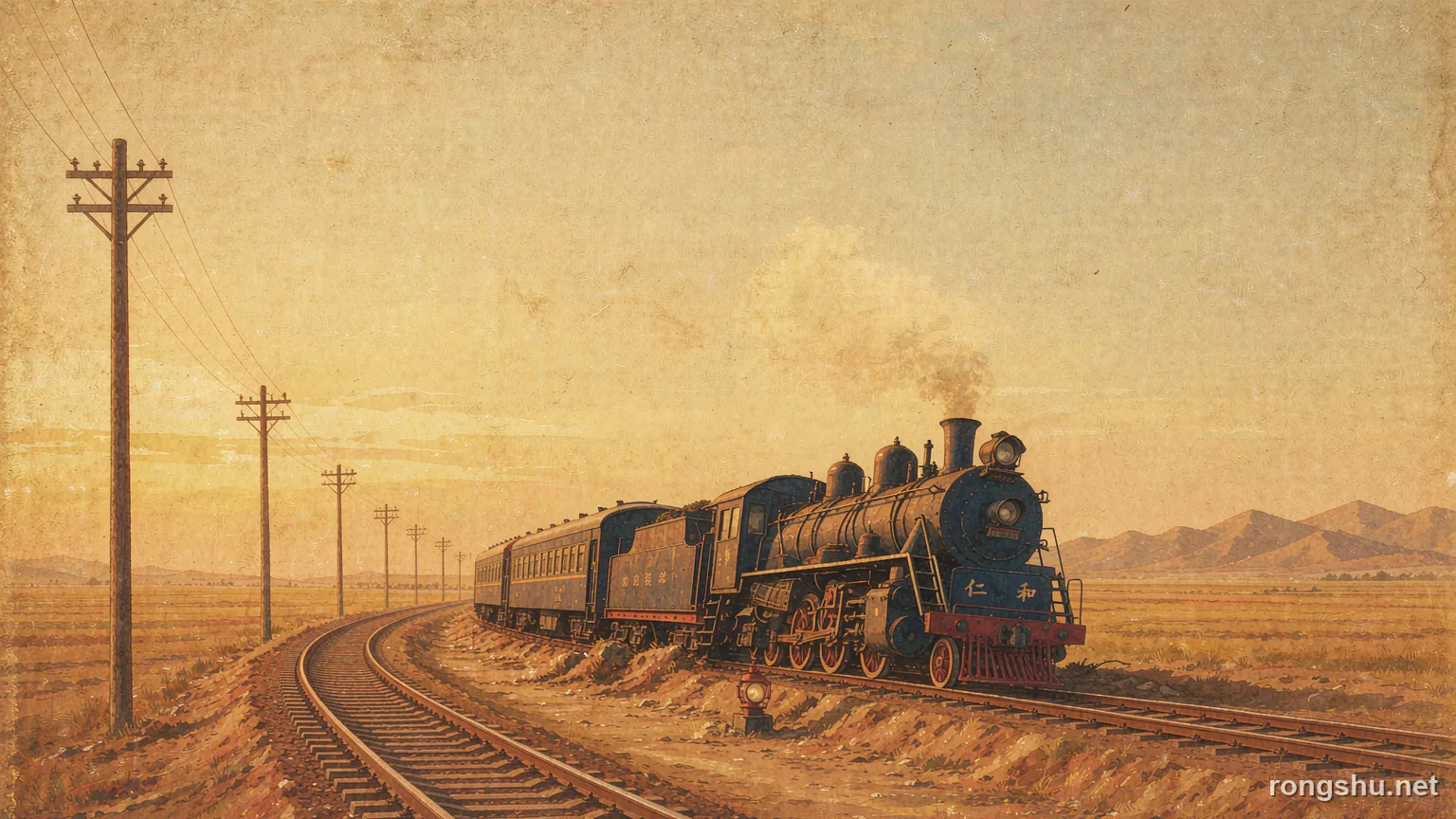
It was the second express of the week, running from Pukou to Tianjin. Railwaymen called it the blue steel train, because the carriages were imported steel, painted dark blue. The people who travelled on it tended to be people of means.
On a curve south of Lincheng, which is now Xuecheng in Zaozhuang, the driver saw shapes on the track ahead. He sounded the whistle and it made no difference. He braked hard.
The train was going too fast to stop in time. The engine ran onto a stretch of rail whose fishplates had been unbolted, and the locomotive, the mail car and a third class carriage went off the track and over.
Then the shooting started. A thousand men came out of the dark, climbed onto the sleeping cars, broke the windows, took what they could carry, and took people.
One. The mountain first
To make sense of the case you have to start with where these men came from.
Baodugu, in southern Shandong, is a mountain with sheer walls on every side. The waist of it is narrow, but the summit is a plateau, and the local story is that the only way to get a calf up there was to carry it in your arms, which is how the mountain got its name. The plateau had trenches, cisterns and water jars, enough grain and enough water to hold out. It had one fatal weakness. If government troops surrounded it on all four sides, the road for food and water was cut.
The men holding it belonged to the Sun family.
The elder brother, Sun Meizhu, had been a county-level scholar and around 1918 had built a stronghold on Baodugu with an uncle, Sun Guizhi, gathering the famine poor of southern Shandong and northern Jiangsu. At the Qingming festival of 1920 they formally raised the banner of the Shandong Autonomous Army. By 1922 they numbered three or four thousand. The man who actually made the decisions was the uncle, Sun Guizhi, known as the old master of the house.
In July 1922 Sun Meizhu was killed by government troops. The band raised his younger brother, Sun Meiyao, to command. He was twenty-four.
From then on the government changed its method. It did not attack. It sat around the mountain. The military governor of Shandong, Tian Zhongyu, brought up the fifth and sixth mixed brigades and the twentieth brigade and closed the ring. By the spring of 1923 the water on the summit was running low and the grain was nearly gone. The contemporary phrase was that both water and grain were exhausted.
Sun Meiyao sent a man to Shanghai to ask advice from Zhang Pinqing, who had connections among the Shanghai secret societies. What Zhang said became the starting point of the whole affair. Holding the mountain, he told them, could not be done. They should try their luck on the Jinan-Pukou line.
The line ran north. On the line, the easiest and most spectacular target was a train with foreigners on it.
Two. The fishplates
Once the decision was made, the preparation was careful.
They first established the timetable. There was a second express running Pukou to Tianjin once a week, and it carried western passengers who had boarded at Shanghai and Nanjing. They found the driver of that train, a man named Wu Dadong from the village of Tangyin west of Yicheng, met him through an intermediary, and questioned him about how the train ran. They fixed the place for the ambush on the curve south of Lincheng and north of Shagou, where the train would be slowing.
To keep the whole train from going over, they worked out the distance. The track was to be tampered with only after the train had passed Shagou station, and the men who did it took out a few of the steel fishplates that joined the rails.
The roles were assigned in advance. Some men held the mountain. Some went ahead to Xuzhou and Bengbu and boarded the train there as inside men. Some did the stopping. Some covered the retreat, handled the reception, or held off the government troops. Before dawn on May 5 the force left the hills, worked around the government positions, and moved into villages near the ambush point. That evening they took up their positions.
Not long after two in the morning on May 6, the train came off the rails and stopped.
There were thirty-nine foreign passengers aboard and roughly thirty Chinese, though the counts differ between accounts. One Englishman was shot dead at the scene for resisting. The rest were taken off the train and robbed.
Towards daybreak the band began moving the prisoners back into the hills. On the way they ran into a government battalion. They put their foreign captives at the rear, holding up white handkerchiefs and white jackets as a screen, and fought a retreat up towards Baodugu. The captured passengers, Chinese and foreign, were taken to the villages below the peak and into the caves on the summit.
Three. Five ministers and a diplomatic storm
When the news got out, the reaction that mattered most was not in China. It was abroad.
On May 7 and 8, the ministers in Beijing of Britain, the United States, France, Italy and Belgium lodged the strongest protests the government had yet received. In the United States there were calls for direct military action in China. Japan had no citizens among the captives, and Japanese newspapers nevertheless began arguing for an international force to take over the Chinese railways.
On May 9 the five ministers delivered an ultimatum. The Beijing government had three days to secure the release of every foreign national. After that, the indemnity would rise with every twenty-four hours that passed.
Beijing panicked. Ordinary government business stopped, and the whole administration sat down to discuss how to get the foreign captives out.
That was exactly what Sun Meiyao wanted. His strongest asset was not his rifles. It was the nationality of his prisoners.
Among the captives was an American named Powell, editor of the Shanghai weekly The China Weekly Review. The first letter sent down from the mountain was his. It urged the government troops not to attack and to seek a peaceful settlement, and every foreign captive signed it.
Life on the mountain was not quite what the phrase bandit lair suggests. Tinned food, cigarettes, fruit, newspapers and magazines sent up from Shanghai were passed on to the foreign prisoners. Powell wrote a series of dispatches from captivity which ran in the Shanghai press, describing the life and the landscape. There was a sixty-three year old Englishman named Smith who suffered from insomnia and had come to China on a rest cure. Hauled up to the summit on a rope, he slept worse than ever, and was saved only because the mountain could by then receive mail, so his pills could be posted up to him.
Four. The talks break down
The negotiations opened on May 11, at the Zhongxing coal company in Zaozhuang.
The government side was led by the military governor Tian Zhongyu and the provincial governor Xiong Bingqi. The bandits were represented by Zhou Tiansong. Their opening terms were three. The government troops should lift the siege and return to their stations. The band should be taken into government service as a brigade, with Sun Meiyao as its commander. And they should be supplied with ammunition.
The government was willing to discuss the first two. The third was refused. The two sides were close to signing when the bandits added a condition. Foreigners and the gentry of three counties, Zou, Teng and Yi, should also sign as guarantors that the government would keep its word. What they feared was a massacre after surrender. There was precedent. A band had been taken into service before and its leaders had then been killed.
On May 16 Tian Zhongyu ordered the troops to lift the siege and withdraw, and appointed Sun Meiyao as a pacification commander, sending the commission up the mountain.
Sun Meiyao tore the commission up in front of the government envoys.
He wrote to Tian Zhongyu, styling himself commander in chief of the Autonomous Army, disavowed the terms agreed the day before, and demanded the complete withdrawal of government troops and the supply of grain to the mountain. His reading was that a government frightened of a foreign incident would give more if he held out, and that holding out would pay.
That tore up the talks with the paper. The bandit terms then climbed steadily. They asked for Zhang Jingyao to be made military governor of Shandong. They asked to be reorganised as two divisions. They asked for three counties to be recognised as their own territory, and for government troops to pull back a hundred li. They asked for everyone of the same trade in four provinces to be given the same treatment.
In Beijing, some now argued for switching from conciliation to suppression, and Feng Yuxiang was proposed as the officer to do it. The diplomatic corps refused to allow force. The foreign hostages were still on the mountain.
Five. The man who went up
The person who finally cut the knot was a different official.
His name was Chen Tiaoyuan, the garrison commander of Xuhai. Lincheng was in Shandong and not his responsibility. The affair had dragged on, and Cao Kun asked Jiangsu to send help, and Qi Xieyuan sent him.
Chen Tiaoyuan was used to dealing with bandits and understood how they thought. He talked to the leaders in Zaozhuang and got on with them at once. He also saw the root of the deadlock clearly. Neither side trusted the other. The government was afraid that if it released the terms, the men would not be handed over. The band was afraid that if it handed the men over, it would be wiped out.
So he did something. He went up the mountain himself.
He took with him the Jiangsu commissioner for foreign affairs, an American, local gentry from Teng and Yi counties and a representative of the Shanghai chamber of commerce, twenty people in all, ostensibly to bring the hostages down and in fact to put himself in the bandits hands as security.
On the mountain he drank and ate with Sun Meiyao as if he were visiting an old friend. He noticed that the young commander’s eyes were red and swollen, and asked whether he was ill. Sun Meiyao said he had been up several nights with too much to do. Chen Tiaoyuan took a pair of dark glasses out of his pocket and gave them to him. Wear these, he said. You are the master of a stronghold. You should take better care of yourself. By the account of the time, nobody had spoken to Sun Meiyao like that in his life.
Chen Tiaoyuan had, however, brought two brigades with him. They were there for his safety. If the bandits neither released the hostages nor let him leave, the brigades would attack at once. Sun Guizhi was in no position to ignore that.
On June 12 the two sides reached terms. The government troops besieging the Autonomous Army would all return to their stations. The force would be reorganised as the Shandong New First Brigade, under the fifth division, with Sun Meiyao as its commander, three thousand men to be taken on, and eighty-five thousand yuan paid over. The captured passengers would all be released, with two Chinese kept as hostages.
Six. A quail, five months later
With the affair settled, Sun Meiyao became famous. His three thousand men put on government uniforms and were stationed around Zaozhuang.
The turn came half a year later.
The newly appointed military administrator of Shandong, Zheng Shiqi, and the garrison commander of Yanzhou, Zhang Peirong, had always regarded Sun Meiyao as a problem to be removed. They began by sowing discord between Sun Meiyao and two of his officers. Then they set a banquet.
On December 19, 1923, Sun Meiyao accepted an invitation to dine in the main building of the Zhongxing coal company in Zaozhuang. He knew the other side meant him no good. He went anyway. He took no attendant and no weapon. He walked in unhurried, with a quail cupped in one hand.
Before he had sat down, a man in a neat uniform came in behind him, also carrying a quail, and said to him: Commander Sun, that is a fine bird. Shall we take them to the east courtyard and set them fighting.
Sun Meiyao had no choice but to walk towards the east courtyard.
Men had already been placed in both courtyards. As soon as he was outside, several soldiers rushed him and pinned his arms behind his back. He did not shout and he did not struggle. They marched him out through the east gate and shot him there.
He was twenty-four years old.
The next day his new brigade was surrounded and disarmed. Some of the men broke out and escaped. The rest were dispersed or sent to Jinan for retraining. The affair that had begun with a train ended there, with a reorganisation and a shooting.
Seven. What an outside reader should know
A train stopped in open country on a long journey, with a mixed group of passengers held for ransom, is one of the great set pieces of western fiction. Agatha Christie built her most famous novel on it. The Americans had their own version in fact and on film, the train robberies of the old west, where a gang pulled the rails or stacked sleepers and brought a train to a halt in the middle of nowhere. Readers who know that tradition will find this case familiar.
In the fiction the puzzle is who did it and why. Here nobody had to work out who did it. Sun Meiyao put his name on the letters. Readers who come to Chinese true crime expecting a closed room and a clever detective will find the opposite of that here. The question that occupied five governments for six weeks was not detection at all. It was what anyone could actually do.
And the answer, in 1923, was that almost nothing could be done. This is the sense in which Lincheng is a Chinese criminal case before it is a mystery. Under the treaties of the period the foreign powers held extraterritorial rights, and their ministers in Beijing could set deadlines for the Chinese government and threaten to raise the price with every day that passed. The Beijing government in 1923 had no doctrine, no trained team, and no authority over the ground where the hostages were being held. It negotiated because there was nothing else it could do, and the men on the mountain knew it.
Eight. The trains ran again
This was 1923. The trains on the Jinan-Pukou line went on running between Shagou and Lincheng. The curve where it happened was relaid.
The case has been written up many times since, never the same way twice. In official documents it is a bandit rising. In some memoirs it is a band of starving farmers driven up a mountain and left with one throw of the dice. Both accounts are in circulation.
One thing is not in dispute. The reason a train stopped that night was not a fault in the engine and not the weather. It was that somebody had unbolted a few steel plates from the rails. The whole business began with a handful of fishplates.