At daybreak a man appeared at the gate of the county office in Tianchang.
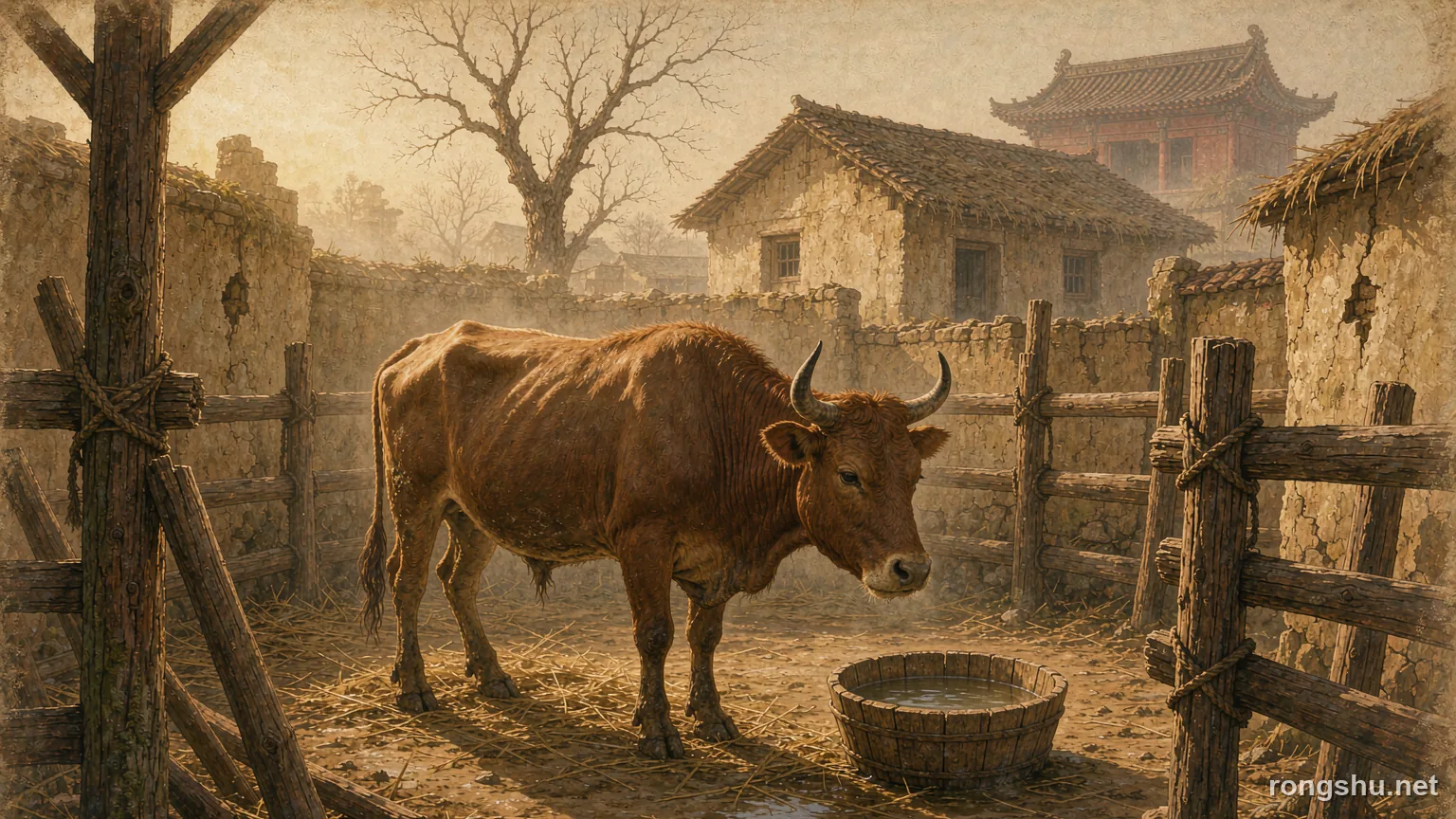
He was leading an ox. The animal walked slowly, and blood ran down from its mouth and dripped along the road behind it. The man kept turning round to look at it, afraid that it would go down.
Inside the office he tied the ox at the foot of the steps and knelt to lodge a complaint. His ox, he said, had had its tongue cut out.
One. The only case the histories kept
The case is recorded in the Song History, in the biography of Bao Zheng.
One thing should be said at the outset. Bao Zheng is a name with an enormous reputation in China, but in the official histories there is almost exactly one case that he is recorded as having judged himself. The histories are full of how upright he was, how he refused to bend for relatives or for the powerful, how he stood up to favourites at court. Of actual detection, they give three short lines.
It happened while he was magistrate of Tianchang county, in what is now Anhui province.
Bao was no longer young by then. He had passed the highest examination early and could have taken office, but his parents were old and he would not leave them. He turned down appointment after appointment, staying at home to look after them. When they both died he built a hut beside their graves and observed mourning there, and even when the mourning period was over he was unwilling to leave, and only the repeated urging of the village elders sent him to take up a post.
That is not a small thing. Passing the examination was the single greatest opportunity a scholar could have, and men went to extraordinary lengths for it. He set it aside, year after year, to stay with his parents. By the time he finally entered service, men of his cohort were already far above him.
So Tianchang was his first real posting. He was, by later reckoning, about thirty-eight years old.
His first hard case there was this ox without a tongue.
Two. Why cut the tongue
What makes the case strange is that only the tongue was taken.
An ox thief wants the ox. This man did not steal the ox and did not kill it. He cut off part of its tongue and left. A tongue is not meat worth eating and not something that can be sold for money. He was not after the animal. He was after the man who owned it.
Some background is needed here. In a farming society an ox is the centre of a household economy, worth years of a family’s labour. Every dynasty protected them, and by the Song it was a criminal offence to slaughter one privately. The ox was the property of the farmer, but it was also something the state claimed an interest in keeping alive.
That rule is the key to the whole business.
What happens to an ox with no tongue.
It cannot eat and it cannot drink. An animal in that condition does not die quickly. It wastes away over days, and what is left is a carcass. It has become an ox that is certain to die.
And what does a farmer do with an ox that is certain to die. He can watch it die and rot in the pen and be left with nothing. Or he can, while it is still alive, kill it, sell the meat and keep the hide, and recover some part of what he paid. The second choice is the sensible one. It is also the one that breaks the law, because killing an ox privately is the offence the state punishes.
That is what the man with the knife actually wanted. He did not intend to harm anyone with his own hands. He intended to build a trap, and to let the farmer walk into it. The ox dies, that is the first layer. The farmer kills it to cut his losses, that is the second layer, and that is the one that matters. Once the farmer has broken the law, the man who cut the tongue comes forward and reports him.
He does not have to take his revenge himself. The county court will beat the man for him. That is the cruellest part of the design.
Think one step further and it is clearer still. The man who cut the tongue knew the farmer, his circumstances and his temperament well enough to bet on one thing. Faced with an ox that was going to die anyway, any man who had worked for what he owned would refuse to let it rot. There is no confrontation in this plan and no quarrel. He gives the man a small push, and the man does everything else for him.
Three. Seven words
The farmer knelt in the hall and waited to be told what would be done.
Bao Zheng heard him out and said one sentence.
Go home. Kill it, and sell the meat.
The farmer was stunned. He had come to the court because his property had been mutilated, and the magistrate was telling him to commit an offence. But the words had come out of the magistrate’s mouth, and he had no other road. He did as he was told.
Why did Bao Zheng not send men to examine the pen and find out who had a grudge against him.
Because he had nothing to work with. The tongue had been cut at night, the pen was a mud wall with wooden rails, and there were no footprints to read. In a village where everyone knows everyone, everyone also knows who quarrels with whom, and knowing is not proving. An investigation would have produced gossip, and the ox would have gone on starving while the case hung there.
So he took another road. Instead of asking who had done something, he asked what the person who did it would have to do next. He was not investigating the past. He was investigating the future.
A few days later, a slaughtered ox appeared in the market at Tianchang.
Four. The informer at the door
Killing the ox was where the case really began.
Before long a man came to the county office.
He had not come for a reward and he had not come to give evidence. He had come to lay a charge. A household, he said, had slaughtered an ox privately.
The household he named was the household of the man whose ox had lost its tongue.
Under Song law this was a solid complaint. Private slaughter of an ox carried a penalty, and an informer could expect something for his trouble. He had timed it carefully. He cut the tongue, forced the farmer to kill the animal, and then presented himself at the door on cue.
The one thing he had misjudged was Bao Zheng.
Bao Zheng looked at him and put two things side by side. First, this household had had its ox mutilated. Then this man had come in to report the household for killing it.
He asked a single question. Why did you cut the tongue out of his ox and then come here to accuse him of it.
The man collapsed on the spot. The Song History uses two characters for it. He was astonished and he submitted. What astonished him was not that the magistrate could investigate. It was that his own scheme, which he had thought entirely private, had been visible to another man from the beginning, as clear as water in a bowl. What he submitted to was not only the authority of the office. It was that without laying a hand on anything, he had walked himself to the front of the hall.
That is where the case ends.
Five. What was in the seven words
Later storytellers remember this case as an example of a clever man being clever. Look closely and he did only one thing. He brought a man who was hiding in the dark out into the light, by the shortest route available.
The first step was not to ask who cut the tongue but why anyone would. Other people saw a case of property damage. He saw a chain. Cut the tongue, the ox must die. The ox must die, the owner must kill it. The owner kills it, the owner breaks the law. The owner breaks the law, somebody reports him. Push the chain through to the end and the man who reports it must be the man who started it.
The second step was not to go looking for evidence but to give the chain a nudge. He told the farmer to kill the animal and sell the meat. On its face this is absurd. A magistrate instructing a complainant to commit an offence. But only if the offence was actually committed would the man waiting to report it step forward.
The third step was that he never once said, you are the thief. He put two facts side by side in the hall and asked why. That question worked faster than any instrument of pain.
This is the most common technique in the older Chinese case literature and the one that most rewards skill. Do not go after the confession. Go after the motive. A killer can refuse to admit anything, but the things he has already done will arrange themselves in order.
Anyone who reads Chinese detective stories, or the modern literature of Chinese true crime, will meet this reasoning again and again. It is the oldest piece of technique in the tradition, and it is still the piece that does the most work.
The technique was copied later, over and over, in the plays about Judge Bao, with the scenery changed. In one Yuan dynasty drama, Bao turns a dispute over family property into a capital case. He spreads word that the young man who brought the claim has died of his wounds in prison. Then he tells the defendant, in open court, that if the dead man was her nephew, she was merely disciplining a junior and can settle the matter with money. If he was not her nephew, she has killed a stranger, and must pay with her life. To save herself she admits that he was her nephew and hands over the contract she had hidden.
The case in the history books and the case in the play run on the same trick. Put the conclusion on the road the other person has to walk, and let him walk it. The difference is that one is real and the other is invented, and it is worth keeping the two apart.
Six. The real Bao Zheng, and the one on the stage
Two things have to be separated here.
The first is genuine. By his biography in the Song History, Bao Zheng was known above all for an unbending kind of integrity. At court he was described as firm and severe, so that royal relatives and palace eunuchs drew in their hands when he was present. People compared the sight of him smiling to the Yellow River running clear, which is to say that it almost never happened. In the capital they had a saying. There is no back door to Bao. He is the one who stands in front of the courthouse like a king of the underworld.
As prefect of Kaifeng he did one thoroughly practical thing. Under the old rules an ordinary person bringing a complaint could not come up to the hall. The petition had to be passed in through the clerks. That gap was where the clerks made their money. Pay, and the paper moved. Do not pay, and it sat. Bao Zheng opened the main gate of the prefectural office and let complainants come straight to the front of the hall, to state their case to him face to face, and after that, as the history puts it, the clerks did not dare to cheat.
That reform was worth more than any number of solved cases. He had not changed a case. He had changed a whole channel.
The second thing is invented. The Judge Bao of the folk tradition has a black face and a crescent moon on his forehead, judges the living by day and the dead by night, and keeps three executioners blades arranged in a row. None of that is in the history. Yuan drama gave him one case, Ming and Qing compilers filled in hundreds, and after a few centuries almost every notable case in Chinese storytelling had been hung on his name.
The modern Chinese writer Hu Shi put it neatly. These stories, he said, are of unknown origin, and so people pile them on one man.
That is the honest accounting. What Bao Zheng actually judged, so far as anything can be checked, comes to one or two cases, and this is the best of them, this ox with no tongue cut out. Everything else is what several hundred years of ordinary people put onto the name, because they wanted a magistrate who could not be bought, and this one had the right shape for it.
Seven. The ox afterwards
The Song History does not say who bought the meat, and it does not give the farmer a name.
It gives three lines. A man had his ox tongue cut out and brought a complaint. Bao Zheng told him to go home, kill the ox and sell the meat. Later a man came in to report him for private slaughter, and Bao Zheng asked him why he had cut the tongue and then accused the man of it, and the man gave in.
What else happened in Tianchang in those years is not recorded either. What is left in the three lines is a newly appointed magistrate, and an ox without a tongue.