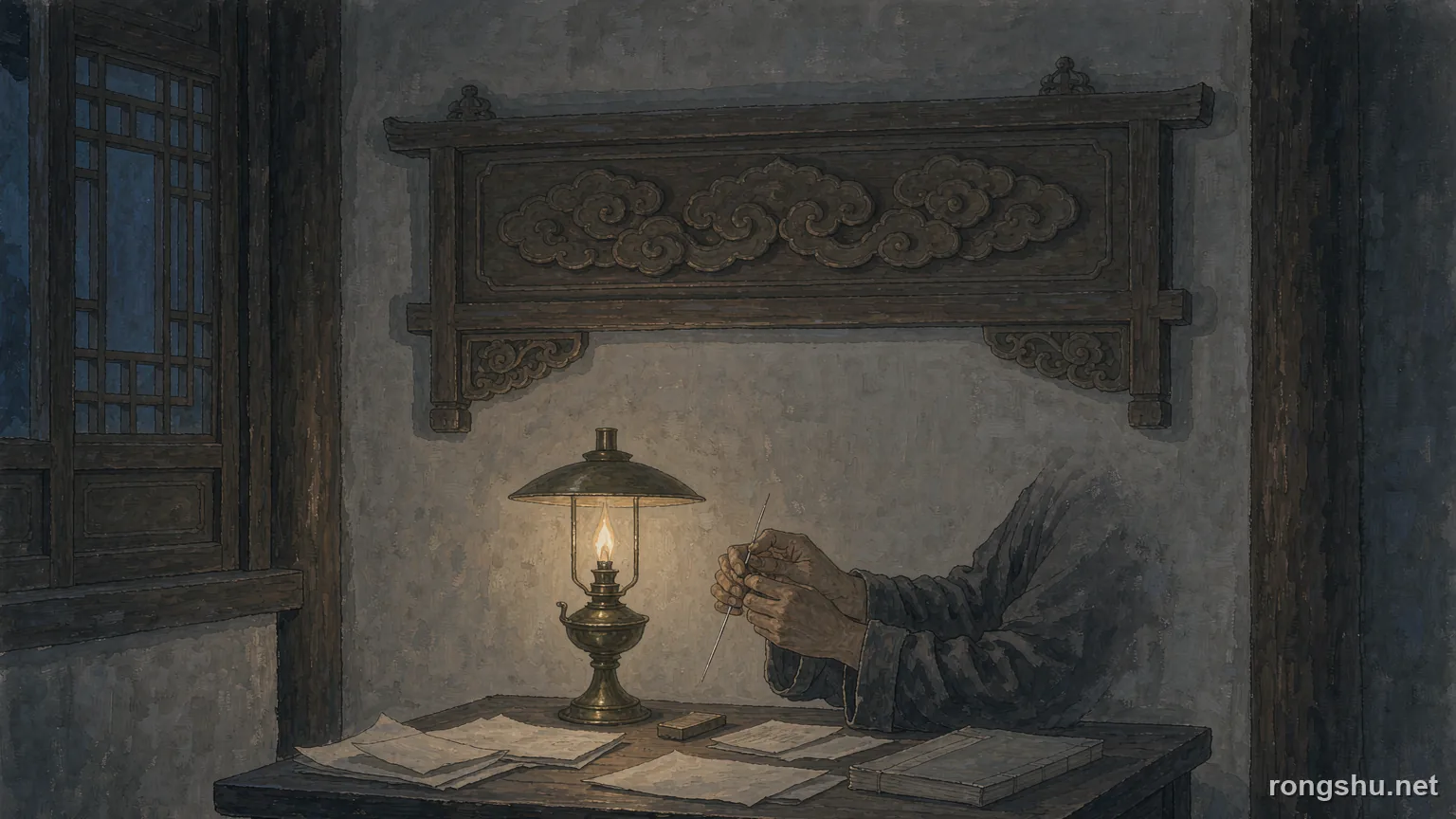
In the tenth month of 1873, in the county of Yuhang in Zhejiang province, a low-ranking officer whose job was to examine bodies pushed a silver needle into a dead man and drew it out black.
On that basis he reported that the man had been poisoned.
The dead man was Ge Pinlian, in his early thirties, a hired hand at a bean-curd shop. He had been well the day before. Then came a high fever, vomiting and diarrhoea, and by that afternoon he was gone. His family could not accept it and went to the magistrate.
That one needle carried a case from a county office in Yuhang all the way to the Forbidden City, and it took three years to arrive.
The story is the first of the four great scandals of the late Qing. There are no swordsmen in it. There is a scholar who had passed the provincial examination only months earlier, a young wife whom the neighbours nicknamed Little Cabbage, a sister who would not let go, and a newspaper that had only just learned to speak.
It is also one of the very few Chinese criminal cases of the nineteenth century whose paperwork survives almost in full, which is why it sits near the front of any serious study of Chinese true crime. Most miscarriages of that era left nothing behind but a line in a gazetteer. This one left a file.
One. The needle that was not washed
Western readers came to Chinese detective stories through a Dutch diplomat. Robert van Gulik, posted to Chongqing during the Second World War, found a forgotten Qing novel about a Tang dynasty magistrate, translated it, and then wrote a series of detective novels of his own. The magistrate became Judge Dee, and for decades he was the West’s idea of the Chinese official who solves the impossible case.
Real Chinese justice had something older behind it. In 1247 an official of the Song dynasty named Song Ci wrote a manual, Collected Cases of Injustice Rectified, a systematic guide to examining a corpse and reading what it has to say. It is the earliest surviving forensic text in the world, written three hundred years before anything comparable in Europe. It tells the examiner how to test for poison, how to tell a wound made before death from one made after, how to read the colour of bone.
Van Gulik is fiction. The silver needle is not.
Song Ci set down the rule himself. To test for poison, the needle must first be scrubbed clean with water in which honey locust pods have been boiled. Only then is it pushed into the body. If the step is skipped, or done carelessly, the result means nothing.
The man whose job this was, the wuzuo, was not an official. He was a hired underling of the county office, poorly paid and low in standing, expected to handle the bodies nobody else would touch. Yet in a murder case the first and most important piece of evidence was the report he wrote. Get it right and the case has a foundation. Get it wrong and every review built on top of it stands on sand.
The officer, Shen Xiang, pulled the needle out and found it black, and reported that Ge Pinlian had died of poison.
There was a second thing, worse. What he first wrote down was that blood had run from the dead man’s nose and mouth. In the file that went up the chain of command, that had become blood from all seven openings of the head.
One is ordinary in a man dying of fever. The other is the signature of poison. One word, and the whole nature of the case changed.
The proper response at that point would have been to re-examine the body and establish what had actually killed him. The magistrate of Yuhang, Liu Xitong, did not do it. Two private things sat on top of the case, and both of them pointed the same way.
The first was a grudge. Yang Naiwu, the scholar, was blunt and fond of writing petitions for his neighbours. He had already crossed the local officials. He had once written a couplet and hung it at the county office gate, mocking the magistrate as the sort of man who kept two sets of law.
The second was gossip. Ge Pinlian and his wife had once rented a room in Yang Naiwu’s house. Yang Naiwu read books and had taught the young wife, Bi Xiugu, to read, and the two families were close. The town had a phrase for it, four characters long: the goat eats the cabbage. Yang, goat, and her nickname, cabbage.
Before the examination of the body, Liu Xitong had already heard the phrase. He arrived at the scene with his mind made up, and he left it with a verdict.
Two. From the county office to the governor
Bi Xiugu was brought in. She denied everything.
So the magistrate used instruments. There were finger-presses that crushed the joints of the hand, and a rack that squeezed the legs, and red-hot wire. She passed out more than once. In the end she gave him what he wanted: she said that Yang Naiwu had bought arsenic and given it to her, and that she had put it in her husband’s medicine while he lay sick.
Yang Naiwu was a juren, a graduate of the provincial examination. Under Qing law a man with a degree could not simply be tortured. The degree had to be stripped first. Liu Xitong sent off the paperwork asking for that, and then, the same night, went ahead anyway. The scholar was beaten until he lost consciousness three times. He refused to confess.
His refusal did not stop the case from moving.
The prefect of Hangzhou, Chen Lu, reviewed it and applied the instruments again. This time Yang Naiwu broke, and produced a detail that would decide everything: he said he had bought the arsenic from a pharmacy called Ai Ren Tang, on a street in Yuhang, from a man he called Qian Baosheng.
That confession was the most dangerous thing in the file.
The owner of the shop was really named Qian Tan, and he had never sold arsenic to Yang Naiwu. Liu Xitong had him brought to the county office, and after some persuasion Qian Tan testified exactly as the confession required.
By then the county and the prefecture had assembled a chain that looked complete: adultery, conspiracy, purchase of poison, murder. The proposed sentence was death for Yang Naiwu and, for Bi Xiugu, death by slow slicing, the penalty the Qing kept for the gravest offences, in which the condemned was cut to pieces. To propose it meant that in the province the case was already closed.
The file went to the provincial judge and then to the governor of Zhejiang. Neither of them stopped it. It was sent up to the Ministry of Punishments.
Three. The sister on the road
Before the two women set out, it is worth seeing how many doors a Qing murder case had to pass through.
The county reported to the prefecture. The prefecture reported to the provincial judge. The judge reported to the governor. The governor reported to the Ministry of Punishments in Beijing. Every level was supposed to read the file afresh, and every level had the power to overturn the one below it. In practice most cases took their final shape in the county, and the levels above did little except seal them. That was the ground Liu Xitong stood on when he let a careless examination stand and bent the testimony to fit it.
There was one other road, and it was the only one that led out of the province. A family that believed it had been wronged could appeal straight to the capital, over the heads of the whole chain. It was called a jingkong, an appeal to Beijing. It was long, costly and humiliating, and it was the only way to get the case in front of people who had not helped to build it.
In his cell, Yang Naiwu wrote his own appeal. It was a ferocious document. He listed eight separate things about the official case that could not be explained, one by one: that he had not been in Yuhang when the man died, where the poison was supposed to have come from, and why nobody had checked what Qian Tan said.
His sister Yang Shuying and his wife Zhan Caifeng began travelling to Beijing. They sold what they had, and went again and again to the censorate and to the gendarmerie to lodge their petition. Filing one was not simply handing over a sheet of paper. The petitioner had to appear in person, be questioned, be recorded, and then wait. If no answer came, the petitioner came back and did it again. A single round trip took months.
In the operas the sister throws herself on a bed of nails to make her case. That is theatre. What actually happened is that two women walked thousands of kilometres, filed their petition, had it rejected, and filed it again.
Help came from two directions.
One was inside the government. Xia Tongshan, a vice-minister, and Weng Tonghe, the emperor’s own tutor, took an interest. Weng read the file and found it full of holes. Bian Baoquan, a supervising censor, memorialised the throne that the case was widely disbelieved and asked that it be heard by the Ministry of Punishments. Eighteen officials from Zhejiang serving in the capital signed a joint petition.
The other was a newspaper. Shenbao, founded in Shanghai, had reported the case for the first time in January 1874. It followed it for three years, publishing more than seventy news reports and commentaries, and printing the memorials and imperial edicts from the file alongside them. It was one of the first exercises in press scrutiny in China.
A newspaper cannot reverse a verdict. It can make a case in a county office visible to everyone.
Four. Even the imperial commissioner upheld it
The throne ordered a re-hearing, and sent the provincial education commissioner of Zhejiang, Hu Ruilan, as imperial commissioner to conduct it.
The appointment was the problem.
An education commissioner looks after schools. He is not a judicial official, and Hu Ruilan did not know much about criminal cases. And what he had to review was the entire provincial apparatus, from the county to the governor: every man in that chain was either the author of the verdict or the author’s superior.
He did investigate, and he did find the doubts. In the end he memorialised that the case had been examined repeatedly, that the testimony agreed, and that no torture had been applied, and he upheld the death sentences.
From his cell, Yang Naiwu wrote a couplet that travelled further than any of his petitions.
A juren becomes a prisoner, and scholarship is dragged in the mud.
An education commissioner plays the judge, and Naiwu dies.
After that round the case was very nearly over. One man spoke out hard against reopening it: Ding Baozhen, governor-general of Sichuan. His argument was that bones whiten as a body decays, so white bones prove nothing. He added a warning that mattered more than the argument. If this verdict were overturned, he said, no one would dare be a local official again.
But the side that wanted the case reopened prevailed, and not entirely out of conscience. Zhejiang officialdom was staffed almost end to end with men of the Xiang army faction, and the governor answered to Zuo Zongtang. For the court in Beijing, an injustice in a county was also an opportunity to take back a little of the south.
Five. The coffin at Haibui Temple
In the fifth month of 1876 everyone in the case was brought to Beijing, along with the coffin of Ge Pinlian.
On the ninth day of the twelfth month the Ministry of Punishments opened that coffin in public at Haibui Temple in the south of the city. This time the examiners were the ministry’s own men, Xun Yi and Lian Shun.
They judged the cause of death by a book.
The book was the one Song Ci had written in 1247. It set out what the bones of a poisoned man look like, and what the bones of a man who died of disease look like. In 1876 it was still the authority. The bones of Ge Pinlian were yellow-white throughout, with no trace of poison.
He had died of illness. He had not been poisoned.
In the courtroom Liu Xitong and the examiner Shen Xiang both admitted it. The examination had been careless. They had decided on poison in advance, and then used torture to get the testimony that matched.
Six. After
In the second month of 1877 the ministry closed the case. Yang Naiwu and Bi Xiugu were acquitted and released.
The verdict still carried a sting. It gave no reason except that the pair had failed to avoid suspicion. Yang Naiwu was beaten a hundred strokes, and the degree that had been stripped from him was not restored. Bi Xiugu was beaten eighty.
Then came the reckoning. Liu Xitong, the magistrate of Yuhang, was dismissed and sent into exile in Heilongjiang, and died on the road. Yang Changjun, governor of Zhejiang, and Hu Ruilan, the imperial commissioner, were dismissed. The prefect of Hangzhou was removed along with others.
Not all of them ended the same way. Within a year Yang Changjun was restored to office on Zuo Zongtang’s recommendation, and went on to govern several provinces. Hu Ruilan was also brought back, and later served as one of the senior judges who reviewed capital cases.
Yang Naiwu came out of prison with his legs ruined. He went home and grew mulberry for silk, and bred a silkworm variety that he sold in packets printed with his own name. He died in 1914.
Bi Xiugu went back to Yuhang, had her head shaved, and entered a nunnery under the name Huiding. She died in 1930.
The case closed. It left three things behind: three years, two imperial commissioners, and a coffin carried from Yuhang to Beijing.
It also left something that had not existed before. This was the first Chinese case of its kind to be followed day by day in print. Readers learned for the first time that what happened inside a county office could have somebody writing it down.
A silver needle, and one step skipped, sent an innocent man to a cell under sentence of death. Four years later a different set of men reopened a coffin and judged the bones by the rules of a book, and let him go.
That book was written in 1247. By 1876 it was more than six hundred years old, and it was still the standard by which this country examined its dead.