In the summer of 756, at noon, an army stopped on the road west of the Tang capital and would not go on.
Three thousand men, more or less: the imperial guard, the best troops the empire had.
In the middle of the column rode the emperor himself, and the chief minister, and a crowd of princes and princesses.
They had not eaten a proper meal in two days.
The sun stood straight overhead and the dust of the road was white. Inside the armor the sweat ran down and pooled at the belt. Some of the men could not speak. Some kept a hand on the hilt of a sword and never took it off.
The day before, they had been the pride of the greatest court on earth. Now they had come a hundred and fifty li from the capital, and the horses had halted.
An army that stops on its own march is telling you something.
To understand that noon, you have to go back one year.
The Missing Beacon
In the eleventh month of 755, in the far north-east, a general named An Lushan raised a rebellion.
Two things about him matter. He held three frontier commands at once, which meant that the soldiers of an entire border, a hundred and fifty thousand men or so, answered to him and to no one else. And he had spent years making the emperor laugh. Once, when the emperor asked what was inside his enormous belly, he answered that it held only one thing, a loyal heart.
What he said now was that he was marching to clear the emperor’s side of a bad minister. The minister was named Yang Guozhong.
At court, nobody believed a word of it. Yang Guozhong promised the emperor that the rebel’s head would be delivered within ten days.
Within a month, the eastern capital, Luoyang, had fallen.
Then the emperor began to kill his own generals. The two men who had fallen back to hold the great pass at Tongguan were accused by a palace eunuch and executed on the spot. The defense of the pass was handed instead to an old general named Geshu Han, who was half paralysed after a stroke.
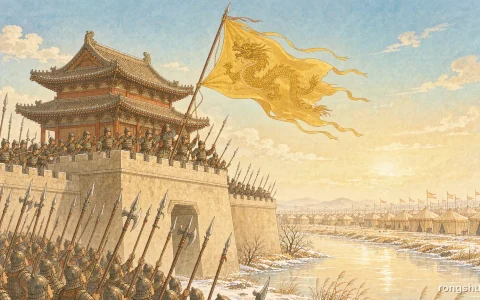
Tongguan was the eastern gate of the capital. On one side of it runs the Yellow River, on the other the Qinling mountains, and a single narrow road goes between. Whoever holds it holds the way in.
Geshu Han did the only sensible thing. He stayed inside and did not come out.
For half a year he held. The rebels sat outside and got nowhere. Far away in the north, two other Tang generals were winning battle after battle and threatening the rebel base. An Lushan began to think about pulling back.
It was going well.
Then the man in the capital began to worry. Yang Guozhong feared that the general at the pass had grown too strong, and that sooner or later his own place would be at risk. So he told the emperor a story. The rebel force outside Tongguan, he said, was the scrapings, the old and the weak, and a single push would scatter it.
The emperor believed him.
Courier after courier rode out with orders to attack.
Geshu Han wrote back that the rebels were offering bait. Two other generals wrote the same thing. Do not open the pass, they said.
The emperor did not listen. The riders went out one behind another, until their horses overlapped on the road.
On the fourth day of the sixth month, Geshu Han struck his own chest, wept aloud, and led his army out through the gate.
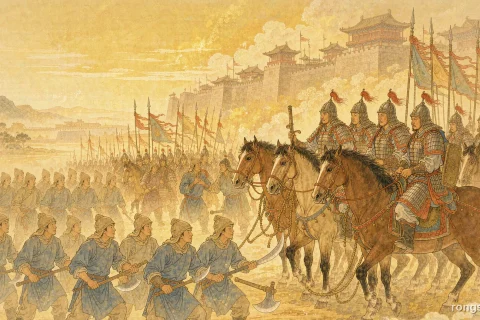
Four days later they walked into an ambush in a corridor seventy li long, mountains on one side and the river on the other. The carts and the horses jammed together so tightly that the men could not raise their spears. The rebels rolled stones down from the heights and set fire to carts of brushwood, and the smoke covered the whole road.
Of the army that went out, eight thousand came back.
On the ninth day of the sixth month the pass fell. Geshu Han was tied up by his own officers and handed over to the rebels.
That night, the capital waited for something.
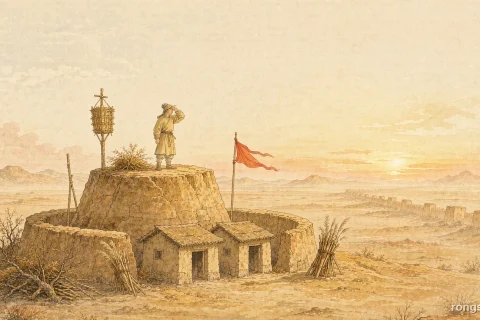
Since the rebellion began, a fire had been lit on the pass every evening. As long as Tongguan stood, the signal travelled west, station after station, until it reached the capital. They called it the peaceful fire.
On the night of the ninth, the fire did not come.
Before Daylight
The emperor panicked.
The next day his chief minister had a suggestion. Go to Sichuan, he said. He had governed that province from a distance himself, the country there is ringed by mountains, and a ring of mountains is the safest place in the world. The emperor agreed.
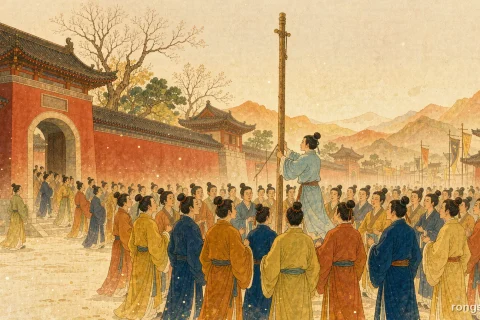
For a few days after that, the court put on a show. On the thirteenth of the month the emperor climbed a tower and issued a proclamation. He would lead the army out in person, he said. Posts were handed out and keys were assigned, and the plan for the defense of the city was laid out neatly for everyone to see.
That night he quietly had the commander of the guard pick out the six divisions and hand them money and silk. From the imperial stables he took more than nine hundred horses.
Before daylight on the fourteenth, a side gate of the palace opened.
The people who went out through it were the emperor, a few of his consorts and sons and grandsons, the chief minister, two or three other officials, the commander of the guard, and a cluster of eunuchs and attendants. The ones inside the walls who were not on the list simply stayed behind.
At dawn, officials came to court as usual. The water clock dripped, the guards stood at their posts. Then the doors opened and the palace people poured out, and nobody knew where the emperor had gone.
The city came apart in an hour.
On the very first day on the road, the food ran out.
At noon they reached a palace hall outside the city, and the emperor sat down under a tree and waited to be fed. Nobody came. The men sent ahead to arrange food and lodging had run off, and so had the county magistrate.
The chief minister went to the market and bought flatbread. Farmers nearby brought coarse rice mixed with beans. The emperor’s grandsons crowded round and ate it out of their hands, and in a few moments it was gone and they were still hungry.
The emperor watched them and covered his face and wept.
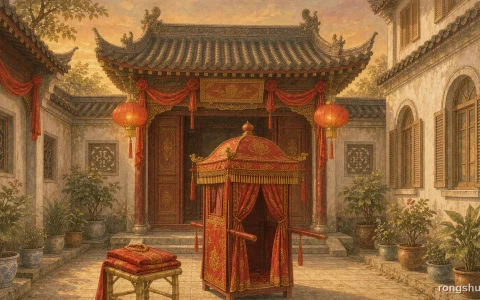
Late that night they reached a town whose magistrate had also fled. There were no lamps in the post station. The whole party lay down on the floor together, shoulder to shoulder, and in the dark nobody could tell the noble from the servant.
That was the night the anger in the guard began to set.
They were the ones marching. They were the ones going hungry. They had nothing to eat and the man at the top had flatbread. And every soldier knew whose name to put to all of it.
The Shout at the Gate
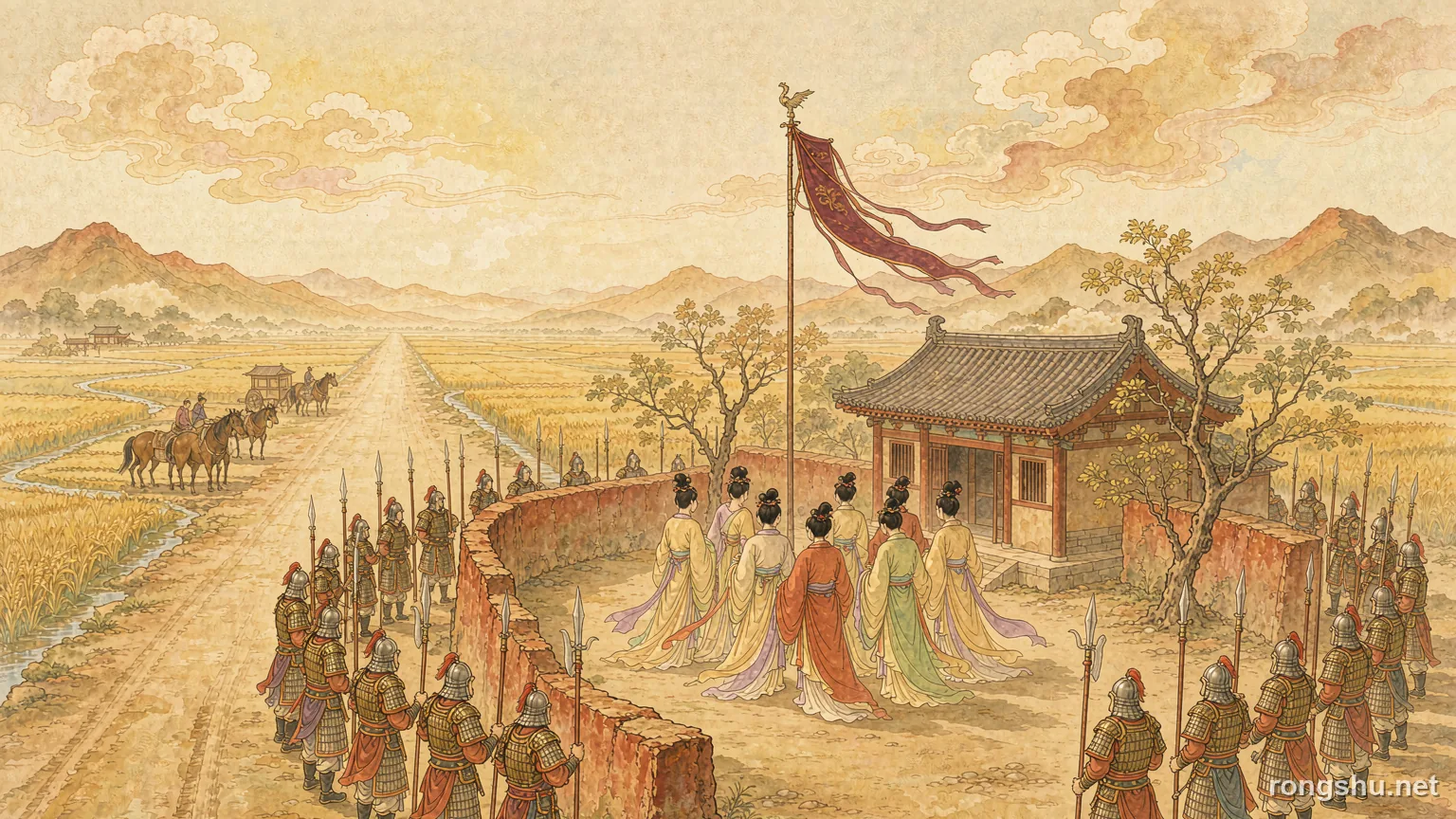
At noon on the fourteenth they came to the post station at Mawei.
Twenty or more envoys from Tibet were waiting there, and they crowded round the chief minister and asked him for food.
At that moment someone in the guard shouted that the chief minister was in league with the foreigners.
An arrow flew and struck the saddle.
The chief minister turned his horse and rode for the west gate. The guard went after him. The swords came down. His head was cut off and carried out on the point of a spear.
His son died with him, and two of the emperor’s own aunts. A senior official who stepped forward to stop the killing was cut down where he stood. Another was beaten bloody, and only a shout from the ranks saved him.
Inside the station, the emperor heard it.
He came out leaning on a stick, and walked among the soldiers, thanking them, telling them to fall back in.
Nobody moved.
Three thousand men stood in a ring around the post station with their swords in their hands.
The emperor sent his oldest eunuch, Gao Lishi, out to ask what they wanted.
The commander of the guard came forward and answered in one sentence. Yang Guozhong had rebelled, he said. The consort Yang could no longer be kept at the emperor’s side. Let his majesty cut the bond and see justice done.
A Roman would have recognised the scene. The ruler in the hands of his own guard. In Rome the men who were meant to protect the emperor were the ones who most often decided whether he kept his throne, and a guard that made one ruler could unmake the next before breakfast. China had its own version of this, and once in a very long while the version came out into the open. This was one of those days.
Cut the Bond
The emperor stood still.
I will settle it myself, he said.
He turned and went back inside and stood leaning on the stick with his head down.
One of the young officials knelt and knocked his head on the ground until it bled. There is no arguing with an angry army, he said. Everything turns on this one moment. Decide now.
The emperor argued back. She has lived her whole life inside the palace, he said. How could she know anything about a plot?
Then Gao Lishi spoke.
The old eunuch had served the emperor for decades, ever since he was a young prince whom nobody expected to rule. He said something plain. She is innocent, he said. But the soldiers have killed the chief minister, and she is still at your side, and they will never be able to rest. Think it through, your majesty. If the soldiers are at peace, then you will be at peace.
The emperor said nothing more.
He told Gao Lishi to take the consort to a shrine beside the post station.
She died there. She was thirty-eight.
Later writers put a pear tree in front of that shrine and said she went to her death under it, and that somebody afterwards found a stocking beneath the tree. Those details were added later. The official record says only that she was strangled.
The body was carried out and laid in the courtyard of the station. The emperor called the guard commander in and made him look at it.
The soldiers took off their helmets and their armor and knelt to ask pardon for what they had done. The emperor thanked them. They shouted his long life and went out, and only then did the column re-form.
North to Lingwu
The next day the emperor meant to go on west.
The soldiers objected again. Yang Guozhong’s men are all in Sichuan, they said. That way is not safe.
Where, then? Some said the north-west. Some said a town far out on the frontier. Some said go home to the capital. The emperor had Sichuan on his mind, but he did not dare say so.
In the end they agreed to go a little further and then decide again.
They had hardly started when the old men of the district crowded round the horses and begged the emperor to stay. He could not answer them, so he sent his heir, the crown prince, back to calm them.
The old men closed around the prince and would not let him ride away. Within a short while there were several thousand of them.
The emperor waited a long time for his son to come back. He did not come.
The emperor sighed and said one word. Heaven. Then he detached two thousand men from the rear of the column, gave the prince the horses from the imperial stables, and told the officers that the crown prince was good and dutiful, and could be trusted with the state, and that they should serve him well.
Then he went on west, through the mountain gate, to Sichuan.
The crown prince rode north. At Pingliang he collected tens of thousands of government horses and raised a few hundred more men. In the seventh month he reached Lingwu.
On the twelfth day of that month, on the south tower of the city wall, Li Heng took the throne. He changed the era name to Zhide, and named his far-away father retired emperor.
He is remembered as Emperor Suzong.
The old emperor lived on in Sichuan for more than a year. In 757 the Tang armies retook the capital and he was brought home. He was moved out of the palace he had loved into another one, and the eunuch who had served him for decades was sent away into exile.
He died in 762, in a hall of that second palace.
The war that began at Mawei ran for seven more years. It ended in 763.
In the years around it, the official count of households in the empire fell from about nine million to fewer than three million. Some of that was death, and some was plague, and a great deal of it was people simply leaving the registers, going up into the hills or into the great temples where the tax men could not follow. The numbers can never be made exact. But something had gone out of the dynasty, and it never came back.
The post station is still there. It stands in Shaanxi, at a place called Xingping, a short drive from the city that was once the capital.
It was an ordinary noon. The sun was bright and the road was long.
The army walked on for a while, and then it stopped.