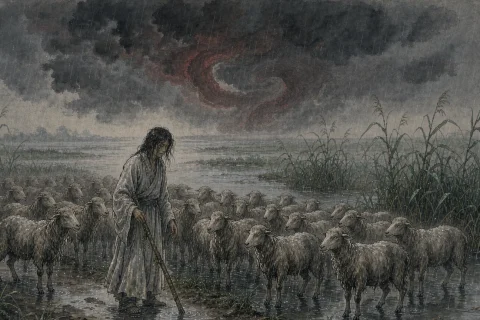
There is a cave on the north-west side of a ridge called Yongling. On the first day of the eighth month, every year, the people of the valley walked a young girl up to the mouth of it and then backed away until they could no longer hear her crying.
One year, the girl who walked in was not crying.
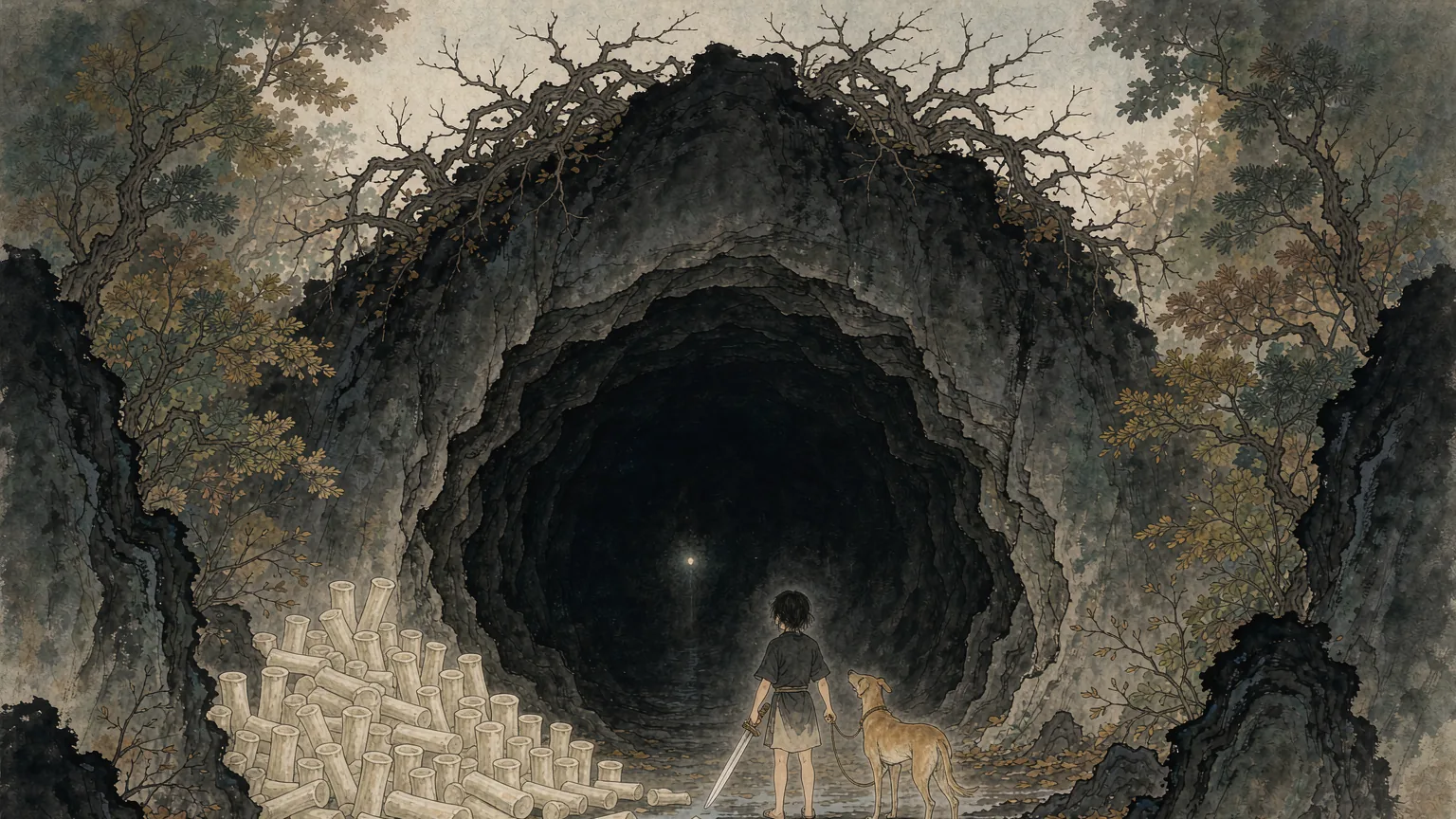
She had a sword under her coat and a dog on a rope.
This story also comes from Gan Bao, and from the same book, In Search of the Supernatural, written in the fourth century.
It is not invented. The place names are real. Dongye is the country around what is now Fuzhou. Jiangle county is in the mountains of Fujian, and Yongling is the ridge beside it. Gan Bao wrote these places down one by one, and the people who copied his book took it as a record. He files it the way he files everything else: which county, which ridge, who was made magistrate afterward.
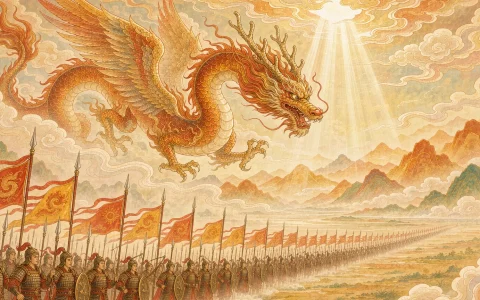
What the record describes is an old arrangement. There was a great serpent in a cave in the north-west of that ridge, seven or eight zhang long and more than ten arm-spans around. Nobody could do anything about it.
It had already killed the local commandant, and several officials in the counties under him. The government had sent men up the mountain, and the men had not come back.
At first the county sacrificed cattle and sheep to the serpent, and that bought a year of peace. Then the serpent came to a shaman in a dream and said what it wanted. It wanted to eat people. It wanted girls of twelve and thirteen.
The officials had no way to fight it. What they could do was buy a daughter from a poor family each year, or take one from a family that had already been disgraced, raise her until the eighth month, and walk her to the cave.
They did that for nine years.
Nine years. Nine girls.
Chinese folklore horror has an endless supply of monsters that eat children, and Chinese ghost stories are mostly about the people who get eaten. This one is not.
In Jiangle county there was a man named Li Dan, who had six daughters and no son.
After the ninth year they began looking for the tenth. If your daughter turned twelve that year you kept the gate shut. Men were sent around the villages to look. Some families hid a girl behind the firewood, and some sent her away to relatives in the night, and if anybody saw her go, the whole clan knew by morning.
The officials did not shout and they did not use force. They wrote names down and said they would come for her on the first day of the eighth month. Everyone knew what that meant. The arrangement had been running so long that it had stopped looking like a crime and started looking like a tax.
Li Dan’s youngest daughter was named Li Ji. She went and put her own name down.
Her parents refused.
So she argued with them. This part of the story is the part that Chinese readers have remembered longest. She said that her parents had no fortune, that they had borne six daughters and not one son, and that daughters were the same as nothing. She said she did not have the kind of talent that could save them, and she could not earn money, and that she was eating and wearing clothes for nothing. She said it would be better to die early, and that selling her body would bring in a little money to keep them alive.
The comparison she makes is to a girl named Ti Ying, from the Han dynasty. Ti Ying wrote to the emperor to beg for her father’s sentence to be reduced, and got it. She is the standard by which Chinese tradition measures a good daughter.
Li Ji was saying that she could not be that. So she would do this instead.
Her parents would not hear of it. They shut the door on her.
She went anyway. Nobody in the house could stop her.
Before she left, she asked for two things.
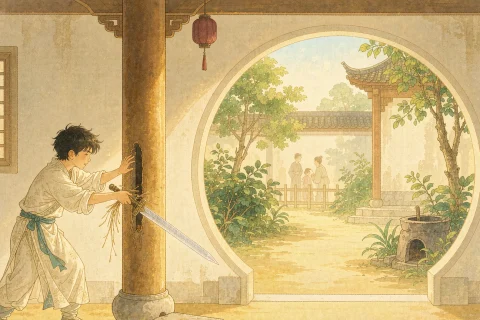
The first was a good sword, properly ground, not a kitchen knife.
The second was a dog, one that would bite a serpent.
The county gave her both. If you are going to send a daughter to her death, the story suggests, you can at least hand her the tools.
On the first day of the eighth month she went into the shrine before dawn. She sat down in it with the sword against her ribs and the dog on the rope.
She had also brought something else. Several measures of rice, pounded and made into cakes, and mixed with honey until the sweetness carried a long way. She set the cakes in piles at the mouth of the cave.
That part was her own idea. A serpent hunts with its nose, and sweetness will pull its head down. She was not trying to poison it. That much rice cake would not have killed a thing that size. She wanted its head low and its whole attention on the ground.
Then she waited.
The shrine was very quiet. She could hear the dog breathing behind her. She put her hand on the hilt, and the hilt grew warm.
She did not have to wait long. The sun cleared the ridge and the draught in the cave mouth changed. It was not wind. It was something moving further in.
The serpent came out.
Gan Bao does not describe it closely. He gives two details. Its head was as big as a granary, and its eyes were like mirrors two feet across.
It smelled the honey first. It lowered its head and began eating the cakes stacked at the mouth of the cave. The scales along its body moved one over another with a small sound.
Li Ji let the dog go.
The dog went straight at it and closed its teeth on the serpent’s flank.
Li Ji came in behind and swung the sword.
The first cut came down badly. The serpent heaved over, its tail swept across the shrine, and tables and braziers and everything on the walls went over at once. The dust came up off the floor and she took it full in the face.
She did not step back. She wiped her face and went round to the back half of the animal and lifted the sword with both hands, and cut again, and again.
She was cutting into its spine. She did not know where a serpent kept its life, so she worked on the rule that if a thing cannot be cut through, you cut it more times. Her hands were shaking. Her feet were not.
Blood came out onto the floor and it was cold. The serpent could not hold itself. It drove out of the cave.
In the courtyard it raised its head once, and then it went down.
It died at the bottom of the steps.
She stood in the courtyard a moment with the body in front of her and the dog at her side and the sword still wet in her hand. It was the first morning in nine years that the valley had woken up without expecting to lose somebody.
In the end, only one girl and one dog had done anything at all.
When it was light, the village came up. They saw the serpent first, a thing that size lying across the steps, and then the small girl standing beside it with a dog at her feet.
Some of them knelt down. Somebody started shouting for the others. When the county men arrived they found the serpent, and Li Ji beside it, one hand still on the sword.
Nobody touched the body that day. It was the afternoon before they got a dozen men together and carried it away. They carried it a long way.
Afterward she went back into the cave. What she was looking for, the record does not say, but a girl who has just killed something that size does not go back in there for nothing.
Li Ji took the sword and walked into the cave.
Inside it was dark, and the smell was old. It was not one smell but damp and rot and decay folded together and sealed in stone, and she stood in the entrance for a while before she could go in.
She went in a short distance and her foot came down on something.
Bones.
The skulls of nine girls were heaped in the cave, and other bones with them, and some of the skulls still had hair.
She stood and looked at them for a long time. What she said is recorded in four characters.
Ru cao qie ruo.
You were cowardly.
She said that the serpent had eaten them, and that it was a great pity.
Then she came out slowly, and walked home slowly.
Word of it reached the King of Yue.
The King wanted to marry her. Her father was made magistrate of Jiangle county, and her mother and her sisters were all given rewards. The family of Li Dan was poor no longer.
The marriage is the strangest note in the story. Some readers take it as a reward, and some read it as the same girl being handed on from one household to another. Gan Bao does not comment. He writes it down and moves to the next entry.
The record adds one more line. After that, no monster troubled the country around Dongye again.
Seven characters in the book. What they contain is this: the mountain road was passable, nobody wept on the first day of the eighth month, and no girl of twelve had to be hidden behind the firewood.
In the autumn of that year the people of Jiangle walked the mountain road in the eighth month for the first time without going around that cave.
You can go to Fujian today and ask where Yongling is, and where the serpent’s cave was, and most people will not be able to tell you.
The song they used to sing about her is gone too. Gan Bao heard it and wrote that it was still being sung in his own time, which was seventeen hundred years ago.
Only the story is left, and the people who tell it always get to the same four characters, there in the dark at the end.
You were cowardly.
She said that to the nine girls who went into the cave before her. They were about her age.
They were carried in. She was not.