In the town of Huayin, in the Xuande years of the Ming, a scholar came home long after dark carrying an empty bamboo cage. His name was Cheng Ming. The cage was woven of fine split bamboo, and there were two or three blades of green grass still stuck to the bottom of it. He had carried that cage for a month, and in a month it had never held a cricket worth keeping.
The old word for a cricket in China is cu zhi. It means something like the one who hurries the loom. When the summer ends and the cricket begins to sing, the autumn has come, and the women must sit down at their looms. The name is a small clock made of an insect.
A cricket fight is not a casual thing, either. A good cricket must be chosen and kept, fed on crab meat and chestnuts, housed in a clay jar over a floor of packed earth. Two crickets are not done with a match when one of them runs off. Usually it ends when one has lost a leg, or a wing, or is lying on its back and cannot get up. The winner often dies a few days later as well. A cricket fight is fought with a life, on both sides.
Pu Songling wrote this story down in a book called Strange Tales from a Chinese Studio, and he wrote nearly five hundred stories in it, about ghosts and foxes and spirits and all manner of strange things. There is no ghost in this one. The only strange thing in it is a cricket. And that cricket behaves better than most of the people.
If you know the Brothers Grimm, you know roughly what Pu Songling was doing. The Grimms went out and collected the tales that ordinary people told, and wrote them down. So did he, about two hundred years earlier and on the other side of the world, except that what he collected were the stories people told about the dead.
It began with a sentence spoken in the palace.
The emperor of that reign loved cricket fighting. The fashion blew out of the palace and across the provinces, and every year the officials demanded more crickets from the villages than the year before. Huayin produced no good crickets at all. It did not matter. The quota came down anyway, and when a county could not fill it, the quota fell on the men who had to do the collecting.
Cheng Ming was a xiucai, which means he had passed the lowest level of the imperial examinations. He had read his books and failed to go further, and so the county had drafted him as a lizheng, a village headman. A lizheng is not an official. He is the man who runs errands for the magistrate, who collects the grain, who presses the families for what they owe, and who takes the beating when anything goes wrong. His family had been poor to begin with. After a year as lizheng they were poorer.
Crickets were demanded of him and he could not produce them. He did not dare to squeeze the poor villages any harder, so he went out to catch them himself. He walked the hills and the old grave mounds and the broken walls with his cage, turning over stones all day, and in a whole month he did not find one that was worth anything. A cricket is quick. It hears a footstep and vanishes into a crack, and you can turn ten stones and never hear a single note.
When the deadline came, he was called to the magistrate’s office and beaten with a plank. When it was over, the magistrate told him what would happen the next time.
He went home that evening and took off his coat, and his back was striped with red. His wife cooled the welts with water from the jar. He lay face down on the bed and heard voices outside the window, and he was sure they were laughing at him. He would not light a lamp, in case somebody knew he had come home. The spirit went out of him that night, and he began to think about ending it.
There was little left in the house to sell. His wife had already pawned two old hairpins and several bolts of cloth, and the money had bought only a few pounds of rice. She was steadier than he was. She said that nobody in this world is finished until the last road is closed, and that they had not found the road yet.
His wife said, wait. There is a hunchbacked shamaness who has come to the village. She can tell you where a thing is hidden. Go and ask her.
So his wife took money and went. A few other people were waiting in the shamaness courtyard, all of them there for the same kind of errand. When it came to her turn, the woman shut her eyes and muttered, and would not say plainly what she meant. She drew a small picture on a piece of paper. The picture showed a walled yard, and under the wall sat a toad, and beside the toad grew a clump of grass.
Cheng Ming spread the paper on the table and looked at it for a long time. Then he understood. It was the little shrine at the east end of the village.
He picked up his cage and went.
Behind the shrine there was a stone, and behind the stone there was indeed a clump of grass. He held his breath and listened. Something was singing in the grass. He parted the blades slowly and a cricket jumped out, a large one, with a long tail, a blue-green neck, and wings that shone like gold.
It took him half the yard and two dives, and left his coat covered in dust, before he had it under his hand. He put it in the cage, and his fingers were shaking. He carried it home the way a man carries something he cannot believe he owns. He did not dare to breathe too hard on the way.
Cheng Ming had a son, nine years old.
When he left the house he latched the cage tight and told the boy, again and again, not to open it. The boy promised.
But a child is a child. The moment his father was gone he lifted the lid a crack, just to look. The cricket sprang. He grabbed for it, and in his panic he closed his hand on it, and when he opened his hand the insect did not move. One leg had come off.
The boy was terrified. He put the body back in the cage and tried to behave as though nothing had happened. It did not work.
His mother came home and looked, and her face went white. She shouted at him that he had done it now, that this was the end of them. It sounds like a cruel thing for a mother to say. It was not, in that house, an exaggeration. One cricket that could not be delivered could cost a whole family its life.
The boy ran out of the house, crying.
They looked for him until dark, with the neighbours holding lamps. His mother found him first, at the well. He was floating.
They pulled him out. He was not breathing. His hands and feet were still warm and soft. The two of them held him and could not speak at all. Nobody lit a lamp in that house that night. The only sound was water dripping off the stone rim of the well, one drop at a time.
Near midnight, Cheng Ming was still sitting in the front room when he heard a cricket singing outside the door.
It was not the big one. This voice was thin, and steady. He took a lamp and went out, and there on the threshold sat a small cricket. It was very small, smaller than an ordinary cricket, and a dull grey-brown at that. On any other day he would not have glanced at it twice.
But he had just lost his son and he was empty, and he picked the thing up and put it in the cage. He expected nothing from it. The house was simply too quiet, and he wanted to hear something alive.
The next day the boy from next door came over. The boy kept a cricket called Crab Shell Green, the champion of the village, and he made money with it, and he carried himself accordingly. When he heard that Cheng Ming had a cricket too, he wanted a match. Cheng Ming looked at his own little grey insect and refused. It would not be a fight. It would be a slaughter.
The boy would not leave, and he called a few of his friends over to watch. So the two crickets were put into a clay basin, and Crab Shell Green rushed in at once.
The little cricket did not dodge. It ducked, slipped under the big one, and fastened its jaws on its belly. Crab Shell Green struggled twice, broke away, and crawled into the corner of the basin and would not come out again.
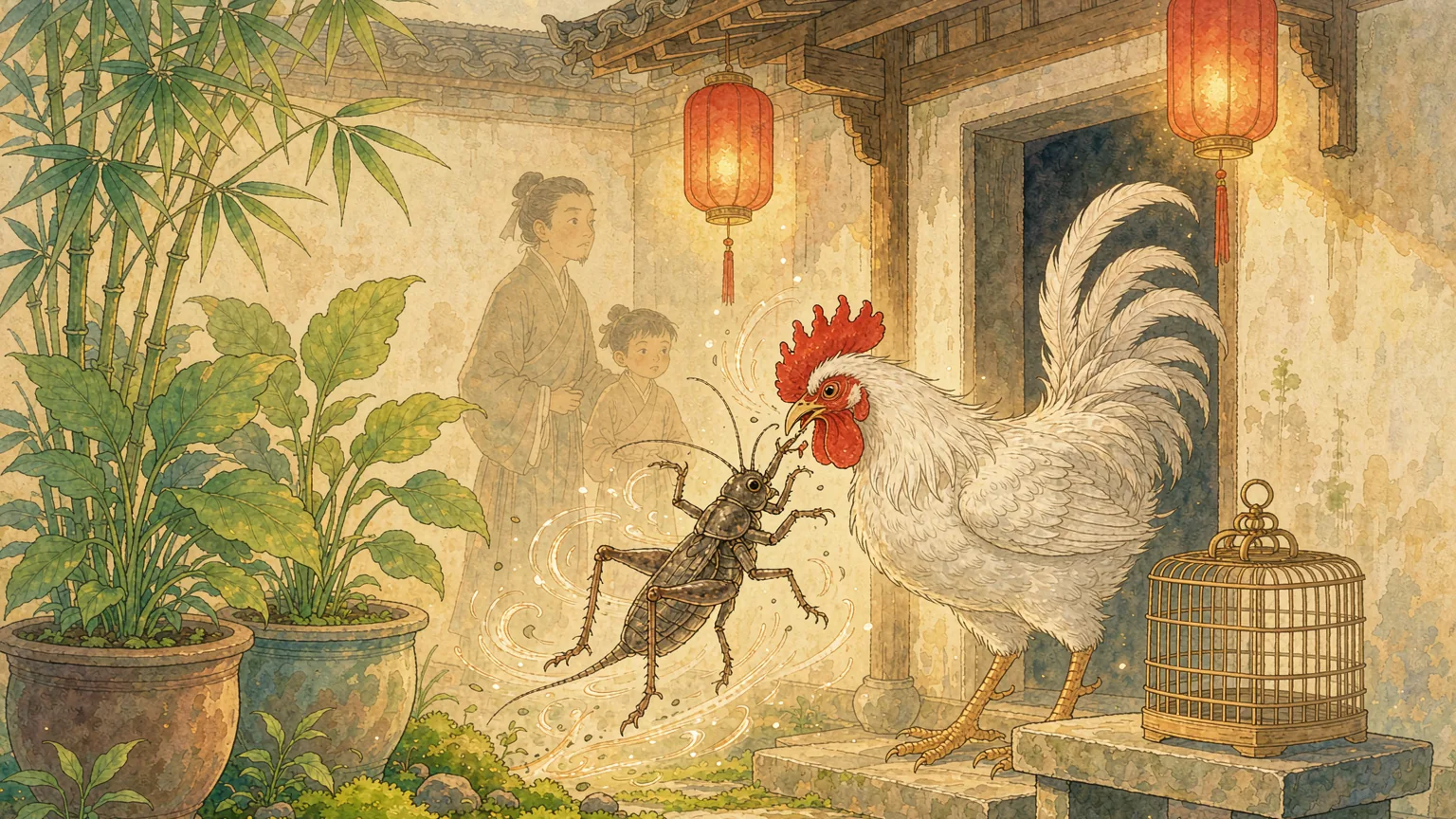
The yard went quiet. The boy stood there with a red face and reached in to take back his champion. Just then a chicken wandered into the yard, saw the insects in the basin, and jabbed its beak down at them.
The little cricket leaped and landed on the chicken’s comb and bit down. The chicken screamed and flapped and shook it off at last, and the cricket landed, bounced, and hopped back to the edge of its cage, where it gave one short, level chirp.
Cheng Ming stared at it, and something in him turned over.
After that the record moves quickly.
Cheng Ming presented the little cricket. It went up to the county and beat every cricket in the county. It went up to the prefecture and beat every cricket there. In the end it reached the palace. The palace crickets were the finest in the empire, kept in gilded jars and fed on the most delicate food, and not one of them could stand against it. It never sang while it fought. It sang when it was finished, one brief, level note, as though boasting were beneath it.
The emperor was pleased. He rewarded the provincial governor, and the governor in turn rewarded Cheng Ming. Cheng Ming was given land, and money, and his household rose again, richer than it had ever been.
A year later, the son he had buried came awake.
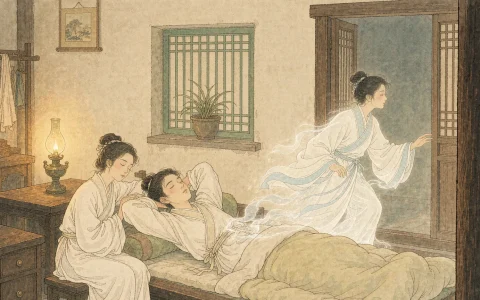
He had not quite died in the well that day. His breath had stopped and he had slept, and over the better part of a year he came slowly back, able to eat and speak again, still nine years old. The doctors were called and could not explain it. They said only that the child had a strong fate.
He told his father something, in a muddled way. He said that he had spent the year dreaming. In the dream he had become a cricket himself, quick and high-leaping, and nothing could beat him, and he had only just woken up.
Cheng Ming heard him out and said nothing.
The family prospered from then on. Cheng Ming never kept another cricket as long as he lived.
The bamboo cage that had turned the family fortune hung from a beam in the house, and he never threw it away.
Some people said the child really had turned into an insect. Others said it was only a dream, and that the two crickets, the first and the second, were never the same one. Pu Songling wrote both versions down and refused to say which was true.
In the years after, the fashion for cricket fighting only grew in Huayin. Every autumn the streets filled with men carrying jars, betting on their insects and quarrelling over them. Nobody knew that the thing which had lifted the Cheng family out of poverty was a small grey cricket that no one would have looked at twice. And nobody asked why Cheng Ming kept no crickets of his own.
Only the little cricket is left, sitting in the story, and nobody in it ever speaks the thing out loud.