On the mountain above the river there is a rock.
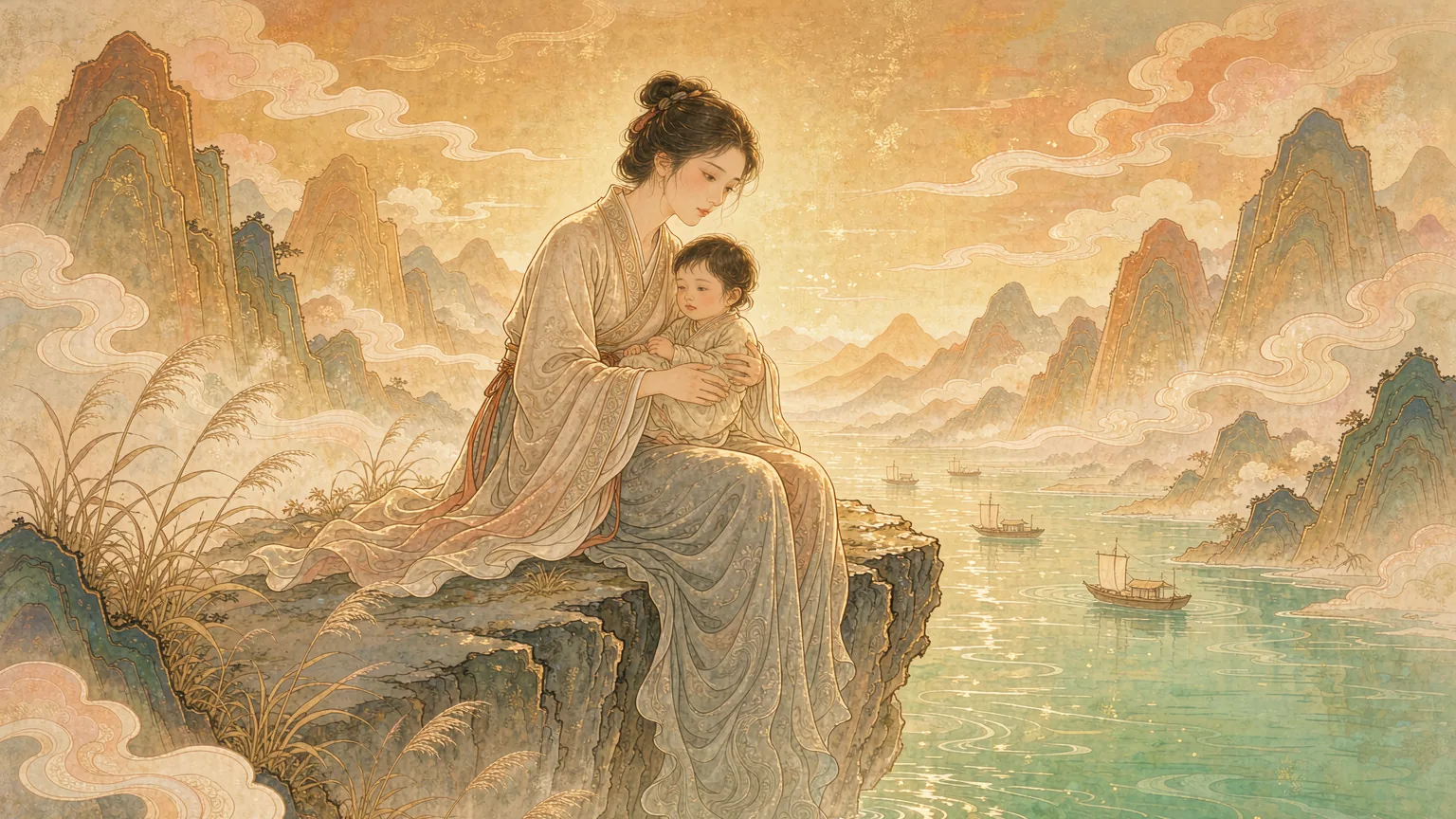
It is not tall, about the height of a person, and it stands at the top of the ridge, leaning a little toward the water. Look closely and the shape is that of a woman. There are the shoulders, and the back, and a bundle held against the breast, like a child in her arms.
Boats have passed below for hundreds of years. The boatmen look up and point at the rock, and tell the newcomers what it is called. They call it Wangfushi, the rock of the woman who watched for her husband.
The rock has a history. It is recorded first in a Southern Dynasties book called Record of the Hidden and the Visible, by Liu Yiqing. It says that on the north mountain of Yangxin county there is a rock shaped like a standing person. The old account is that a faithful wife once lived there. Her husband was taken away for military service, far off, to a war at the edge of the country. She carried her small child and saw him off at this mountain, and stood watching for him every day, and in the end she turned into stone.
There is more than one rock in China with this name. There is one at Wuchang, one at Dangtu, and one at Xinye. In some places the story is told of the woman who waited for Yu the Great while he was taming the floods. The stories are much the same. The rocks are different. Which one is the true rock, nobody can say.
And there is no need to say. The two words of the name are the whole story already. One person went away, and one person stayed behind to wait. The one who waited stood still in one place. The one who went away never came back.
Legends of this kind are how Chinese folklore keeps its grief. They are not tales of haunting, and there is no monster in them at all. They are stories of a love that outlasts the body, and they are told beside the very things that are said to have witnessed it.
To tell the story of this rock, you have to start with the man who went away.
It was autumn when the officials came to the door. They pasted a paper on the door board with her husband’s name on it.
It was a conscription order. There was a war in the north, and men from the river towns and the hills and the fields, all of them of age, were being taken, for three years or longer. The officials said he must report to the county seat within three days.
Three days. She unpicked every piece of cloth in the house that could be unpicked and sewed it into the lining of a thick coat. She wrapped what salt was left at the bottom of the jar. She mended his shoes for the third time.
They left before dawn. She carried the baby, only a few months old, on her back, and walked him down the mountain.
At the ferry he told her not to come further, that the wind was strong and the child was on her back. She pushed the coat into his arms and said that he should send word when he arrived. He said that he would.
The boat pulled out. She stood on the bank and watched until the boat shrank to a black speck on the water, and then to nothing.
Their life together had not been rich, but it had been in good order. There were three rooms of rammed earth, a stove blackened with smoke, and a chipped bowl kept on the edge of the stove. He carried the water and she cooked. He went to the fields and she washed and swept and kept the yard clean. The child had been born the winter before, wrinkled as a little old man, and her husband had loved him so much that he would not sleep at night and lay by the cradle watching, saying that the boy had her eyebrows.
After he left, she did not move that bowl from the stove. It stood where it was, gathering dust, and she left it standing.
The first time she climbed the mountain was the third day after he left.
The wind was strong up there and the grass came past her knees. She carried the child and climbed until she was out of breath, and sat down on a rock at the top that was shaped for sitting, and looked out at the river.
There were many boats on the water. Freight boats, ferry boats, boats drawn up at the bank. She counted them one by one and marked which bank they came from and which they went to. She thought that one of them might be the boat he was on.
She counted until dark and found nothing. Going down, the child fell asleep against her back, and his drool soaked through one shoulder of her coat.
The next day she went up again.
After that the days went by like that.
In spring the river rose, and small yellow flowers opened along the path. She sat on the rock and watched the water turn from clear to muddy, higher every day.
In summer the sun was cruel. She laid the child down in a patch of shade and sat on. The rock grew hot under the sun, and she fanned with an old rush fan, half for herself and half for the heat in the stone.
In autumn the reeds at the foot of the mountain turned white, and when the wind passed they rustled like someone turning pages far away. Watching the reeds, she remembered how he used to stack the firewood behind the house in autumn, in rows so neat that you could measure them with a string.
Winter was the worst. The wind came straight up from the river like a knife. She wrapped the child against her breast and turned her own back to the weather. Her hands cracked open, and she held them against her belly to warm them a little at a time.
The child learned to walk, then to run, then to follow her and ask when his father was coming home. She answered, every time, that it would be soon. He grew taller, and could climb to the rock himself and sit and watch the river for her. One day, watching, he said that the boats on the river were always the same few boats. She was quiet for a moment and did not answer.
At first the neighbors came to see her. After a while they stopped.
One autumn a man came back from the army to the ferry, lame in one leg, who said he had begged his way home from the north. The villagers crowded around to ask about her husband. The man thought for a while and said that there had been such a name among that group, that the man was long dead, that his body had not been brought home and was buried where he fell.
The news reached the mountain. She sat on the rock for a long time and said nothing.
She looked down at the child in her arms, and the child looked up at her. She brushed the hair back from his forehead and said that his father would come home.
She said it over and over, until she could no longer tell whether she was saying it to the child or to herself.
Then the woman from the next house came up the mountain once with a basket of warm rice cakes, and told her to come back home, that a person must live on.
She listened, and did not weep, and said nothing. She broke the rice cakes in half and fed half to the child. When the neighbor had gone down the mountain, she said to the child, who still could not speak, that his father would come home.
Nobody in the village could remember just when she stopped sleeping at the foot of the mountain.
What they knew was that in the end the chimney of that house stopped smoking in the daytime too. She was on the mountain by day, and she was on the mountain by night, sitting against the rock, dozing there. When the child was hungry she fed him on the rock. When it was cold she held him closer and wrapped him in her own coat.
The child wore through several sets of clothes. Hers was always the one she had been married in, washed pale, worn through at the edges, the old cotton showing inside.
It was in those days that certain things happened, without anyone noticing.
First her hands. One night she pressed the back of her hand to her face for warmth, and felt that the hand was cold and hard, like someone else’s hand. She rubbed it and it did not soften.
Then her knees. She sat so long with the child in her lap that the cloth over her knees stiffened into a single plate that gave a dull sound when struck.
Then the hem of her skirt, and her back, and the way she sat, slowly joined in one piece with the rock beneath her.
She did not know it. The child did not know it. The child only felt that his mother’s breast grew a little colder every day.
That morning the child woke from the cold.
It was just light, and a white mist lay on the river. He shifted, wanting to burrow further into his mother’s arms. He said, Mother.
She did not answer.
He looked up at her face. It was turned toward the river, and the eyes were open and still.
He reached up and pushed at her shoulder. It would not move. He pushed with both hands, and threw his whole small body against it, and still it did not move.
He went around to the front and looked at her face. It was still his mother’s face. It had only been touched by frost, and gone hard, and gone cold.
His crying went out over the mountain, over the river, and down to the boats.
The sun came up and made the stone a little brighter. On the stone sat a woman, with a child in her arms, her face toward the river.
That stone has not moved from its place in a thousand years.
A poet of the Tang dynasty, Wang Jian, wrote a few lines about it. In the place where she watched for her husband, he wrote, the river runs on and on. She turned to stone, and she has not turned her head back once.
Later someone built a small shrine beside the rock, and on feast days a stick of incense is burned there. The ash settles on the stone and the rain washes it clean again.
A child who climbs the mountain with an adult will see the rock and ask whether she is still waiting.
The adult does not answer. The adult only takes the child’s hand a little more firmly and leads him down the mountain.
Boats still pass below. One goes, and one comes. The stone faces the river, its face tilted a little, as if it were watching, and as if it had long since stopped.