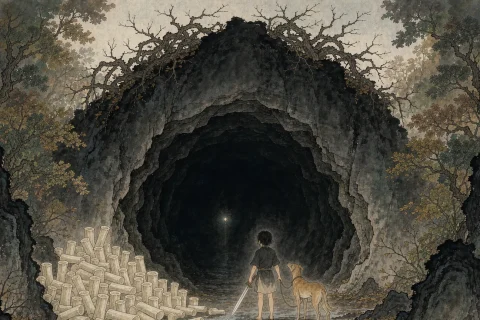
At the foot of the city wall of Song, the labour gangs went out before it was light.
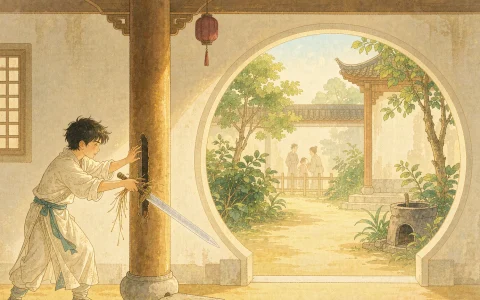
They were men under sentence, sent to build the wall, with tags around their necks, and they did the heaviest work there was. In that gang there was one man named Han Ping. He was not tall. He kept his head down and said nothing.
He had once been a minor official in the household of the King of Song.
The story is recorded by Gan Bao in In Search of the Supernatural, and it was told among ordinary people for a long time afterward. It belongs with the oldest Chinese supernatural tales, and it has the plainness of something that was once true and is now only a story. Later generations gave it a name. They called it the tree of mutual longing.
That phrase is still in use in Chinese today. A tree of mutual longing means two trees grown into each other, branches woven together, and it also means the ache between a husband and a wife. Most people who use it have no idea where it comes from. It comes from here.
The story is simple, and it is brutal. A man with power took a look at another man’s wife.
Han Ping’s wife was of the He family, and people called her Lady He.
She was beautiful, beautiful enough that even the ruler of Song had heard of her. King Kang of Song was the lord of a state in the Warring States period, a violent and headstrong man, and he did not let go of anything he wanted.
He sent men to bring Lady He into the palace.
Han Ping did not resist. He was an official, and what does an official have to fight a king with. He was bitter, and he kept the bitterness inside him, and he did not say it aloud.
But the King of Song would not tolerate even that. He drove Han Ping out of the palace and sentenced him to wall-building, the same work as the gangs at the foot of the wall.
A man whose wife has been taken from him, sent down to carry stones under the wall. That was the shape of Han Ping’s life then.
The wall rose a stretch at a time, and he bent a little lower with every stretch. The other convicts all knew who he was, the minor official whose wife the King had taken. Nobody said it to his face. Everybody watched his back. He spoke three sentences a day, and went last from the work site every evening.
Lady He did not have an easy time of it in the palace either. She thought about her husband, and she could not get a single letter out.
The King of Song was not short of beautiful women, but there was only one like her. The more he stared at her, the more she closed her face. She did not smile and she did not talk. The palace servants said among themselves that Lady He was cold. Only she knew that she was not cold. She was waiting, holding herself still until she could think of a way.
In the end she found a way.
Everything that came into and out of the palace was inspected in those days. A letter passed through several pairs of hands before it was delivered. That was what she was counting on. The more a letter looked like idle talk, the less trouble anyone would take over it. She hid the thing that mattered inside the lines that did not.
One day she got a message passed to Han Ping. It was very short and very strange.
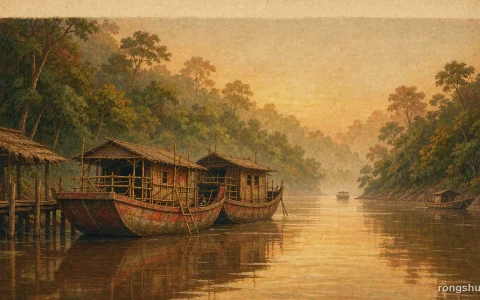
It rained and rained. The river is broad and deep. When the sun rises, take care.
Read plainly, it is about the weather. It had rained without stopping, the river was high and dangerous, and one should be careful when the sun came up.
The clerk who saw the letter took it for ordinary talk about the weather and thought nothing of it. It was delivered to Han Ping.
Han Ping understood it at once.
The rain that would not stop stood for the sorrow piled layer on layer in her, with no end to it. The broad deep river stood for the thing between them that could not be crossed.
The last line was her own death. When the sun rises, take care. She meant herself. She had begun to think about dying.
People in that age wrote letters the way they hid things. What could not be said plainly was folded into the gaps between the words. Han Ping read it at a glance because every line of it was their own life, the rain and the river and the sun, all of it things they had seen together when they were simply living. To anybody else it was weather. To the two of them it was goodbye.
Han Ping read the letter. He did not weep and he did not make a scene. Quietly, he killed himself.
Lady He heard that her husband was dead.
She did not break down in front of anyone. She did one thing. She put her clothes away in the dark, and left them there, and let them begin to rot.
The cloth still looked sound. In fact it had gone brittle. It would tear at a pull.
The King of Song did not know. One day he took Lady He up onto a high terrace to look at the view. The terrace was high and the wind was strong.
While no one was watching, Lady He stepped to the edge of the terrace and threw herself off.
The men beside her grabbed for her and caught hold of her clothes, and the cloth came apart in their hands like paper.
She struck the ground below and died at once.
Above her the terrace fell into confusion. Some shouted, some ran to tell the King. By the time the King of Song arrived she was gone. He stood at the edge of the terrace and looked down for a long time, and nobody could say what was going through his mind.
Afterward, among the things she had left at the terrace, they found a note she had written. She asked to be buried in the same grave as Han Ping. If they could not be together in life, she asked, let them at least lie side by side in death.
The King of Song read it and was furious. He refused. He had them buried apart on purpose, one grave to the east and one to the west, and said that if the two of them wanted to be together, then their graves could spend eternity looking at one another across the distance.
The strange part began after the burials.
Before long a tree came up out of each of the two graves.
The trees grew fast. In about ten days they were as thick as a man could span with his arms. The two graves were set far apart, with nothing between them.
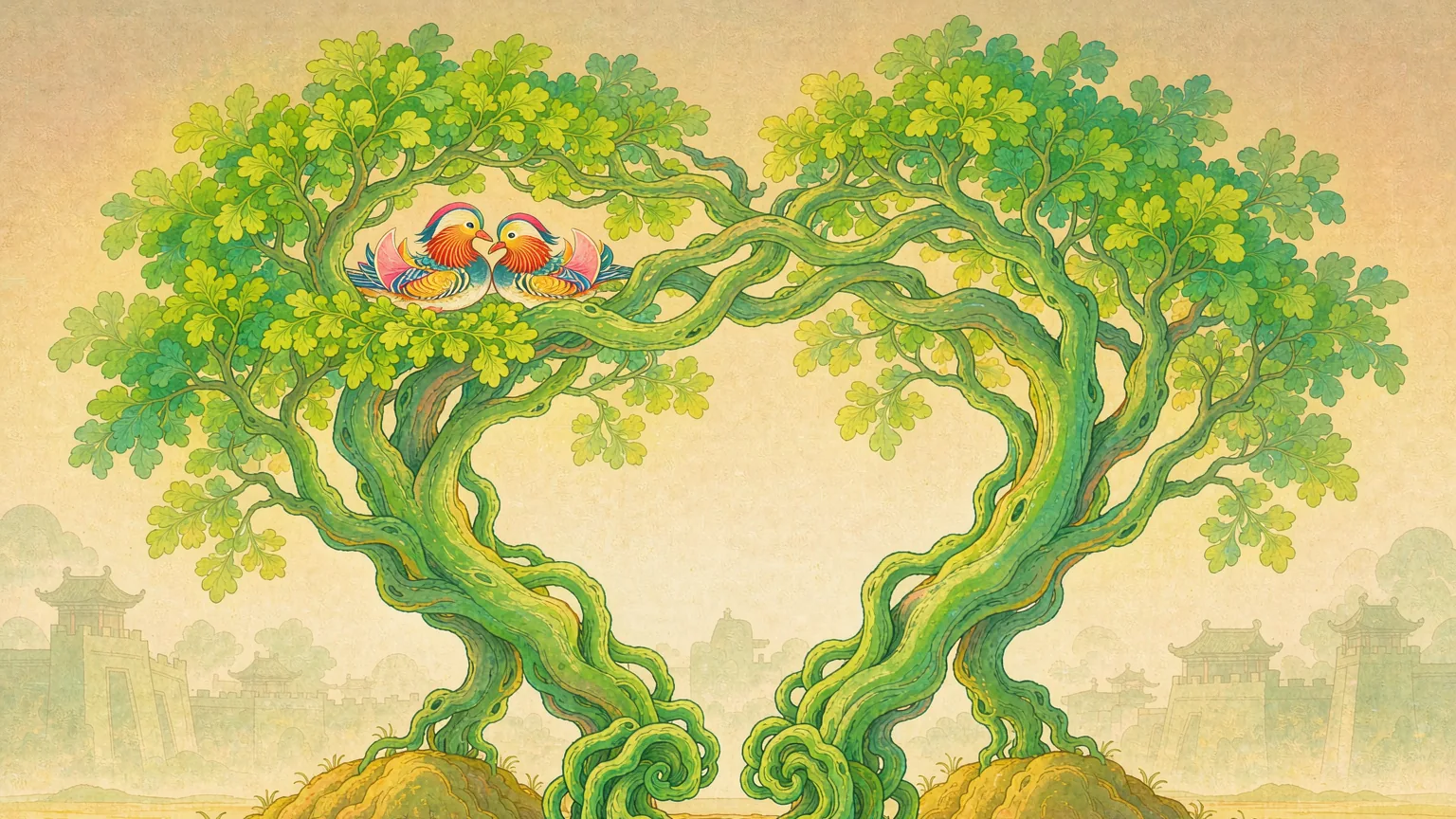
But the trunk and the branches of each tree began to bend, little by little, towards the other. And at last the branches of the eastern tree and the branches of the western tree met in the air and wound round one another, so that they could not be pulled apart. Below the ground, the roots had long since joined into one.
The two trees grew very large after that. People on the road in Song would stop and look. A woman with a child would point and say, look, that is Han Ping and his wife. The child would not understand, and she would tell it again, from the wall-building to the leap from the terrace.
A pair of birds came to nest in the trees. People said they were mandarin ducks, the birds that stand for a married pair. They cried day and night, a mourning sound that made anyone who heard it uneasy.
In the state of Song, people said this was Han Ping and his wife. They had been forced apart while they lived, and now the trees were doing for them what the King would not.
So they called the two trees the trees of mutual longing, and they called the birds the birds of Han Ping.
In his notes Gan Bao adds one line. He says the songs people made about it were still being sung in his own time.
That was several hundred years later.
If you go to the old country of Song in Henan today, around Shangqiu, you will not find the two trees. Trees die. Even a tree that thick dies.
King Kang of Song is remembered in the histories as one of the tyrants of the Warring States, a man who loved violence and women and quarrelling with people, and who did not die well either. Almost nobody knows any of that now. The tree is still spoken of. The king is only a name.
The word itself went on to live in poetry. One poet told a friend to gather red beans in the south, saying they were the thing most worth remembering. Another wrote of ten years in which the living and the dead had grown dim and drawn apart, and of dreaming of his wife in a quiet room at night. None of them needed Han Ping. All of them were doing what he did, which is to put a person out of reach into something you can still see.
What is left is a word.
Mutual longing. People use it for missing someone out of reach. Few of them remember that it began as two trees, forced apart to the two ends of a road by a king, which went around his sentence underground and in the air and twined themselves together anyway.
That kind of ending belongs with Chinese urban legends as much as with the old histories. It is what a folktale does when it cannot give the lovers anything in this world. It moves the promise underground, where no king can reach it.