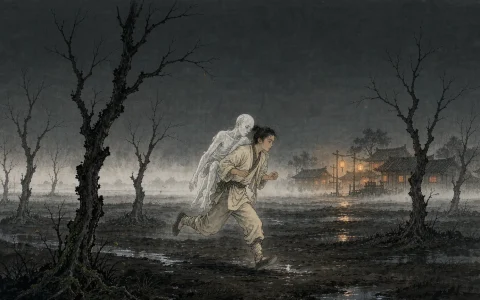
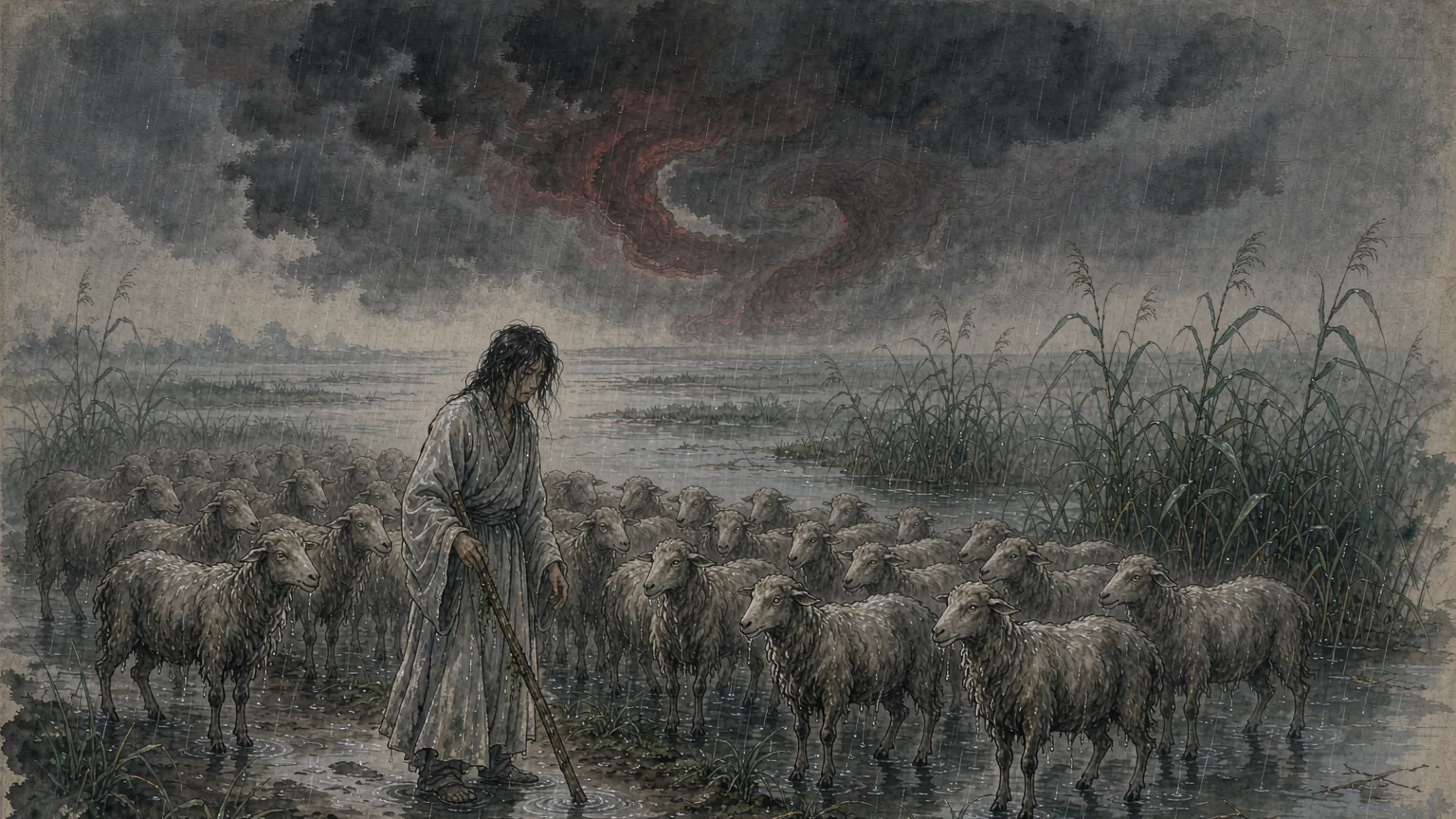
It was raining on the road outside Jingyang, and Liu Yi had mud up to his ankles, and then he came round a bend and saw a flock of sheep beside the road with a woman standing among them.
None of the sheep were grazing. They were standing still, heads turned the same way, watching the traffic.
The woman was holding a herding staff and looking at nothing. There was no colour in her clothes at all.
This story comes from the Tang dynasty, and it was written by a man named Li Chaowei. The Chinese gave these long Tang tales their own name. They called them chuanqi, which means something like tales of the marvellous.
They were written by men who had failed the examinations and had time on their hands, and they run to thousands of characters, with plots that bend back on themselves three or four times. Liu Yi is one of the most famous of them all, and a great many later Chinese ghost stories borrowed their machinery from it.
Now, before anything else, one thing has to be cleared up about Chinese supernatural tales.
A Chinese dragon is not a dragon in the Western sense.
The Western dragon is a monster with wings. You see it, and you fight it, and the story is over. A Chinese dragon is an official. It is made of water and it manages rain, and it has rivers and lakes under its authority. It has a title, a court, a family, brothers, in-laws, and a son-in-law it does not like.
It gets angry. It protects its own. It also, when it is in the wrong, lowers its head.
So the dragon palace in this story is not a cave full of treasure. It is a large household, with rules about who may speak and when.
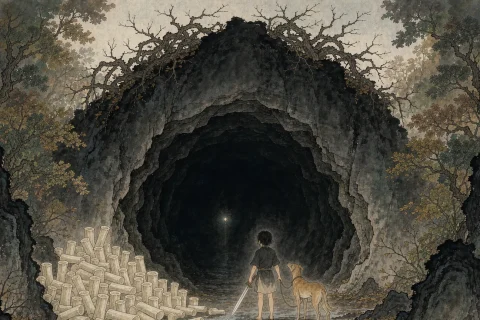
Liu Yi was on his way home from the capital, where he had sat the examinations and failed.
He saw the sheep first, and thought it strange. In this much rain, nobody puts sheep out on the road.
Then he came close and saw her face. She was beautiful, and there was no blood in her cheeks at all, and her brows had been drawn together so long that they had set that way.
He stopped and asked who she was, and why she was suffering out here.
She did not answer at first. Then she cried, and she told him.
She said that she was the youngest daughter of the Dragon Lord of Dongting, and that her parents had married her to a family at Jingchuan. She said that her husband had never once looked at her. He trusted the maids, and the maids talked, and that was that. When she complained to her parents-in-law, they took their son’s side and turned her out and set her to herding.
Liu Yi asked how long she had been here.
She said almost three years. She said that she had cried for the first year, and that she had stopped.
He looked at the sheep again, and she followed his eyes and said something he did not understand. She said that the sheep were not sheep.
Liu Yi asked what they were.
She said that they were rain workers.
He looked more carefully after that. The animals were wrong in a way he could not name. They stood as if they might leap. When they drank, the water moved oddly around their mouths.
She took out a letter and said that if he would carry it to Dongting, she would remember it for the rest of her life.
He asked why she had not given it to anyone else.
She said that she could not walk beyond this stretch of road, and that most of the people who passed were going the other way, to Jingchuan.
He asked how a man was supposed to deliver a letter to a lake.
She said that on the south shore of Dongting there was a great orange tree, and that the local people called it the village orange. He was to untie his belt and fasten the letter to the trunk, and then knock three times. Somebody would come up out of the water, and he was to follow.
Liu Yi took the letter.
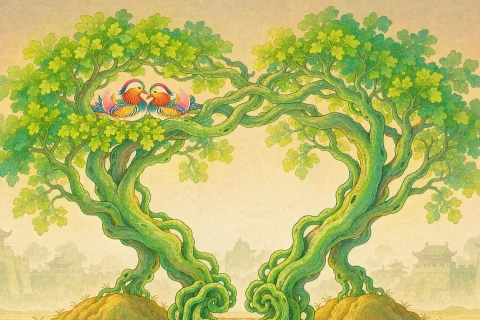
On the south shore of the lake there was indeed a great orange tree.
Liu Yi unfastened his belt and tied the letter to the trunk and knocked three times on the bark.
The water moved. An armoured man came up out of it and stood in front of him, and asked where he had come from.
Liu Yi explained. The man told him to close his eyes.
He closed them. He felt himself going down, and there was the sound of water, and then the sound of water stopped and the ground under his feet was dry.
He opened his eyes and there was a walled palace in front of him. The pillars were white. The gates had boards over them with characters on them, and the guards on either side stood straight.
When he looked up there was no sky. There was water overhead, green and lit from above, and light came down through it in layers. Outside the walls there were trees, and the trees moved the way trees move in a current, and made no sound at all.
The Dragon Lord of Dongting read the letter, covered his face with his sleeve, and wept.
He said that the fault was his own. He had married his daughter into that house and left her herding sheep hundreds of li away, and he had not known.
The whole palace wept with him. The sound went out through the doors and kept going.
One thing should be said about the Dragon Lord of Dongting. He was a slow man and a reasonable one. His younger brother, who ruled the Qiantang River, was neither.
Qiantang was not at home that day. When he came back and heard, his face changed.
The Dragon Lord told Liu Yi a little about him. He said that this brother had once thrown a great flood, back in the time of Yao, and that it had lasted nine years, and that Heaven had finally pinned him in place to stop him from doing it again.
Qiantang asked where his niece was herding.
He did not wait for an answer. He went out.
Liu Yi was sitting in the hall when the sky came apart. The sound was not thunder. It was much larger than thunder. Everyone ran outside.
There was a red dragon in the air. It lashed its tail once and the clouds tore open. It went toward Jingyang, and the rain went with it.
Qiantang came back around dusk.
He stood in the hall still wet, and said that he had killed them.
Someone asked how many.
He gave a number. Six hundred thousand. He said that eight hundred li of crops had been flattened, and that he had brought their daughter back.
He said that he had found the man sitting in his hall with a crowd of maids around him, and that when he asked the man a question, the man had been insolent.
The hall was quiet for a long time. Then the Dragon Lord said, slowly, that one bad house was another bad house’s business, and that they could settle their own accounts.
Then word came from outside that the princess had arrived.
The woman who had been herding sheep came in wearing different clothes. She walked up to Liu Yi and stopped, and said nothing at all.
The Dragon Lord held a banquet for him. Qiantang came too, and drank hard, and spoke plainly.
Halfway through the meal he said, out of nowhere, that his niece should be given to Liu Yi in marriage.
Every person in the hall looked at Liu Yi.
He stood up. He said that he had come this way by coincidence, and that he had carried the letter because he could not bring himself to walk past her. He said that he had wanted nothing out of it from the beginning.
Then he said that Qiantang had killed several hundred thousand people that day on a single surge of temper, and that if such power were now to be used to press him into a wedding, he would be even less willing.
The hall went silent.
Qiantang looked at him for a long time. Then he laughed, and said that Liu Yi was right.
The Dragon Lord had said nothing through all of it. When he walked Liu Yi out he said only that the family would remember.
Liu Yi went home. He married a woman of the Zhang family, and she died not long after. He married a woman of the Han family, and she died too. People began to say that he was not meant to have a wife.
Later he moved to Jinling, where someone arranged a match for him with a daughter of the Lu family. They were married and they were happy. In the second year she gave him a son.
On the day of the child’s first-month feast she closed the door and looked at him and asked whether he remembered her.
He did not understand.
She said that she was not a mortal woman. She said that she was the daughter of the Dragon Lord of Dongting, the same one who had herded sheep by the road at Jingyang.
She said that she had never forgotten what he did. She said that the two wives who died had been her doing as well, and that she had arranged to be born as a daughter of the Lu family so that she could marry him. She said that she was telling him now because he had been good to her, and there was no longer any need to hide it.
Liu Yi sat there for a long while. Then he asked whether the woman with the sheep had been her.
She said yes.
After that the two of them went back to Dongting once, to visit.
What came later is told less clearly. Some said that he simply lived a very long time and never looked any older. Forty years on, a cousin of his named Xue Gu was serving as an official on Lake Dongting when he saw Liu Yi sitting in a boat.
Xue Gu started toward him.
Liu Yi stopped him and took fifty pills out of his sleeve and said that they were for him, and that if he took them he would live a long time too.
Then the boat left.
The Tang tale runs for several thousand characters and stops there.
The woman who had herded sheep in the rain, the one her husband had thrown out of the house, ended up married to a failed examination candidate who had walked several hundred li for her.
But one thing the story never says anything about.
The letter was tied to the orange tree with the belt from around Liu Yi’s waist.
Nobody ever asked what happened to the belt. Nobody ever asked what the letter said either.
Only the Dragon Lord of Dongting ever read that page.