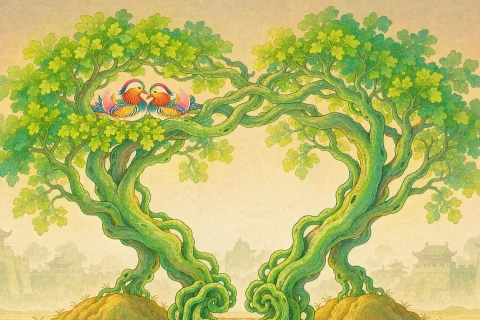
In the state of Chu, in the foundry where the swords were made, the fire did not go out for three years.
Ganjiang stood at the furnace with sweat running off him and ash on his face. He knew the swords would be finished in the end. He also knew that on the day they were finished he would most likely not live to see the next one.
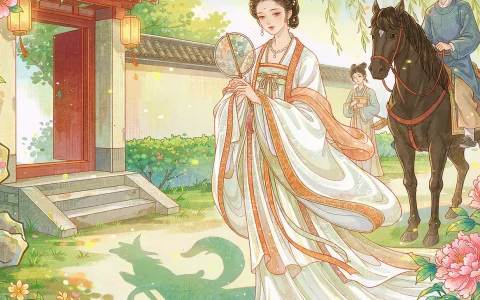
Ganjiang and Moye were husband and wife, and the two most famous sword-makers of the ancient world. The pair of swords they made took their names. The male sword was called Ganjiang. The female was called Moye.
The story is recorded by Gan Bao in a book called In Search of the Supernatural. Gan Bao lived in the Jin dynasty, and he spent his life collecting strange things and curious things and things he had only been told, and writing them into a book. His method was honest. He set down who had said it, and where he had heard it, and whether it had later come true. That is why the book reads, all these centuries later, like a set of field notes from the distant past.
His notes on the swords are just as plain. Ganjiang was making a sword for the King of Chu, and it took three years to make. In the eyes of a king, three years is a crime. Tales like this one sit in the border country between history and the kind of old story that people now file under Chinese urban legends.
On the night the swords were finished, Ganjiang called his wife to the furnace.
He said: I have made a sword for the King of Chu, and it has taken me three years, and he will kill me for it. When I go to him I will not come back.
He paused, and said: it is not that I mind losing my life. It is that I mind losing the sword. It is the best thing I have ever made, and I will not leave it to the man who kills me.
He said: you are carrying a child. If it is a boy, then when he is grown, tell him one thing. Tell him to look south from the door of the house, and find the pine that grows out of a stone, and look behind it. The sword is there.
The next day Ganjiang took the female sword and went to see the King of Chu.
He did not take the male sword.
The King looked at the sword and flew into a rage. Three years to make a sword, and only one brought. He had the weapon examined, and then he heard that there was a second sword, a male one, that had not been handed over, and his rage doubled.
He turned the sword over and over and the longer he looked the angrier he became. He said that if a sword took three years to make, the King might as well throw his treasury to the wind. He asked where the male sword was. Ganjiang gave no answer. It was the silence that killed him.
The King of Chu had Ganjiang killed.
The male sword stayed in the house, hidden behind a pine that grew out of a stone on the southern side.
Moye gave birth to a boy.
The boy is not named in Gan Bao. Other books call him Chi, or call him Meijian Chi, which means the one with the eyebrow gap, because the space between his eyebrows was a foot wide. That is a later invention, but it is the name he carries now.
The boy grew. He had never seen his father. When he was old enough to ask, he asked his mother where his father was.
Other children in the village knew there was no man in his house, and sometimes they shouted after him in the lane. He did not shout back and he did not cry. He simply walked a little faster. He could not have told them who his father was. He did not know himself.
Moye told him the whole of it, and told him the sentence as well. The pine on the stone, to the south, with the sword behind it.
She spoke slowly. Halfway through she stopped and looked at her son, as though there were something more she wanted to say, and in the end she said nothing. She gave him the one sentence she had, and left the rest for him to work out.
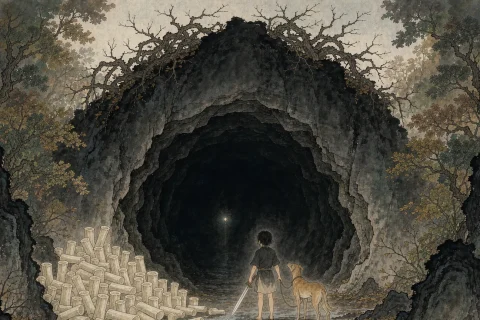
The boy went out. He stood at the door of the house and looked south, and there was no southern mountain to be seen. He thought for a while, and then he understood. His father had not meant a mountain at all.
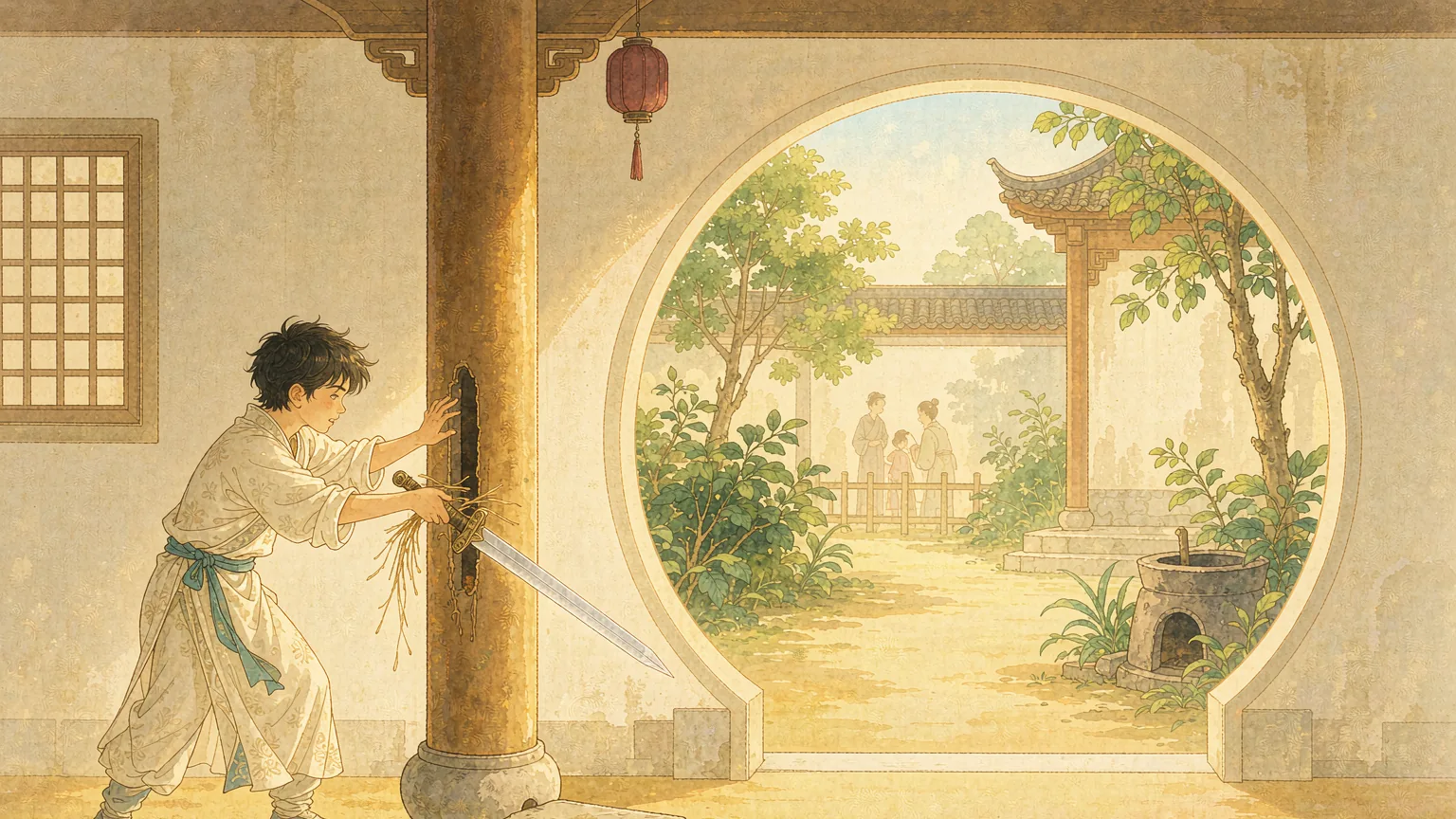
He went back inside and walked to the pillar at the front of the hall. The pillar was pine wood, and it stood on a block of stone.
He moved the stone aside and lifted the base of the pillar. Lying inside it was a sword. The male sword, and the edge of it caught the light.
His father had left it for him.
The King of Chu had a dream.
In the dream there was a boy whose eyebrows were set a foot apart, and the boy was carrying a sword and saying that he would kill him. The King woke up in a cold sweat, and he put a price on the boy’s head.
He did not know the boy by name. He had the notice posted at every crossroads in Chu. What he wanted was not really the head. He wanted the dream to be over.
The boy was hunted, and fled into the mountains. He had run out of roads. He crouched by a stream and wept. He wanted revenge, but he was a boy in his teens and the King of Chu had the soldiers of a whole state.
Then a stranger came up the mountain path.
The man asked him why he was crying.
The boy said: I am the son of Ganjiang and Moye. The King of Chu killed my father, and I want to take revenge, and I cannot do it.
The man looked at him for a moment, and said: they say the King has offered a reward for your head. Give me your head and your sword, and I will take the revenge for you.
The boy raised his head and looked at him.
The record does not say how long he thought about it. It says only this. He took down the sword, and with one cut he opened his own throat. The head came off and fell into his hands. He held it up in both hands with the sword, and gave them to the stranger.
Then the body fell at the edge of the stream.
The stranger carried the head and the sword to the King of Chu.
The King was delighted. He gave the man a reward and asked what else he wanted.
The man said: this is the head of a warrior. A warrior’s head should not be buried carelessly. It should be put in a great cauldron and boiled, and boiled until it is soft, and then it will be clean.
The King thought this sounded right. A huge cauldron was set up, the boy’s head was thrown in, and a fire was lit beneath it.
For three days and three nights the head did not soften.
It floated on the surface of the water with its eyes open, glaring out of the cauldron, and no one could press it down.
They fed the fire bundle after bundle. The water boiled for a day, and then another, and the head stayed exactly as it was, and did not even blink. The men at the rim of the cauldron did not dare to speak. At first the King kept urging them on. After a while he stopped urging. He simply stared at the water, and it was impossible to say what was on his face.
The stranger stood at the rim and turned to the King and said: Great King, it will not soften. Perhaps you must look at it yourself.
So the King rose and came to the edge of the cauldron and bent over it to look in.
In that instant the stranger drew the sword and struck the King’s head from his shoulders. It fell into the cauldron.
Then, with a backhand cut, he took off his own head. It fell in as well.
Three heads tumbled together in the boiling water and were boiled soft, until there was no telling which was which.
Afterward the ministers of Chu came to collect the bodies. They lifted a mass of bone out of the cauldron, and the three skulls were boiled past all recognition. There was no way to say which had been the King, and which the boy, and which the stranger.
There was nothing for it but to bury all three sets of bones together in one grave. Later people called it the Tomb of the Three Kings.
The record does not say what became of Moye. Her husband was dead and her son was dead, and she was left alone with an empty foundry. Some tellings say she went on making swords. Others say she never lit that furnace again, and that in time it cooled, and in time it fell in.
That is where the record ends. It does not say whether the boy’s hands were steady when he held up his own head. It does not say what was on the stranger’s face when he laid the head in front of the King.
Gan Bao writes down one thing and lets it stand. In the end the three heads boiled in the same pot, and nobody could tell one from another.
The King of Chu used the army of a whole state to hunt one boy’s head, and hunted it for a year. In the end his own head was boiled soft in the same cauldron, beside it.
For anyone who grew up on Chinese supernatural tales, the cauldron is the part that stays. It is not the sword and it is not the magic. It is the plain fact that a king and a boy and a stranger came out of the fire the same size.