A hall full of ministers watched a live deer walk across the floor and agreed that it was a horse. Every man there knew a deer when he saw one. The animal had antlers on its head. That was not the question being asked.
The Chinese idiom is 指鹿为马, in pinyin *zhi lu wei ma*. Word for word: point at the deer, call it a horse. It means to push a lie through by sheer power, and to use the lie as a test of who will kneel.
This Chinese fable comes from the Records of the Grand Historian, the huge history that Sima Qian finished around 100 BC. The scene is the last years of the Qin dynasty. The man holding the rope is a eunuch official named Zhao Gao. He had served the First Emperor of China. After that emperor died, he served the emperor’s son, and taught the boy what to believe.
In 210 BC, the First Emperor went out on his final tour.
The caravan rolled east and then south, and stopped at a place called Shaqiu. There the emperor fell ill. He wrote an order naming his eldest son, Fusu, to come back to the capital and take charge of the funeral. The order was sealed. Before it could be sent, the emperor died.
Almost nobody knew.
Li Si, the chancellor, kept the news quiet. His reason was sound enough. The emperor had died far from home. No heir had been formally named. The emperor’s other sons were each watching the throne. If word got out, the empire would break apart. So the caravan travelled on. The curtains stayed closed. Meals were carried to the carriage as usual.
It was high summer. The smell began to turn. The attendants loaded a cart with salted fish, using that sharp stink to cover another one. Nobody on the road dared ask a question.
Only a few men knew the truth. Zhao Gao was one of them.
Zhao Gao was a eunuch and an official of the palace, in charge of the emperor’s carriages. He also controlled the imperial seal. That seal made any document real the moment it touched the paper.
He held two things in his hands. One was an order that had never been sent. The other was the seal that could make it official.
So he began to think.
Fusu was a problem for Zhao Gao. The eldest son was blunt and upright, and he had argued with his father over several cases. He had a good name among the ministers. If Fusu took the throne, Zhao Gao would be out. The youngest son, Huhai, was a different matter. Huhai had studied law with Zhao Gao. He was restless and easy to steer.
Zhao Gao went to Huhai first.
He put it plainly. The emperor is dead. No lands have been granted to the princes. The moment Fusu returns, he becomes emperor, and you get nothing at all. Huhai refused twice. The third time, he agreed.
One more man was needed. Zhao Gao went to Li Si.
Li Si said no at first. So Zhao Gao went after his office. He asked Li Si a simple question. On merit, on cunning, on friendship with Fusu, how do you compare with Meng Tian, the general at Fusu’s side? If Fusu becomes emperor, the chancellor’s seal will go to Meng Tian. Not to you.
Li Si was silent for a long time. Then he nodded.
Three men together rewrote the order.
Two documents went out instead of one. The first named Huhai as heir. The second scolded Fusu for years of useless frontier duty and for complaining against his father. It ordered him to take his own life, and it ordered Meng Tian to die with him.
At the frontier, Fusu read the order and wept.
Meng Tian urged him to wait. The emperor is travelling, he said. No heir has been named. This order could be a forgery. Send a man back to ask. Then die, if you still must.
Fusu answered in one line. A father who tells his son to die needs no second question.
He drew his sword and cut his own throat.
The messenger rode back to the capital. Huhai took the throne, and became known as the Second Emperor.
By then, Zhao Gao had won most of what he wanted.
Next he removed the Meng brothers. Then he came for Li Si. The chancellor was dragged down by the very kind of charge he had helped to fake. Zhao Gao accused him of treason and put him in prison, and had him beaten, again and again. Li Si wrote letters of protest from his cell. Zhao Gao intercepted every one and threw it away.
In 208 BC, Li Si was led out to be cut in half at the waist in the marketplace.
On the way, he turned to his son, who was dying with him, and said one thing. I wanted to take the yellow dog and ride out the east gate of Shangcai with you, and chase rabbits. Can we still do that? Father and son wept together. Three generations of their family were wiped out.
With Li Si gone, Zhao Gao became chancellor of the realm. Every matter of state, small or large, passed through his hands.
The Second Emperor had already given up on governing. Zhao Gao told him this was only proper. A ruler is honored because his ministers hear his voice and never see his face. The emperor was young. If he sat in court and spoke, a single clumsy sentence could lower him in their eyes. Better to stay deep inside the palace and let his chancellor relay the business.
The emperor liked the sound of that. He stopped holding court.
Inside the hall, only one voice remained.
Zhao Gao still did not feel safe.
He had climbed over too many bodies. He knew how many men in that hall hated him. So he decided to test one thing. Among all the officials, how many still dared to stand against him?
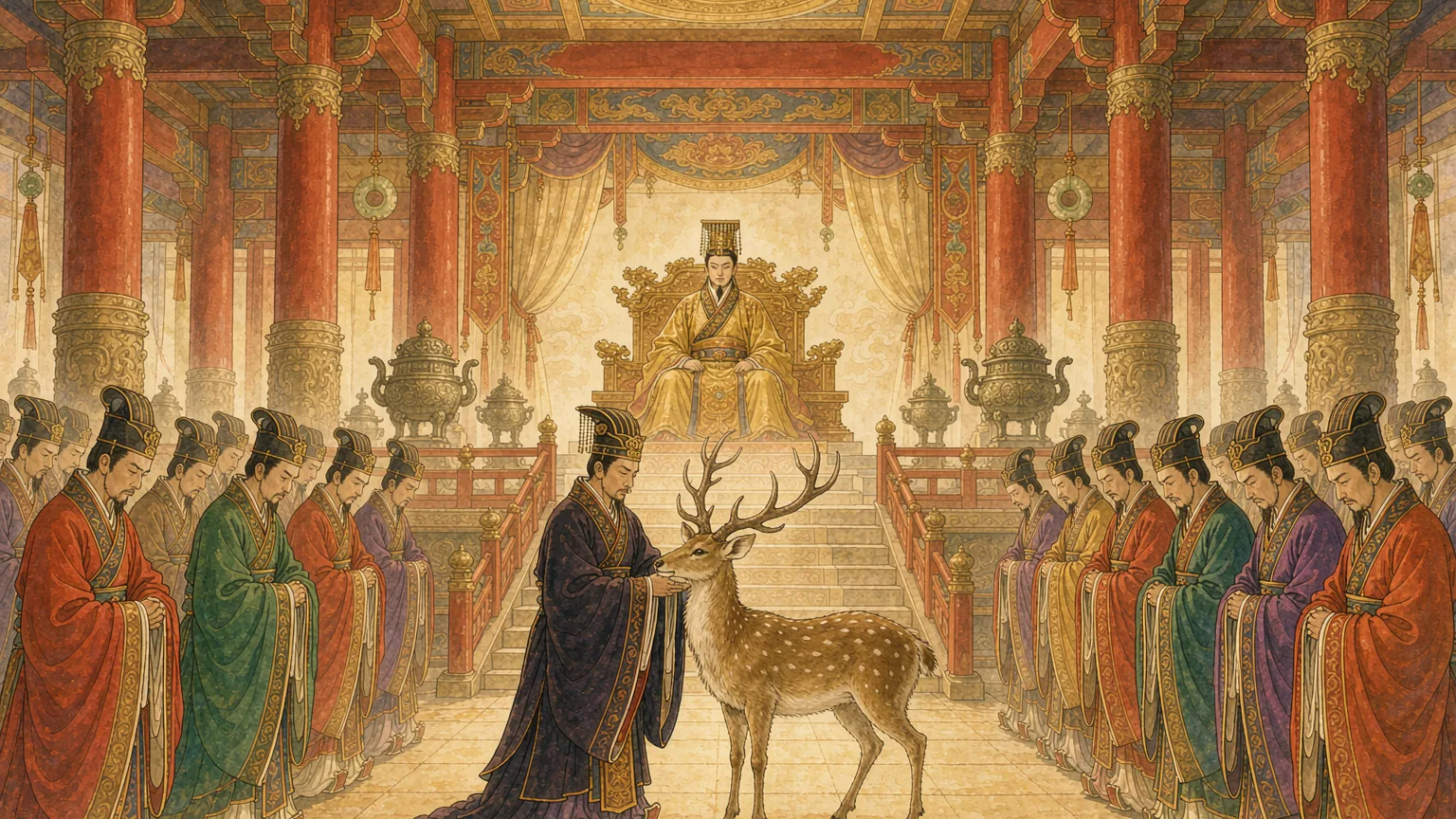
In the eighth month of 207 BC, he walked into the hall leading a deer.
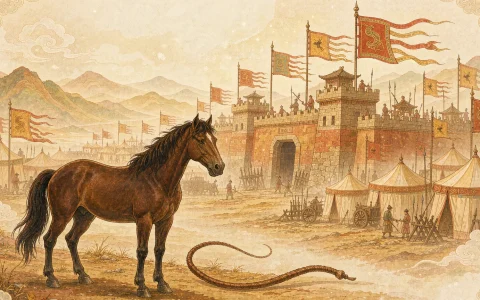
It was alive. Its hooves clicked on the stone. Every man present could see the antlers.
Zhao Gao brought the animal before the emperor and said: this is a horse.
The Second Emperor paused, and then laughed. Chancellor, you are mistaken. This is clearly a deer. How can you call it a horse?
Zhao Gao did not blink. He said it again. It is a horse.
The emperor felt uneasy. He turned to the officials and asked them. Tell me. Is this a deer, or a horse?
The hall went silent.
Some men looked down at their own boots and said nothing at all.
Some stepped forward and said: it is a horse. The chancellor is right.
And some set their jaws and said: this is a deer. It has antlers. Anyone can see it.
The emperor stared at his officials and grew more confused. Later he had a diviner read his fortune, convinced that something had unsettled his mind and made him see a deer where a horse stood.
What mattered was not the emperor. What mattered were the men who had said deer.
Before long, Zhao Gao went through them one by one, using the law as his tool. Some were jailed. Some lost their posts. Some lost their lives. Charges were always found. The old history records it in six characters only: he secretly struck down everyone who said deer.
From that day, no one in the court said no to Zhao Gao.
One deer told him the shape of every spine in the room. The men who said horse stood. The men who said nothing stood. The men who said deer, one after another, were gone.
The four characters did not save Zhao Gao in the end.
The next year, the rebel armies pressed closer. Zhao Gao feared the emperor would blame him, so he struck first. He sent his son-in-law, Yan Le, with soldiers into the Wangyi Palace to force the emperor to die. The emperor begged to be made a king of one commandery. Refused. He begged to be made a noble of ten thousand households. Refused. He begged to be allowed to live as a common man. Refused as well. The blade was already at his throat. He killed himself.
Zhao Gao took the imperial seal and hung it on his own belt. He meant to sit on the throne himself. He walked into the hall. Not one official answered him. The room stayed cold and empty. He stood there a while, then took the seal off.
He stepped back and put Fusu’s son, Ziying, on the throne, dropping the title of emperor.
Ziying set a trap before he took office. He pleaded illness and refused to go to the ancestral temple. Zhao Gao came in person to fetch him. In the fasting hall, Ziying stabbed him to death, and then wiped out his clan.
Zhao Gao died by the method he had spent his life perfecting. Bring a man inside the circle. Then close it.
The court of the deer and the horse did not last much longer either. Ziying held the throne for forty-six days. The army of Liu Bang arrived at the plain called Boshang, and the Qin dynasty handed over its seal.
People keep the four characters 指鹿为马 as a Chinese proverb for a man who insists that wrong is right, and makes a crowd agree with him.
The scene sounds absurd. It is also very common. The sharpest trick of power is never simply to decide things alone. It is to make everyone else afraid to speak. What Zhao Gao wanted was not to know whether the animal was a deer or a horse. He wanted to know who would still walk to the front of the hall for one true sentence.
The deer was always a deer. What changed was the price of saying so. The animal Zhao Gao led into the hall is long dead. What filled that hall with silence was every man who swallowed the word deer.