At the foot of a hill stood a small temple.
It had a tiled roof and a small brass bell.
The temple was very old.
The bell rang once when the wind was strong.
Inside it there was a white wall.
The wall was tall and smooth.
People came up the hill to look at it.
In the daytime the wall was white.
At night the wall was gray.
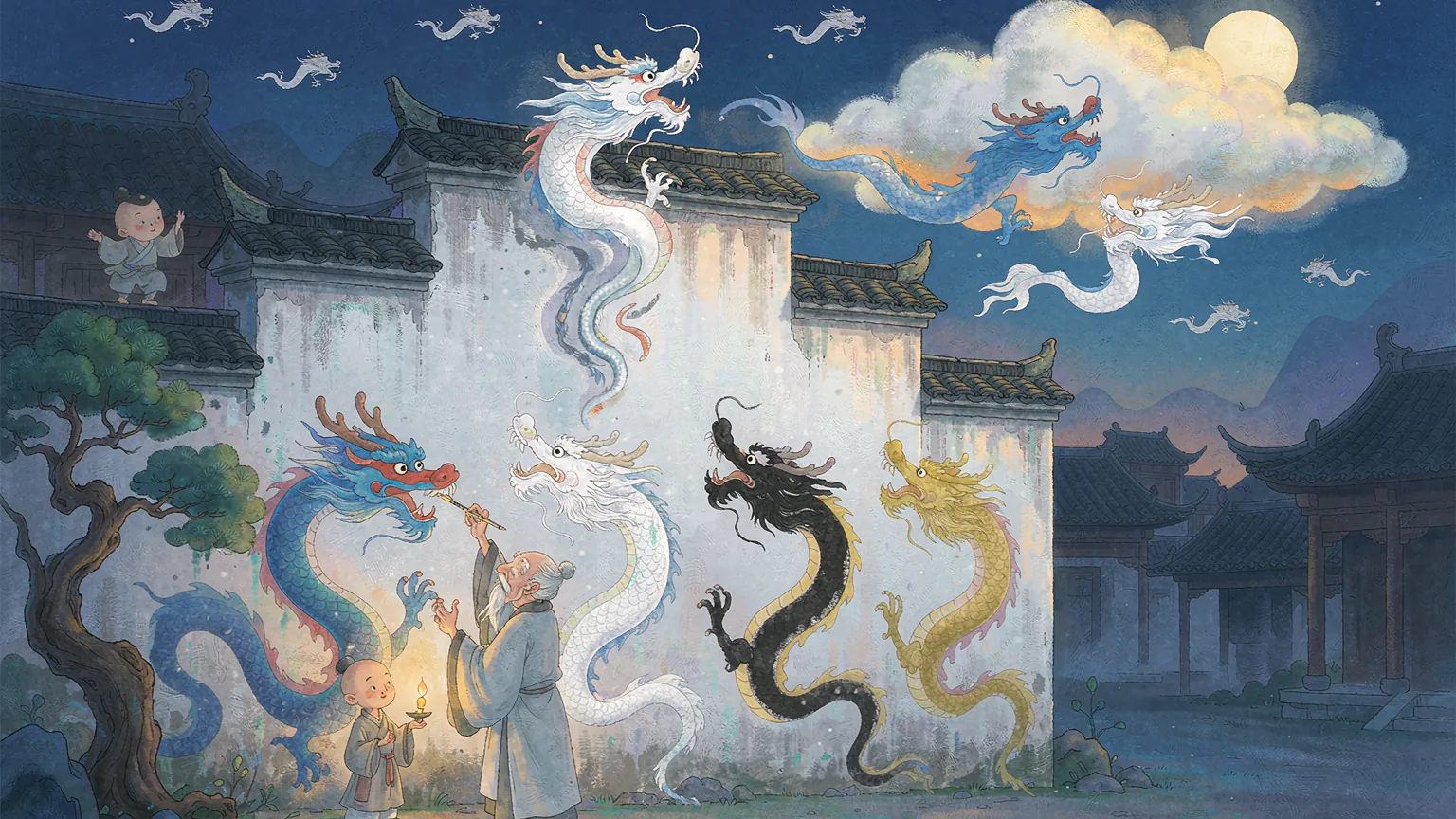
On the wall, four dragons were painted.
The painter was an old man.
His hair was white. His hand was steady.
He painted for a long time.
He painted a little, and then he stopped.
Then he began again.
He painted the horns. He painted the claws.
He painted the scales.
He mixed his ink in a flat stone.
One dragon was blue. One was white.
One was black. One was gold.
One by one, he finished them.
He worked on them for four days.
The dragons held their heads up. Their mouths were open.
There were four dragons, so there were four tails.
Their tails went up and down the wall like water.
They looked as if they were waiting for something.
But none of the four dragons had eyes.
A little monk called Mo came to look every day.
He ground the ink for the old painter.
He kept the brush clean, and it came to a fine point.
The ink was black, and it had a little smell.
“Teacher, why do you not paint their eyes?”
The old painter said, “If they have eyes, they will fly away.”
Mo looked at the blank eyes and thought about it.
He did not believe him.
The people of the village did not believe him either.
They came back the next afternoon, and the next.
“Paint them,” they said. “Paint them.”
They crowded in front of the wall and waited.
They asked the same question, and he gave the same answer.
They waited until the moon came up over the roof, and then they went home to sleep.
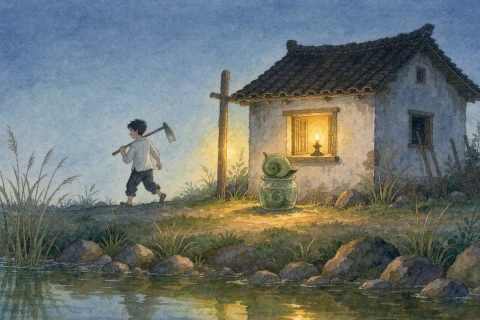
That night there were two lamps in the temple.
The lamps were small, and the flame hardly moved.
Mo held one of the lamps up for him.
The old painter picked up his brush.
He dipped it in the ink.
The ink had a little shine in the dark.
He painted the eyes of the first dragon.
Then he painted the eyes of the second.
Mo stood beside him and held his breath.
Crash –
The window shook.
The lamp flickered.
The whole wall shook.
The two dragons on the wall moved.
The other two stayed where they were.
They moved their tails.
Their eyes were black, and small, and round.
They slid down off the wall.
They flew once around the yard.
The wind lifted the edge of Mo’s coat.
Then they flew straight up.
Past the temple roof.
Past the tops of the trees.
Past the windows of the village houses.
Past the moon over the roof.
Out into the night.
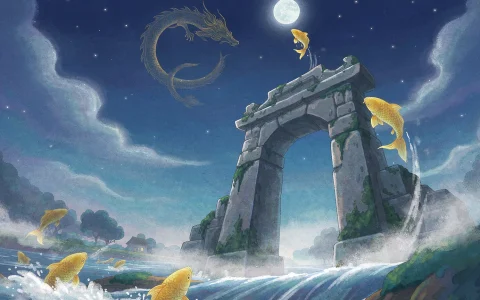
The clouds in the sky opened in a thin line.
The night air came in through the window.
Mo ran out into the yard.
The yard was empty.
He looked up.
The two dragons were in the clouds.
They curled up.
Round and round.
Their scales were bright in the moonlight.
They went to sleep.
The clouds went on moving, slowly.
Mo was sleepy too.
He could hardly keep his eyes open.
His eyes were heavy.
He yawned.
The old painter carried him back inside.
“We will paint the other two tomorrow.”
Mo nodded. He was almost asleep.
On the wall, the two dragons with no eyes were still there, waiting quietly.
Their eyes were still blank, and their mouths were still open.
The lamps in the temple went out, one by one.
Nobody in the village woke up.
The dragons on the wall is an old Chinese folktale, and it is still a favorite Chinese fairy tale at bedtime.
In China, this story has been told for one thousand five hundred years.
People have four words for it. They say: dot the eyes.
Above the roof, the sky was full of slow clouds.
The night was quiet.
The clouds moved slowly.
Two dragons were still on the wall.
Like the others, they waited for the morning.
In the morning the temple would be the same as ever.
The bell would ring, and the people would come up the hill.
There.
So put your head down.
Good night, Mo.
Good night, dragons in the clouds.
This is a very old Chinese bedtime story. It is not long, and it is very gentle. Best read slowly, with the lights low.