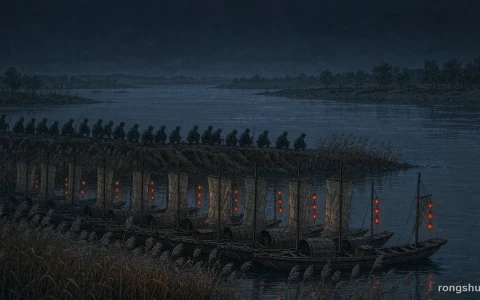
On the evening of 9 December 1948, a small village on the flat farmland of northern Anhui went absolutely quiet.
The village was called Dawangzhuang. Forty households, a few dozen mud houses, and not a living soul in sight.
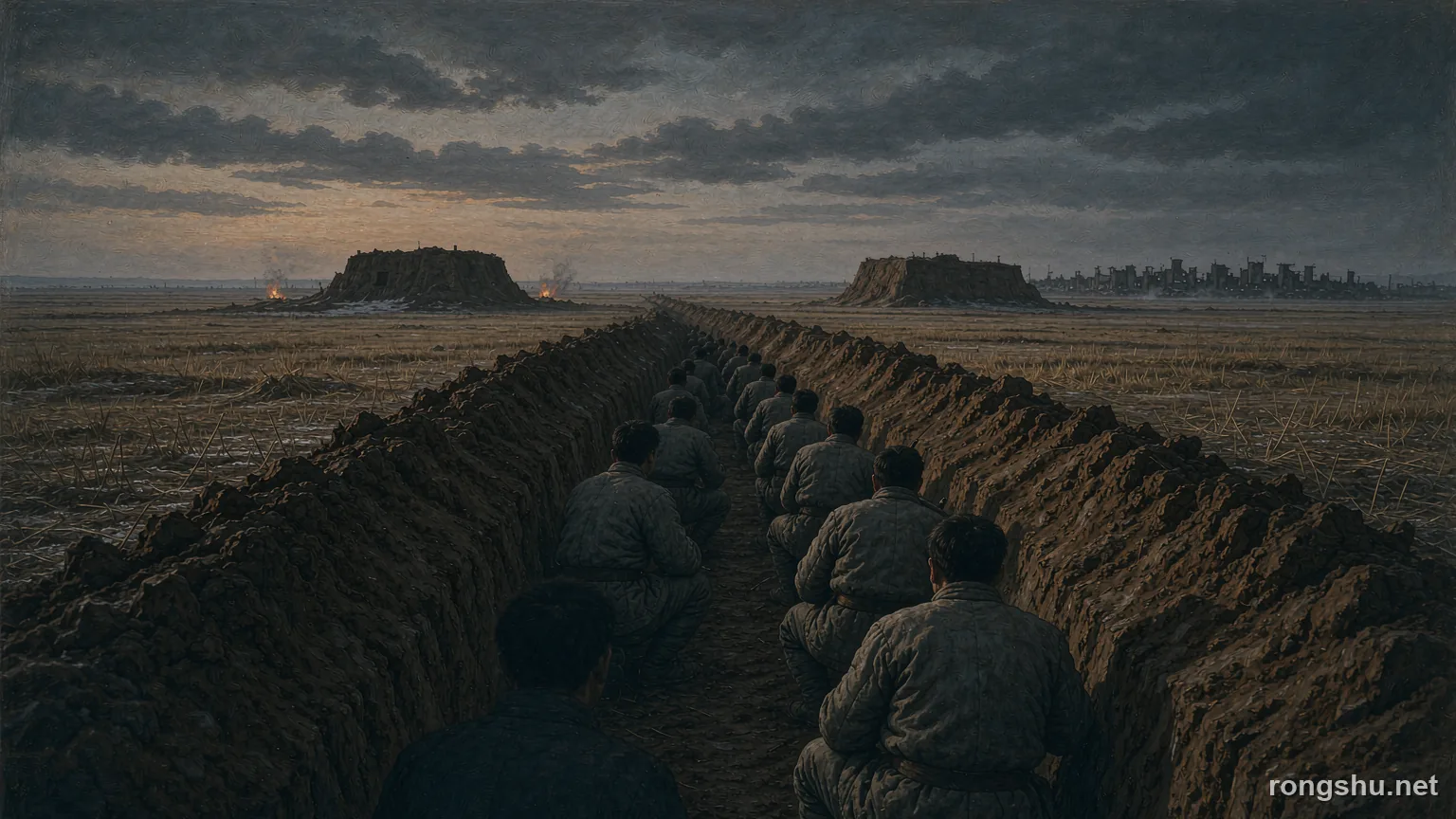
Outside it, trenches dug over the previous fortnight ran all the way up to the foot of the village walls. Several thousand men crouched in them, waiting for dark.
Three days earlier, the Central Plains Field Army had issued its order for the general assault.
One line of it was remembered for years afterwards. Whatever the cost, take the objective.
The enemy in front of them was the Twelfth Army Group, commanded by Huang Wei. Four corps plus an independent fast column. A hundred and ten thousand men, American equipment from boots to bombsight.
The Central Plains Field Army had seven columns and almost no artillery. A year earlier it had left its heavy guns behind in the Dabie Mountains.
Nobody at the top was certain how this fight could be won.
The story began a month before.
On 6 November 1948 the Huaihai campaign opened. Su Yu and the East China Field Army moved first, surrounding Huang Baitao and his Seventh Army Group at Nianzhuang.
Xuzhou was the gateway to Nanjing, and Chiang Kai-shek sent Huang Wei east to break the ring.
Huang Wei’s men had been waiting around Queshan and Zhumadian. They moved at once, tanks in front and trucks towing guns behind, covering thirty kilometres a day.
Chasing them was the Central Plains Field Army, under Liu Bocheng, Chen Yi and Deng Xiaoping.
No trucks. Two legs each.
The ground was the old Yellow River flood zone: marsh, mud and dead channels. Trucks sank and had to be pushed. Tanks could not cross soft ground.
Infantry on foot were faster than anything on wheels.
That was how they caught up. Sixty kilometres in a day, straight into Huang Wei’s path.
On 18 November, at Huangjia Village on the Guo River, the two forces met.
The 4th Regiment of the 1st Column went in first. Its commander, Jin Shilin, was killed at the front, and the political commissar who took over, Zheng Lu, was mortally wounded.
Two senior officers, within a single day.
That night Liu Bocheng, Chen Yi and Deng Xiaoping telegraphed the Central Military Commission. Pull the East China Field Army in, and we take him together.
The answer came back brisk. Yes.
Huang Wei kept moving north.
On 23 November he left Mengcheng and drove toward Suxian. Chen Geng and his Fourth Column were waiting for him head-on.
By that night, the Fourth Column had pulled back.
Huang Wei read it as a retreat. He ordered his men forward, across the Hui River.
What he did not know was that the empty ground on the north bank had been left empty on purpose.
The next morning, the 18th Corps crossed the river with nothing in front of it.
By the time the quiet on both flanks began to feel wrong, it was too late to turn around.
Water ahead. Water behind. Seven columns sitting in the fields on either side.
At dusk on 24 November, the Central Plains Field Army attacked all along the line.
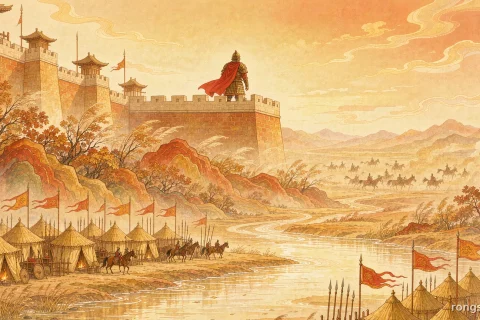
By morning, a hundred and ten thousand men had been folded into a pocket ten kilometres across and five deep.
At the centre stood two earthen mounds, one north and one south, rising abruptly out of the flat plain.
The locals called the place Shuangduiji. Double Mound.
Liu Bocheng called it a bag. And the mouth of the bag was tied.
Soldiers in Europe had a word for this. They called it a Kessel: an army sealed inside a ring that closes a little every day. A hundred thousand men caught in a cauldron is, in the history of war, a disaster that takes weeks. At Shuangduiji it was done in twenty-three days, by an army with almost no guns. It was one of the set battles of Chinese history, and the moment the Huaihai campaign turned.
Huang Wei was not the kind of man to sit inside a bag and wait.
On the afternoon of 26 November he called in his division commanders. Air reconnaissance reported that the ring had closed and the enemy was digging in.
Huang Wei told them that if he struck before the enemy was settled, four of his best divisions could break out abreast.
Someone at the table spoke up and asked for the lead.
The man was Liao Yunzhou, commander of the 110th Division, 85th Corps.
Huang Wei had trusted him for years.
Liao was a Whampoa graduate and a Party member since 1927. He had marched in the Nanchang Uprising, then spent twenty years inside the Nationalist army, rising to division commander.
Huang Wei knew none of this.
Liao told him that four divisions moving shoulder to shoulder would leave nothing in reserve. Better, he said, for his division to go first. If it worked, the rest could follow.
Huang Wei thought this was sound, and ordered the air force to support the 110th.
Then Liao turned around and sent the breakout plan across the lines, along with his own intention. At first light tomorrow, the division would come over.
He asked for one thing. Leave a gap in the ring, let the division through, then close it again.
At six in the morning on 27 November, more than five thousand men of the 110th Division marched out of Shuangduiji heading south.
Each man wore a strip of white cloth tied around his arm. That was the signal.
Huang Wei came up on the radio to ask how it was going. Liao told him the breakout was going well.
A little after nine, four aircraft arrived and circled above the column.
Liao had the men lay out the agreed signal panels, telling the pilots that everything was normal.
Five thousand men, not one missing, walked through the gap.
The moment the last man was through, the gap was shut.
The three divisions following behind walked straight into the fire.
Huang Wei waited in his headquarters for news.
When it came, he could not speak for a long time.
Inside the ring there were still a hundred thousand men.
American equipment, plenty of ammunition, aircraft overhead.
The Central Plains Field Army was too poor to break that with infantry alone. It hoarded what few shells it had.
So it found another way.
The engineers came up with a crude device. Bury an oil drum in the earth. Pack the bottom with propellant, pack the drum with thirty or forty kilograms of explosive.
Light it, and the charge flies out and lands on a bunker several dozen metres away.
The soldiers called it the flying thunder.
Han Liansheng, chief of staff of the East China Field Army artillery, stood over the test ground himself while it was modified. One test went wrong. He did not come back.
The second method was digging.
By day and by night. Sideways and forward. The earth was piled on both sides, and a man could walk upright in the trench without being hit.
They dug until the trench head was only a few dozen metres from the enemy bunkers.
When the shelling stopped, the infantry came up out of the ground and were on top of the position in a few strides.
Close enough to throw a grenade. Close enough to use a bayonet.
No aircraft or heavy gun can safely fire into its own front line.
And so the ring closed, a little each day.
By early December, Huang Wei held a strip five kilometres across.
Ammunition held out. Food did not.
Half of what was dropped from the air drifted outside the ring, and whatever landed was fought over.
Men began climbing out of the trenches to surrender. Asked why, they said they wanted a steamed bun.
Huang Wei’s headquarters stood at Xiaomazhuang, north of Shuangduiji.
One kilometre to the south lay Dawangzhuang.
To reach the headquarters, you had to take the village. It was the southern gate.
The gate was held by the 33rd Regiment, 118th Division, 18th Corps.
The 18th Corps was one of the five elite formations of the Nationalist army, and the 33rd was its best regiment. It had been forged in the war against Japan; at Shipai in 1943 it had fought the Japanese 13th Division at bayonet range.
Everyone called it the Tiger Regiment.
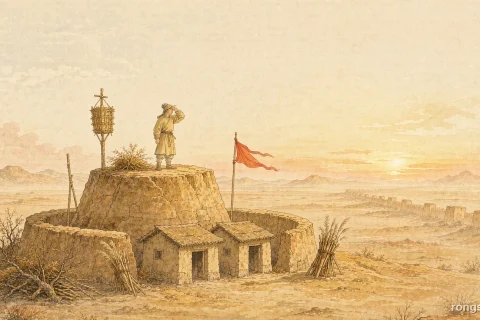
Once inside, the 33rd tore down houses and broke through walls, turning the place into ring upon ring of bunkers: nested strongpoints, fire trenches, barbed wire, abatis. A village of forty households became an iron walnut.
Dawangzhuang is not a famous name in Chinese history. It is a village that happened to stand in the way.
At dusk on 9 December, the guns of the 20th Division, 7th Column, East China Field Army, spoke first.
When the shelling lifted, the infantry of the 58th and 60th Regiments came up out of the trenches.
In eighty-five minutes, Dawangzhuang was taken, and more than seven hundred prisoners with it.
What was left of the 33rd fell back north. In his headquarters, Huang Wei slammed down the telephone.
At midnight, every howitzer, field gun and mountain gun in the 18th Corps opened at once. For fifty-four minutes, thousands of shells came down on a village of forty households.
The houses came down. The bunkers came apart.
At half past seven the next morning, Yang Botao, commander of the 18th Corps, put in every man in the 118th Division who could still carry a rifle, plus seven tanks and a field artillery battalion. Three columns, straight at the village.
By twenty past eight, Dawangzhuang had been retaken.
The 46th Regiment of the 6th Column was placed under the 20th Division about then.
Its 1st Battalion, led by Gao Junjie, worked up a water channel south of the village and took the southwest corner. The 3rd Battalion pressed in from the right.
Then it became an endless back and forth.
Aircraft, tanks, artillery, all aimed at one patch of ground the size of a courtyard.
The graveyard in front of the village changed hands more than a dozen times in a single day.
The houses were already gone. The only cover left was a broken wall, a shell hole, or a body.
The 46th Regiment had nothing to stop a tank with. When the tanks came through, their tracks split the 1st and 3rd Battalions in two.
Men went at them with explosive charges and bundles of grenades. Some set fire to sorghum stalks and carried them burning toward the tanks.
When a position was smashed flat, the dead were stacked up and used as a wall.
When the ammunition ran out, they used bayonets and shovels.
When an officer went down, a private stood up and took over.
In that fight there was a platoon leader named Kong Jinsheng.
He was from Lujiang in Anhui, and commanded the 2nd Platoon, 2nd Company, 59th Regiment, 7th Column.
His position, between Dawangzhuang and the mound called Jiangu Dui, was under fire from three sides.
He beat back three attacks and killed more than three hundred men.
He was hit in the chest and the left shoulder.
At eleven in the morning on the tenth, the fourth attack came in.
The platoon had no ammunition left and almost no men.
A bullet went through Kong Jinsheng’s throat. His abdomen was laid open.
When the enemy came up the slope in a mass, he picked up a shovel and cut down five of them before he fell.
When the relief party reached the position, one man of the 2nd Platoon was still alive.
The platoon was renamed after him.
By the evening of the tenth, Dawangzhuang was firmly in hand.
Seven regiments had been fed into a village of forty households. Six of them were, for practical purposes, destroyed.
In the trench in front of the village the dead lay several deep, and the earth was red.
A few kilometres away, the 23rd Division of the 85th Corps was holding its own stretch of line.
Its commander, Huang Zihua, watched the whole thing through field glasses. When it was over, he said nothing. A few days later he brought his division over.
After that fight, the road to Huang Wei’s headquarters was open. In the Chinese history of the civil war, this was the point at which the Huaihai campaign was decided in the north.
15 December was the twenty-third day of the encirclement.
At nine in the morning, the deputy commander of the Nationalist air force flew over Shuangduiji and told Huang Wei that air cover could not be provided.
Huang Wei said he would manage on his own. He called in two corps commanders and ordered the heavy weapons destroyed, the radios smashed, and a breakout in separate directions at dusk.
At four in the afternoon, the Chinese guns opened again.
Huang Wei did not wait for dusk. He went early.
He, Hu Lian and Wu Shaozhou took three tanks and drove west, out through the ring.
The tank Huang Wei rode in was the newest model in the army. It had never been driven.
Halfway out, it broke down and slid into a ditch.
He got out and ran with the stragglers. Everywhere he went, men were shouting at him to lay down his arms.
He raised his hands.
Wu Shaozhou’s tank could not cross, because the two ahead of it had broken the pontoon bridge. He simply got out and sat by the roadside to wait.
Yang Botao tried to break through and failed, then jumped into a river to end it. The river was shallow and the day was cold. He climbed out and was taken prisoner.
Only Hu Lian got away. His tank drove south past column after column of Chinese infantry, who took it for one of their own and waved it through. It ran out of fuel at a river, and he went on on foot, with a burst of shell fragments in his back.
At midnight, Shuangduiji was finished.
The Twelfth Army Group, four corps and a fast column, a hundred and fourteen thousand men, was gone.
The price paid by the Central Plains and East China Field Armies was more than thirty thousand.
The day it ended, a Nationalist corps commander being marched to the rear passed a convoy on the road.
The wagons were loaded with pork, heading for the front.
A few days earlier he had come through the same country, and every door had been shut.
Afterwards he said that when he saw those wagons, he understood why the battle could not be won.
The farmers around Shuangduiji took their doors off the hinges to carry the wounded and pushed their barrows to the front.
In a single winter, one county sent out more than a million labourers.
The fighting was in front. The pushing was behind.
No railways, no petrol. A country with millions of wooden barrows pushed its own army forward, one wheel at a time.
For years after the battle, nobody lived in Dawangzhuang. The graveyard in front of it was ploughed by shellfire and soaked in blood, and the grass that came up there later was greener than anywhere else.
It is the kind of thing Chinese history is made of, and most of it is not written down.
A shovel can do a great deal, and in the winter of 1948 a hundred thousand men proved it.