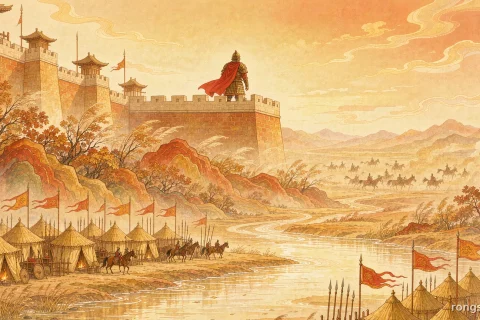
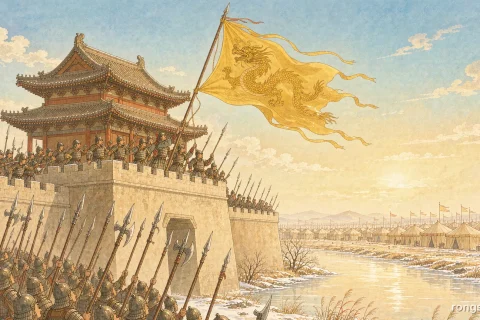
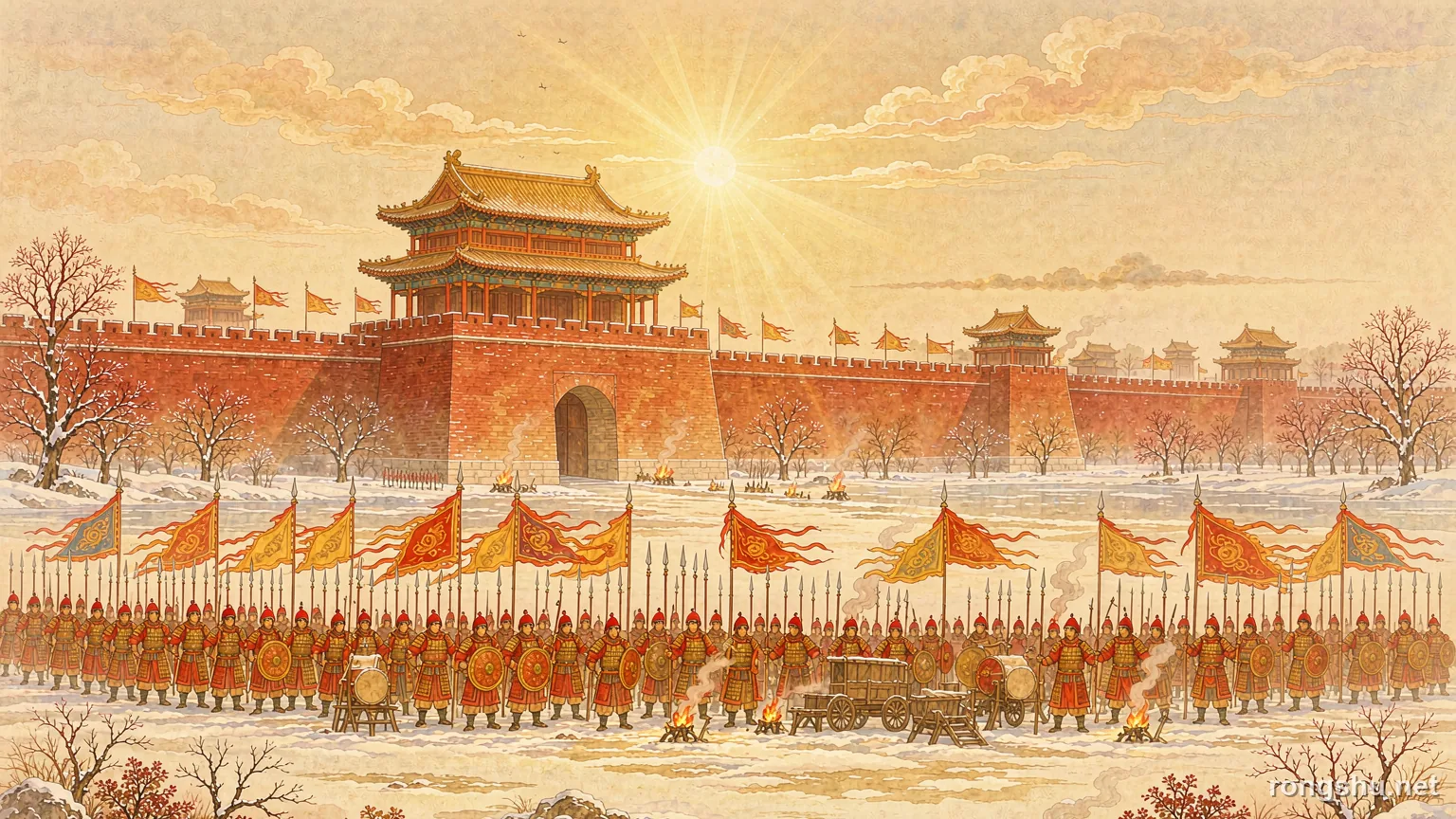
In the winter of 1629, outside the walls of Beijing at the Guangqu Gate, the wind drove the snow sideways.
Smoke was still visible in the distance. The camp of the Later Jin army stood only a few miles away.
It was the coldest season of the year. The armour on the soldiers had frozen stiff.
They had come running all the way from Shanhaiguan, and had hardly slept on the road.
And now they faced more than an enemy. The city behind them was watching them too.
The men on the walls were fully manned. Below the walls stood the army that had just arrived. Its commander was Yuan Chonghuan.
He had been sent for to save the throne. Yet the gate did not open.
There was a reason. This was an army from Liaodong, and the force closing on Beijing was the Later Jin. No one in the city dared to gamble on whether there were traitors in that army.
So Yuan Chonghuan and his men made camp outside the walls and marched out to meet the enemy with their backs to the city.
From Ningyuan
To understand this man, we have to go back three years.
At that time the Ming war in Liaodong was a disaster. In 1619, at Sarhu, the Ming had attacked on four roads and lost almost everything. In 1622 the defeat at Guangning gave away a great stretch of land beyond Shanhaiguan, and many in the court argued for pulling back behind the pass and giving up the frontier.
The frontier fell like an avalanche. Shenyang was lost. Liaoyang was lost. Guangning was lost. The commanders changed one after another, some killed in battle, some punished by the court.
And then a civil official stepped forward.
Yuan Chonghuan had passed the highest examinations and had served as a local magistrate. He might have spent his life writing documents, judging cases, and collecting taxes. Instead he chose the hardest road, to the frontier, to lead troops.
He rode out beyond the pass alone and studied the ground and the defenses of the towns. Then he promised his superiors that with men and grain he could hold Shanhaiguan by himself.
The court sent him.
What he meant to do was plain. Build walls.
At Ningyuan, two hundred miles from Shanhaiguan, he raised a strong fortified city and put the newest western cannon on its ramparts. The Chinese called them the red barbarian cannon.
In 1626 the Later Jin army came.
Nurhaci had led armies for years and had almost never lost. But at the walls of Ningyuan he was stopped. The cannon on the walls spoke, the Later Jin took heavy losses, and they withdrew.
The Ming called it the Great Victory of Ningyuan.
Nurhaci died of illness that same year. Some say his old wounds from the battle brought it on. Others say he simply fell ill at his age. Neither version can be proven.
One thing was clear. In all the years of defending the frontier, this was the first time the Ming had stopped the Later Jin in open battle.
The next year the Later Jin came again, against Ningyuan and Jinzhou, and failed again. This was called the Great Victory of Ningjin.
By rights, Yuan Chonghuan should have been rewarded.
The opposite happened. Because he would not go along with certain senior commanders, and because of the factional wars in the court, no reward came. What came instead was a round of blame. In disgust he resigned and went home.
The Promise of Five Years
In 1627 a new emperor came to the throne. His reign was called Chongzhen.
The Chongzhen Emperor was seventeen. He had inherited a state that leaked on every side. One of the first things he did was to recall Yuan Chonghuan and make him Minister of War, in charge of the whole northeast.
The heaviest military authority in the empire was put into his hands.
He was, by training, a man of letters. He had passed the examinations and served as a magistrate. Now a scholar was carrying the defense of the entire northeast on his shoulders.
Yuan Chonghuan came to the capital to give thanks, and the emperor received him alone on the terrace.
After a long talk, Yuan Chonghuan said something. Give me the authority to act as I see fit, and within five years I will recover Liaodong.
The emperor was delighted. He said that if Liaodong were truly recovered, he would not withhold the rank of a marquis.
When he came out, a colleague asked him privately how the five year plan had been worked out.
Yuan Chonghuan gave an answer that was written down. The sense of it was this. The emperor is anxious, and I said it to put his mind at ease.
That remark became a stone tied to his neck.
To the emperor, it was a promise from a servant to his lord.
To Yuan Chonghuan himself, it was more like a comforting word spoken to calm a worried ruler. But the rules of the court did not accept that. There is no joking in front of the throne.
The emperor remembered the five years, and he remembered the promise. The days went by, and not one town in Liaodong was recovered. That debt would have to be paid.
The Knife on Pidao
The first great act of Yuan Chonghuan’s command surprised everyone.
He killed a man.
The man was Mao Wenlong, a general of the eastern command, stationed on an island called Pidao.
The island held a delicate position. It sat at the back of the Later Jin, not far from their territory. Mao Wenlong gathered refugees there, raised troops, and raided the Later Jin from behind. He never won a great victory, but the mere presence of that force kept the Later Jin from going all out to the west.
Mao Wenlong had his faults as well. He kept his army for himself, reported more men than he had in order to draw pay, and traded on his own account. Censors had been denouncing him for years.
He and Yuan Chonghuan had never got along. Yuan wanted the eastern command folded into his own chain of command, and Mao would not obey.
To Yuan Chonghuan, this man with his soldiers and his island was the largest stone in his path.
In the sixth month of 1629 Yuan Chonghuan went to Pidao under the pretext of inspecting the troops.
He called Mao Wenlong in, listed twelve charges against him in public, and then took out the imperial sword he carried and had him beheaded.
That single stroke made a great noise.
Mao Wenlong was a general of the first rank. Even if he were guilty, a case like his should have been judged by the court. A regional commander had no right to execute him on the spot. When the Chongzhen Emperor heard of it, he was deeply shaken. Then he reflected that the man was already dead, and that he needed Yuan Chonghuan for the moment. So he held the matter down and, on the surface, praised him.
The emperor had added this to the account in his mind.
The Later Jin, for their part, breathed easier.
With the thorn at their back removed, nothing held them in check. A few months later they were free to do something large.
The Enemy at the Gate
In the tenth month of 1629, Hong Taiji did the one thing the Ming least wanted.
He did not come by Shanhaiguan.
Along the line at Ningyuan and Jinzhou the Ming defenses were solid, and a head on attack would gain nothing. So Hong Taiji went around the line altogether, through Mongol territory, and broke through the wall at several passes, including Daankou and Longjing Pass.
Yuan Chonghuan had in fact warned about this road.
He had already sent up a memorial saying that the Ji region was weak and should be held by a strong force, and that if the Mongols guided the Later Jin in through that gap, the harm would be great.
His fear came true in full.
The Later Jin marched south, took Zunhua, and pressed on toward Beijing. The capital was shaken, and the whole city was put under martial law.
When Yuan Chonghuan heard the news, he brought his troops back from beyond Shanhaiguan at once, marching through the night.
He was only a little behind the Later Jin.
Once he reached Beijing, the Chongzhen Emperor received him at once, thanked him, and gave him a sable coat. Yuan Chonghuan said that his troops had marched a long way and were worn out, and asked to bring them inside the city to rest.
The emperor refused.
And so came the scene from the beginning. The army that had come to save the throne had to stand outside the walls and face the Later Jin main force.
At the Guangqu and Zuoan gates he fought several engagements. Both sides took losses, and the attack was held.
Beijing was saved.
But anger was rising inside the city.
On the way in, the Later Jin had burned and plundered, and many great houses had lost their gardens and their land. These people dared not curse the Later Jin, so they turned their anger on Yuan Chonghuan. If you are the commander, how did the enemy reach our walls?
Worse talk spread as well. Some said the Later Jin had been let in by Yuan Chonghuan, and that he had long had an understanding with the enemy.
One by one, these words reached the emperor.
The History of Ming records one episode.
It says that the Later Jin captured several Ming eunuchs outside the walls, let them overhear talk that the Later Jin and Yuan Chonghuan had a secret agreement, and then released them. When the eunuchs reported to the palace, the Chongzhen Emperor grew suspicious at once.
Was there really a trick of this kind by Hong Taiji?
It has been argued over ever since. Some scholars believe the story was invented later, to make Hong Taiji look far seeing and clever.
But even without that piece, the situation was already bad for Yuan Chonghuan.
In the twelfth month of 1629 the Chongzhen Emperor had him thrown into prison.
The first thing the emperor questioned him about was the killing of Mao Wenlong.
The moment Yuan Chonghuan was arrested, his subordinate general Zu Dashou changed expression on the spot and turned his troops back toward the pass. No one in the court could stop them. In the end it was a letter from Yuan Chonghuan, written in prison, urging Zu Dashou to put the country first, that brought the army back.
That a man in prison could call an army back with a single letter made the emperor, if anything, more uneasy.
In the eighth month of 1630 the Chongzhen Emperor ordered Yuan Chonghuan put to death. Among the charges were that he had taken it upon himself to negotiate peace and that he had killed a senior general without authority.
The execution was carried out at the western market in the capital. He was put to death by slow dismemberment, in public.
He was forty seven years old.
The Grave Keeper
After the death of Yuan Chonghuan, the argument over whether he had deserved it ran hard in both directions.
The History of Ming is clear that after he was killed, the whole country cried that he had been wronged. In earlier records, however, the court and the public at the time mostly thought he had deserved his fate.
One account says the whole world thought him innocent. The other says no one at court thought him innocent. The difference between them comes down to this. The same event, seen from different times, yields two different verdicts.
But there was one thing many people in Beijing saw with their own eyes. The Qing army had come in around Shanhaiguan, and Yuan Chonghuan had brought his troops back from beyond the pass to save the capital.
He saved the city.
The city killed him.
His family was caught up in it as well. The court confiscated his property and sent his brothers and his wife into exile three thousand miles away. When the officials came back from taking an inventory, they reported that a man who had held high office for years had left almost nothing of value.
In closing his account, the History of Ming wrote this. After the death of Yuan Chonghuan, there was no capable man left for the frontier, and the signs of the fall of the Ming were fixed from that point.
After he died, his body was left in the street and no one dared to take it.
Later a servant of the household, whose surname was She, came at night, gathered up the bones, and buried them in a piece of common ground inside the Guangqu Gate. He built himself a hut beside the grave and stayed there to keep watch.
He left instructions. His descendants were not to return to the family home in the south, but to keep the vigil, generation after generation.
The She family did keep it.
From the end of the Ming through the Qing, and from the republic to the present day, more than three hundred years passed, and the grave keeper changed a dozen times over.
Today the street inside the Guangqu Gate is full of traffic. In a wall beside it, the shrine and the tomb of Yuan Chonghuan still stand.