On the night of the Lantern Festival the streets of the county town were thick with people. Wang Zifu was standing in the crowd when a young woman came past him with a branch of plum blossom in her hand. She walked on a few steps and turned to the maid beside her. She said that this young man had eyes like a thief. Then she dropped the blossom in the road and went off laughing.
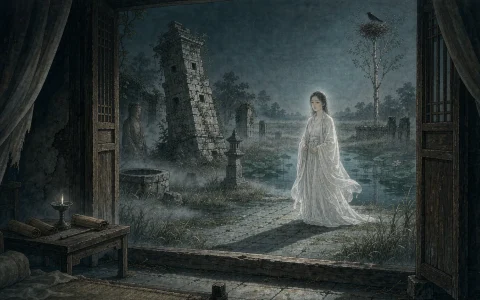
This story comes from Liaozhai Zhiyi, Strange Tales from a Chinese Studio, written by Pu Songling. In a great many of these Chinese ghost stories the main character is not human. There are foxes. There are ghosts. There are stones that have grown into a shape and started to walk. Yingning is two of those at once. Her mother was a fox. The woman who raised her was a ghost.
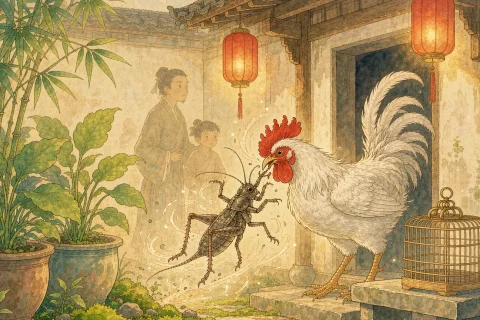
The Chinese fox woman is not the same creature as a werewolf. A werewolf is a person who turns into something else. The moon comes up, the shape is taken over, and you spend the rest of the story trying to remember who he used to be. Chinese supernatural tales work differently. A fox woman was never anything else. She was born a fox. She practiced for years and learned to wear a human form, and then she moved into the village. She lives next door. She borrows your fire. She mends your coat. She laughs at your jokes.
There is no transformation to catch, and no moon to watch. You simply cannot tell.
That is Yingning. Her laugh is the best thing in the house. Every woman in the lane wants to sit with her.
Wang Zifu was from Luodian. His father died when he was small, and by fourteen he had passed the lowest level of the examinations, which made him a xiucai. His mother had never let him wander into the countryside alone. A wife had been arranged for him years earlier, but the girl died before the wedding.
He came home from the festival with the plum branch hidden under his pillow. He would not speak and he would not eat, and he grew thin a day at a time. Monks and Daoist priests were called in, and the rites made him worse. A doctor was called, and the medicine did nothing.
Then his cousin Wu came to visit, and his mother asked Wu to find out quietly what was troubling the boy. Wang Zifu burst into tears and told Wu everything. Wu laughed and said he would find the girl himself.
Wu searched the whole district and found nothing. Some days later he came back and said that he had found her. She was a daughter of Wu’s own aunt, which made her Wang Zifu’s cousin on the mother’s side, and she was still unbetrothed. She lived in the hills to the southwest, about thirty li away.
That sentence was enough to cure him. Wang Zifu began to eat. He took the plum branch out from under the pillow. The flower had dried but had not fallen, and he turned the dry twig in his fingers as if she were standing in the room.
He waited, and Wu did not come. Thirty li was not so far. He told nobody, and walked out of the gate alone.
He went south into the hills for thirty li. In a valley crowded with flowers and trees he found a small settlement. The houses were thatched and swept, and the house facing north had willows over the gate and peach and apricot in full flower inside the wall.
He did not dare go in. Across the way there was a flat stone, so he sat down to rest.
After a while a woman’s voice came from inside the wall, calling a name. Then a young woman came from the east side of the courtyard with an apricot flower in her hand, her head down, fitting it into her hair. She looked up, saw him, and stopped. Then she smiled and went inside. It was the girl from the Lantern Festival.
Wang Zifu had no reason to walk through the gate, and nobody at the door to ask. So he paced from morning until the sun went down. Every so often half a face would appear over the wall.
Then an old woman came out, leaning on a stick, and asked whether he was hungry.
Wang Zifu bowed and said that he had come to visit relatives. The old woman was deaf. She asked what the surname of these relatives was, and he could not answer.
The old woman laughed. He did not know the surname, she said, so how could he be visiting anyone? He looked like a book fool. He should come in and eat and sleep the night, and go home in the morning to find out. Wang Zifu went in.
They talked, and the talk came around to family. The old woman asked whether his mother’s family were the Wu. When he said yes she was startled. That made him her nephew, she said, and his mother was her younger sister. Her own surname was Qin.
She had never borne a child, she said. The girl in the house was the child of a concubine whose mother had remarried and left her here. The girl was not stupid, but nobody had taught her anything, and she laughed all day and did not know what worry was.
The maid was told to bring the girl. For a long time there was laughter outside the door. She was pushed in with her hand over her mouth and doubled over. The old woman glared at her and asked what kind of behavior this was in front of a guest.
Wang Zifu bowed and asked how old she was. The old woman did not hear, he asked again, and the girl went off laughing so hard she could not lift her head.
The girl was sixteen, the old woman said, and as simple as an infant. Yingning was unbetrothed as well, and they would suit each other very well, and it was a pity they were cousins.
Wang Zifu said nothing. He could not take his eyes off her.
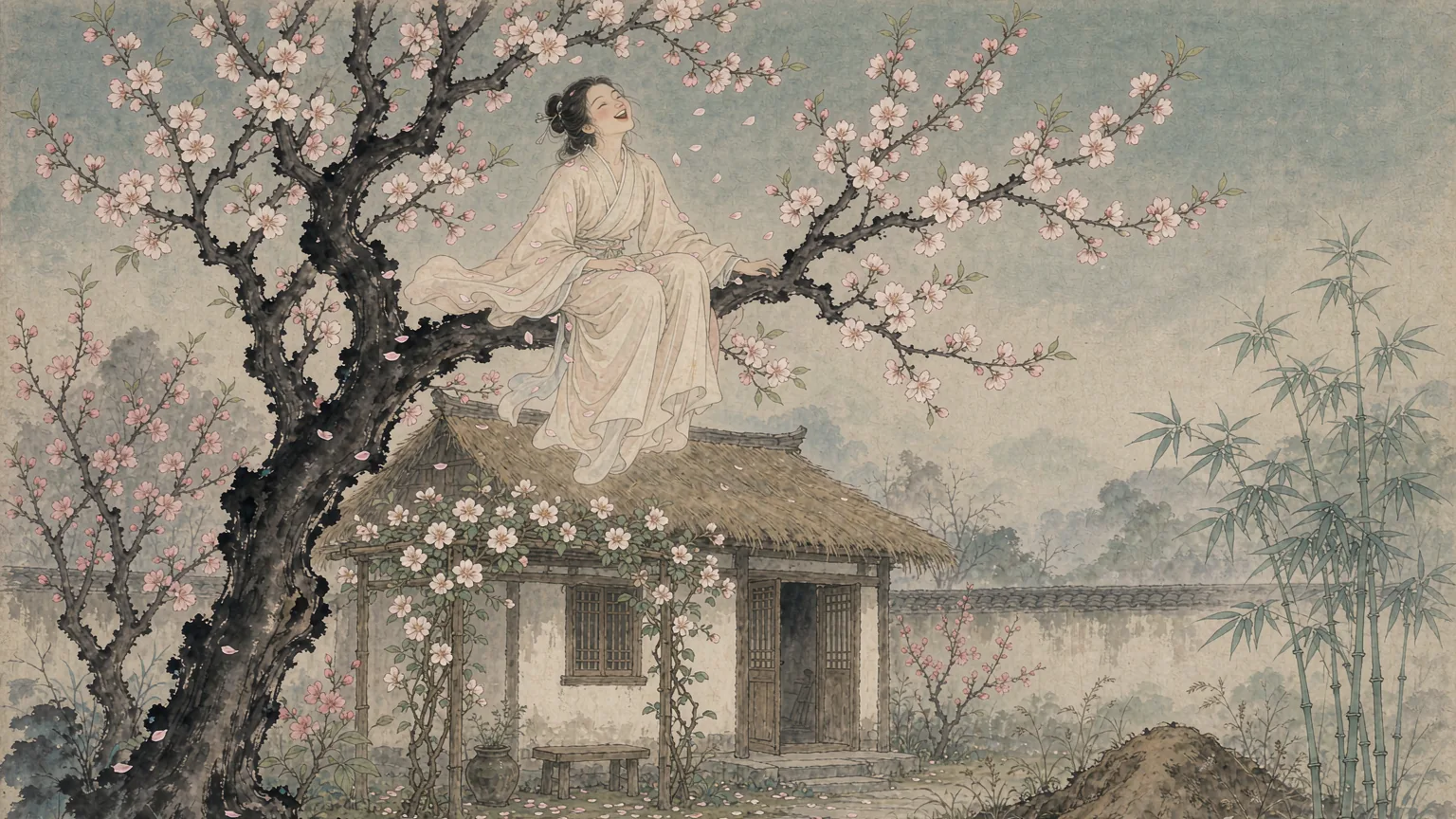
The next day he went into the garden, and Yingning was up in a tree. She saw him and laughed so hard she nearly came out of it. He told her not to laugh, or she would fall. She came down laughing and could not stop, and just before she reached the ground she fell, and that stopped it. He picked her up and pressed her wrist, and she started laughing again and had to lean on the tree.
When she was quiet he took the plum branch out of his sleeve and showed it to her. She said that it was dead, and asked why he had kept it.
He said that she had dropped it on the Lantern Festival, and that since then he had made himself ill with wanting her.
Yingning said that this was a small thing. They were family, so there was nothing to be so careful about. When he left she would have the servant break off a whole bundle of flowers and put it on his back.
He said that he did not love flowers. He loved the person who had held the flower. She said that between relatives there was no need to talk about love. He said that the love he meant was the love between a husband and a wife. Yingning thought about it for a long time and said that she was not used to sleeping with strangers.
Before she finished speaking the maid appeared among the flowers, and Wang Zifu fled.
That evening the household arrived with two donkeys. Wang Zifu told the old woman that he wanted to take Yingning home, and she was delighted. Her old bones could not travel, she said, but her nephew could carry her daughter off to meet her aunt. The two of them set out, and from the pass they looked back and saw her still leaning in the doorway, looking north.
At home Wang Zifu’s mother took one look at the beautiful girl and asked who she was. Wang Zifu said she was his aunt’s daughter, and his mother said that she had no elder sister, so where would a niece come from.
Yingning said that her mother had not borne her, and that her father’s surname was Qin, and that he died when she was still in swaddling clothes. His mother said that she did have an elder sister who had married into the Qin family, but that the woman had been dead for many years. Then she looked at Yingning’s face and at the marks on her body, and every detail matched.
While she was puzzling over it Wu arrived. After Aunt Qin died, he said, her husband lived on alone. A fox had hold of him, and he wasted away from it and died. The fox bore him a daughter named Yingning, and the child was in a blanket on the bed, and the whole household saw her. Then the family got a Daoist seal from the Celestial Master and pasted it on the wall, and the fox took the child and left.
Wang Zifu’s mother began to suspect that the girl was a ghost. She told Yingning what Wu had said, and Yingning was not frightened at all. She told her that the girl had no home and no parents, and Yingning was not sad at all. She only laughed her steady, silly laugh.
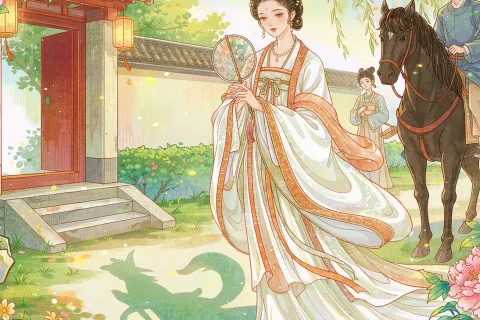
She rose before dawn to greet her elders, and she did needlework beautifully. His mother married them, but still feared the girl was a ghost, so one noon she looked at her in full daylight. The shadow was exactly where it should be.
Yingning loved flowers past all reason. Within a few months the steps and walls were full of them. A trellis of banksia rose leaned against the western neighbor’s wall, and she liked to climb it and pick flowers for her hair.
Then the son of the western neighbor saw her. He stood below and stared until he was dizzy with it. Yingning did not avoid him. She smiled at him, and he decided that she meant yes. She pointed at the foot of the wall, smiled, and climbed down, and he took that for a meeting place.
He went there at dusk. Yingning was there. He went at her.
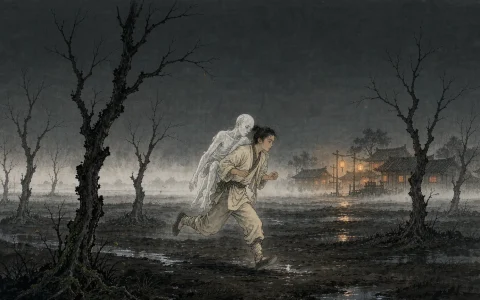
What happened next the book gives plainly. The place was like a needle driven into him, and the pain ran to his heart, and he screamed and fell down.
When they looked closely it was not Yingning. What he had taken hold of was a hollow in a rotten log that the rain had worn. They lit a torch and looked in. There was a scorpion inside as big as a small crab. They killed it and carried the boy home, and by the middle of the night he was dead.
The neighbor brought a case against Wang Zifu. The magistrate knew him for an honest man, ruled that the old man had brought a false charge, and ordered him beaten. Wang Zifu asked for mercy on his behalf, and the man was let go.
Afterward his mother spoke to Yingning. She said that too much happiness had trouble sleeping underneath it, and that with a muddled official the wife would have been dragged into the court.
Yingning straightened and stopped laughing. She swore that she would never laugh again.
His mother said that everyone laughed, and that it only had to be at the right time.
But Yingning did not laugh again. They teased her and she did not laugh. And yet she never once, all day long, had a sad face.
Some nights later she wept in front of Wang Zifu.
While their time together had been short, she said, she had been afraid to speak. Now she had watched his mother and him, and they were too fond of her to mean her any harm, so she would say it plainly. She was born of a fox. When her mother left she had been given to a ghost mother, and they had lived together for more than ten years. She had no brothers, and he was the only person she could rely on.
Her old mother lay alone beside the hill, she said, with nobody to put her bones in the family grave. If he could settle that old grief underground, then perhaps families that raised daughters would stop being willing to drown them or throw them away.
Wang Zifu agreed. He worried the grave would be lost in the grass. Yingning said it would not be.
On the day they had fixed, the two of them went with a cart and a coffin. In the tangle of dry grass Yingning pointed and said, this is the place. They dug, and there was the old woman’s body, and the skin was still on it. Yingning put her hands on it and wept aloud.
They brought her back and buried the ghost mother in the Qin family grave, beside her husband.
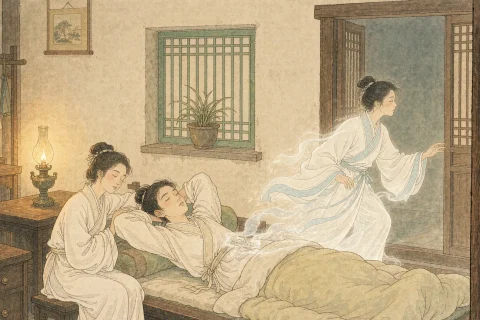
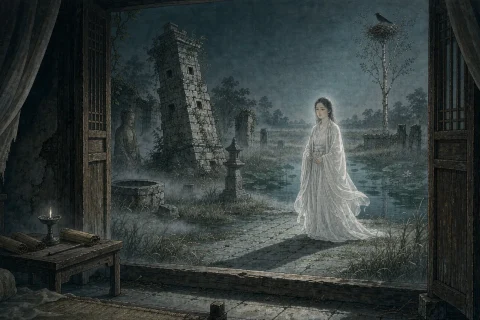
That night Wang Zifu dreamed that the old woman came to thank him. Yingning said that she had seen her in the night too, and that the old woman had told her not to wake him. Yingning said that she was a ghost, and that with so many living people about the yang breath was too strong, and she could not stay long.
Every year after that they climbed to the Qin grave at the Cold Food Festival and swept it.
The following year Yingning bore a son. Held in his mother’s arms he was not shy of strangers, and when anyone looked at him he laughed.
He had a great deal of his mother about him.
Pu Songling added a note of his own. Anyone watching Yingning laugh her silly endless laugh would think she had no heart in her at all, he said. But he asked who had been cleverer than she was on the night by the wall.
He said that his Yingning had most likely been hiding inside her own laugh the whole time.