In Dongan county there was a family named Xi, a small household that nobody noticed. The father, Xi Lian, was a plain and quiet man who in all his life never quarrelled with anyone.
Nothing happened in the house on the day he died. Something happened on the third day after.
Xi Fangping was about twenty then. On the third night after his father’s death he was keeping vigil and dozed off, and his father came to him in the dream.
The old man was covered in wounds. There was blood coming through his clothes, and he stood in the doorway and would not come in. He said that down below they were beating him. Every day.
The one who had set it up was a rich man from the east end of the village, a man named Yang.
Yang had died a few years before Xi Lian. In life he had used his money to push people around, and had pushed Xi Lian around more than once. Down below, he was still using it. He had paid off everyone who mattered in the courts of the dead, and paid them to work on Xi Lian in particular.
Xi Fangping asked, in the dream, whether it did any good to bring a case.
His father said that he had tried. He said, your father is a poor man, and what does a poor man have to fight a case with.
Xi Fangping said nothing when he woke up. He lit incense for his father, went back into the room, and lay down. Then he stopped making any sound at all.
The family thought he had fallen asleep. They felt for his breath and there was still breath. But they could not wake him. He lay there like a warmed shell with nothing inside.
The neighbours came and said his soul had gone wandering. A doctor was called, and the doctor shook his head and said that the breath was disordered, and wrote out two mild prescriptions, and left. Nobody could say what was wrong. The family kept him alive one mouthful of water and one mouthful of gruel at a time. His throat still swallowed, and while his throat swallowed there was still hope.
His mother sat by the bed at night and heard a sound in his throat, and thought he had woken, and bent close, and found his eyes still shut. She wiped the corner of his mouth and pulled the blanket up. She did not know that by then her son was already standing at the bottom of the hall of the City God.
The story is in Pu Songling, in the collection called Strange Tales from a Chinese Studio. Pu Songling was a xiucai, a man who had passed the lowest level of the imperial examinations and gone no higher. He spent his life teaching in a country school, and in his spare time he listened to people tell him about strange things and wrote them into short pieces. He gathered nearly five hundred of them. That book is the deepest well of Chinese ghost stories there is, and half the Chinese supernatural tales anyone can name come out of it. He was not fond of moral lessons. He liked to put a person in the worst possible place and watch what the person did.
He put Xi Fangping in a place like that. The country Xi Fangping had to travel into was the same one his father had gone into. And the man he had to accuse was the richest man in that country.
If the Brothers Grimm had collected their tales and then gone one step further, into the stories people told about the dead and the courts of the dead, they would have arrived somewhere near Pu Songling. Both of them worked from what other people told them. Both of them wrote down what they heard. Only one of them went down into the underworld to do it.
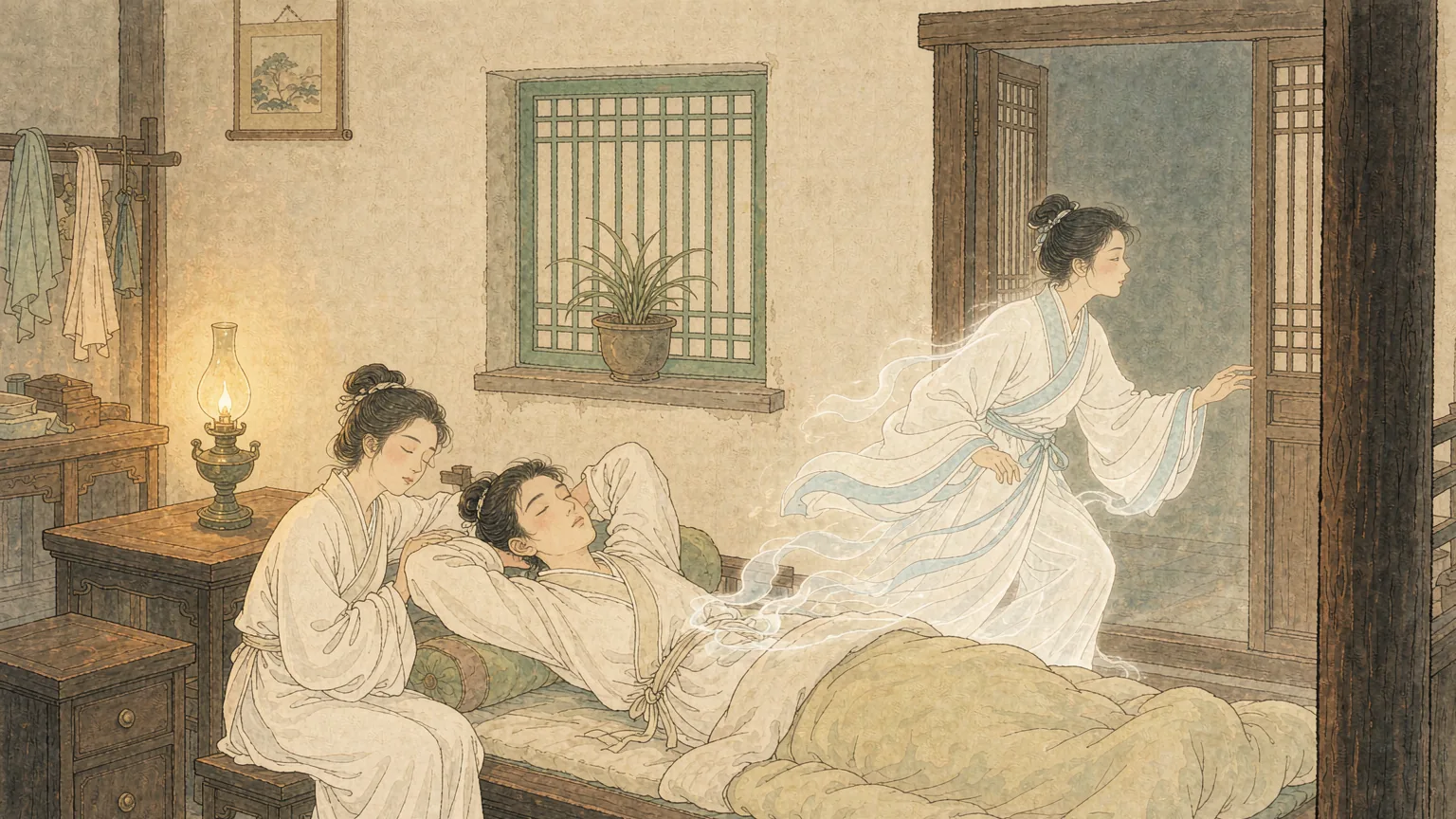
The soul of Xi Fangping walked out along the road.
He came first to the shrine of the City God, who is the magistrate for a single county in the courts of the dead. He knelt in the hall and laid it all out: what Yang had paid, how his father was being beaten, every particular.
The City God heard him out and waved a hand. There was no such matter, he said, and had him put out of the hall.
Xi Fangping stood outside the gate for a moment. He was not a stupid man. He had seen the clerk at the side of the hall look away as he spoke. It was the look of a man who had already been paid.
He did not go home. He walked on, to the next level up, the prefect who governed several counties.
The prefect’s hall was larger and busier. He handed up his written complaint and waited. He waited until dark, and then a sentence came down from the bench. The same sentence. No such matter. He protested, and men came and took hold of him and pushed him back along the road to the living world, and he opened his eyes and he was lying on his own bed.
His family crowded round him. You are awake at last, they said. You have slept seven days.
Xi Fangping sat up. He drank a mouthful of water. Then he lay back down. The next day he was silent again.
That time he went around the City God and around the prefect, and carried his case to the highest court of all, the hall of the King of the Underworld.
There was nothing in that hall but instruments of torture.
The King did not trouble to hear the case in any detail. He asked first: you have brought this to three courts now, and still you will not stop?
Xi Fangping said, I will not.
So they began with the fire bed.
The fire bed is an iron bedstead heated red. Two guards pressed him down on it and rolled him back and forth on the iron. His flesh hissed and spat against the metal. He clenched his teeth and made no sound at all. When it was done they pulled him up and asked whether he would drop the case.
What he remembered afterward was not the pain. It was the smell of his own flesh scorching, the closest thing to roast meat he had ever smelled, and the one smell he could not bear. Roast meat that was himself.
He said, I will not.
Then they brought out the saw.
The sawing was done slowly.
Two guards laid him between a pair of boards and stood the boards upright, and the saw began at the top of his head and came down. When it reached his chest, his sight went black with the pain, and still he would not cry out. Because he made no sound, the saw kept moving down.
Some tellings say that at the chest the guard with the saw paused. The other asked him why he was stopping. The guard said, this one is a man.
So they slanted the saw and brought it down around his heart, so as not to cut it through.
He said later that at the chest he nearly cried out. He opened his mouth, and then he thought of his father in the dream, with blood coming through his clothes, standing in the doorway and afraid to come in. So he shut his mouth. If he cried out, he had lost.
At the bottom he came apart out of the boards, in two halves, and then the halves closed again. The blood ran down to his feet. He lay on the floor and it was a long time before he could speak.
Somebody bent to the ear of the King and said something. The King changed his tone. He had a bowl of soup brought, and offered Xi Fangping a good posting: to be reborn into a wealthy house, to be dressed in silk from the moment of birth, never to know hardship.
This was the best order the underworld could give. Everything a poor scholar spends a lifetime wanting was folded inside it.
Xi Fangping pushed the bowl away. He said that his father’s case had not been settled, and that he would go nowhere.
On that same day a party of men came in from outside the hall.
At the front of it was Erlang Shen, the god of the irrigation works at Guan River, a great judge who travels with a hunting dog and a bow.
He had not come for Xi Fangping. He was passing through. But a passing god sees the blood on a courtroom floor, and sees a man who has been sawn in two and closed up again, and he stopped. He asked for the complaint and read it, and then had the City God, the prefect, and the King of the Underworld brought before him one at a time and questioned.
In less than half an hour the case had turned over.
The verdict ran something like this. The City God and the prefect had taken bribes and perverted the law: dismissed, and sentenced to hard labour. The King of the Underworld had known of it and let it pass: punished with them. As for Yang, who had bought the courts and destroyed an honest man, his property was confiscated and counted out as compensation to Xi Lian. And Xi Lian himself, a man who had done nothing in his life to deserve such a punishment, was permitted to be reborn into a good family and to be young again.
Xi Fangping knelt at the bottom of the hall and listened. After three courts, one fire bed, and a saw, it was the first time anybody in that building had said the thing plainly.
The verdict gave him something as well. A moderate span of years in the world above, and an estate sufficient for his needs, with a line in the judgment saying that it was payment for his stubbornness.
The body of Xi Fangping lay in the house for a long time.
He came back to it at midnight. The empty shell opened its eyes and moved its fingers. By some accounts he had been lying there for ten days or more, and the family had already begun discussing the funeral.
His mother heard the movement first and came in with a lamp, and her hand shook so hard she nearly dropped it. She did not dare to call out loudly, for fear of waking the other rooms, so she asked in a whisper whether it was really him. He answered her.
The next morning the village crowded round to ask what it was like down there. He said it was much the same as up here. They asked more, and he said nothing else.
He sat up. He did not talk about the underworld. He washed his face, ate, and went to his father’s grave and burned a stick of incense, and stood there a while without speaking.
The fortunes of the Xi family improved after that. He had land, and money, and children.
But for the rest of his life he was a man of very few words.
The neighbours said that Xi Fangping had gone down to the dead and come back changed, and that he was no longer the sort who liked to argue a point. He never spoke of the journey. He never spoke of the beatings his father had taken down there.
Some say the judgment of Erlang Shen was Pu Songling writing what the poor wished a judge would write. Others say it was only a son’s dream. Pu Songling takes no side. He writes it down and moves on.
There is only one thing about him that nobody can rewrite. From beginning to end, in all that time, it never once occurred to him to take the complaint back.