In the county of Jinning, in the far southwest of China, there lived a young scholar named Qiao Danian.
He was poor. His whole fortune was a few shelves of old books and a brush worn down to a stub. He was thin and straight, and his essays were the best in Jinning. The neighbors said the Qiao boy would pass the examinations one day. That one day kept moving further off.
There is an old saying in China. A true man will die for the one who truly knows him.
On paper it is a handsome sentence. In this story it means taking up a knife and cutting into your own chest.
The story is recorded by Pu Songling in Strange Tales from a Chinese Studio, under the title Liancheng. Pu Songling taught school in the countryside all his life. In his spare time he set up a tea stall beside the road and invited travellers to sit and drink, and whatever new story he heard he wrote down that night. Two hundred years later the Brothers Grimm did the same work in Europe, walking from village to village and collecting what other people told them. The difference is only in the harvest. The Brothers Grimm gathered fairy tales. Pu Songling gathered people who turned into ghosts, and ghosts who came back to live again.
If you come to Chinese ghost stories expecting the cold shiver of a haunting, you will find something else here. In most Chinese supernatural tales the dead are not monsters. They are people with something unfinished, and the question is never what they are, but whether the living can tell.
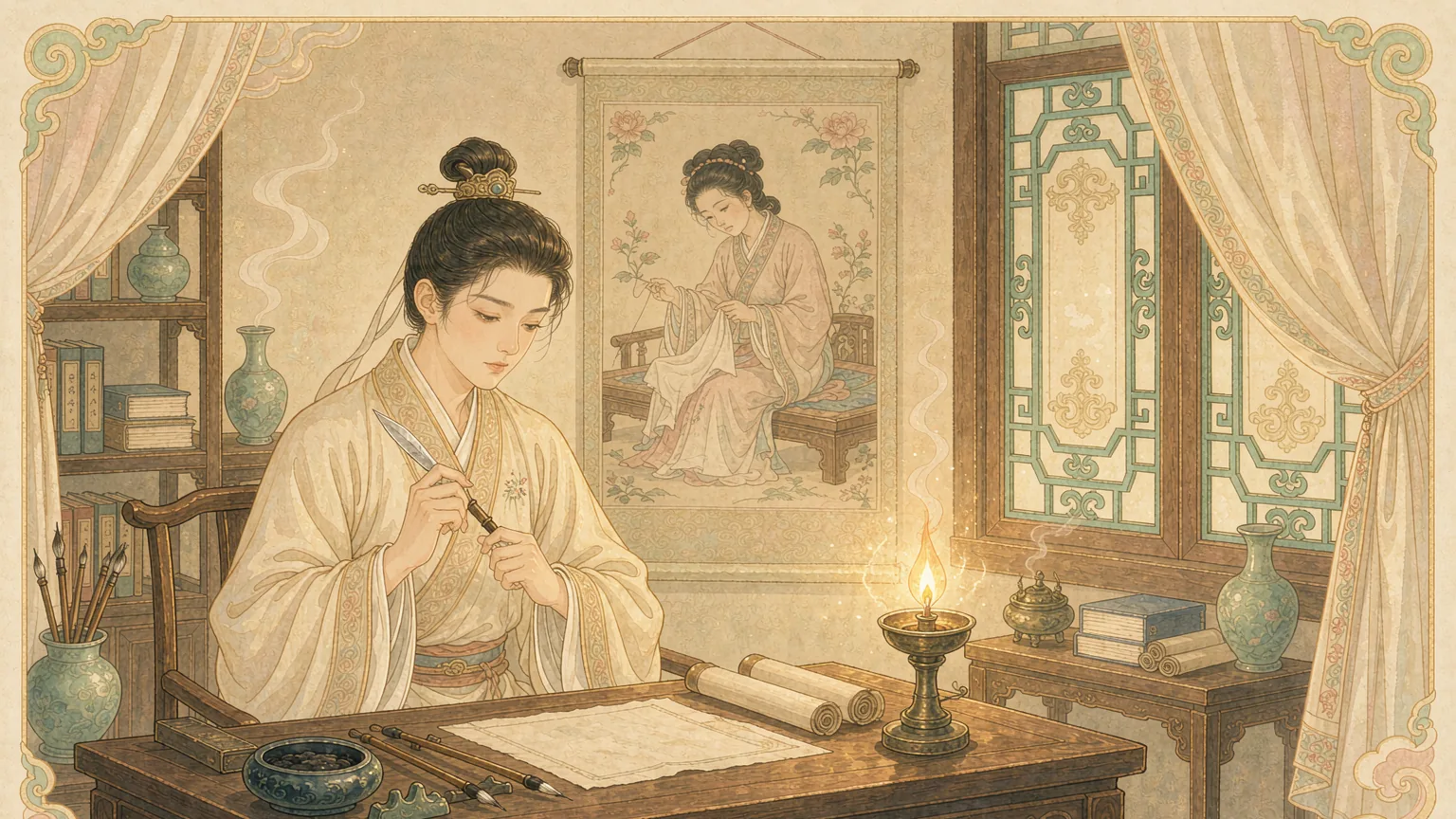
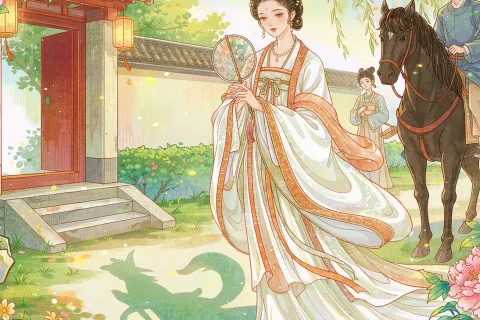
In Jinning there lived an official named Shi, a man of the second degree. He had a daughter called Liancheng.
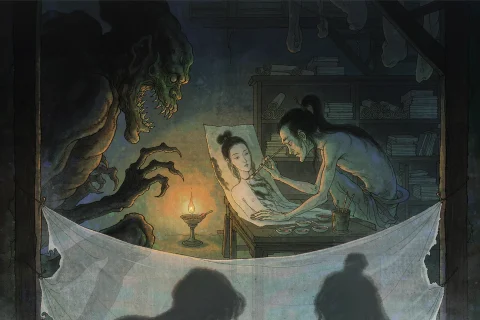
Liancheng was beautiful, and clever with a needle. One year she embroidered a scene she called The Tired Embroiderer. It showed a girl asleep at her frame, the needle still held in her fingers and a single thread running down from its eye to the floor. The thread was worked so fine that it seemed about to move.
When it was finished, her father hung the embroidery in his hall and invited the young scholars of the town to write poems about it. The invitation was polite. The purpose was to find his daughter a husband who could read and who could speak well.
The poems came in a thick stack. Liancheng read them one by one. When she came to two poems by Qiao Danian, she stopped.
She read them through, and at the lines she liked best she read them aloud. Then she told her father that this man had written down what was already in her heart.
The official Shi nodded at first. Then he sent a man to look into the Qiao family. The man came back with a report. Two old rooms, a few thin fields, a widowed mother. The face of the official Shi went dark.
Before long Liancheng was promised to the son of a salt merchant, a young man named Wang Huacheng.
When Qiao Danian heard it, he said nothing.
He copied out the two poems and put them at the bottom of his book chest, under a pile of old papers, and went on with his reading and his teaching.
Liancheng fell ill.
The illness lasted for months. At first it was only a cough. Then she coughed blood, and the flesh went from her day by day, until she was more bone than woman. Every physician in Jinning was called, and dozens of prescriptions were tried, and none of them helped. In the end she could not sit up, and lay listening to the sounds outside her window.
Her father begged for a cure everywhere. One day a monk came from beyond the frontier. He felt her pulse and said one thing. The illness needed a piece of flesh from a living man, one qian in weight, chopped fine and mixed into the medicine. Only that would cure her.
The official Shi had no other hope. He sent the message to Wang Huacheng.
Wang Huacheng heard it and laughed.
He said that he was not going to take a knife to his own chest for the whim of a foolish old man.
The answer came back, and the official Shi shook with rage and could do nothing. Nobody would cut into his own heart for a rumor.
Somehow the news travelled, and turned a corner, and came to the ears of Qiao Danian.
Qiao Danian went into his study alone and barred the door. He took off his coat. He found a small knife and laid its edge against his own chest, and felt for the place.
That place was the heart. That was the spot that beat and beat, and held the whole of a life.
He did not wait long. The knife went in and took a piece. Blood ran down along his ribs and soaked the whole front of his shirt. He dressed the wound himself, wrapped it with cloth in layer after layer, and held the edge of the table for a long while before he could stand. Then he sent the piece of flesh to the house of Shi.
The flesh went into the medicine, and the illness of Liancheng grew lighter, day by day.
The official Shi understood at last who had meant it truly.
He called Liancheng to him and said that he would marry her to Qiao Danian. Liancheng stood with her head down, her ears red, and could not say a word.
But Wang Huacheng refused.
He brought a case against the Shi family at the magistrate court. He said that the girl had been promised to him first, and that a promise could not be taken back.
The magistrate had taken money from the Wang family. On the day of the ruling, Liancheng was given to Wang.
Qiao Danian stood in the hall and said nothing at all. Everything he had to say was inside that piece of flesh. There was no one to read it for him.
Liancheng was carried back to the house of Wang.
Before long she fell ill again.
This time nobody could save her. She lay in bed, her eyes on the beams above her, and said softly that her life had been given to her by Qiao Danian, and that she would return it to him in death.
Then the breath went out of her.
Qiao Danian came to the mourning hall.
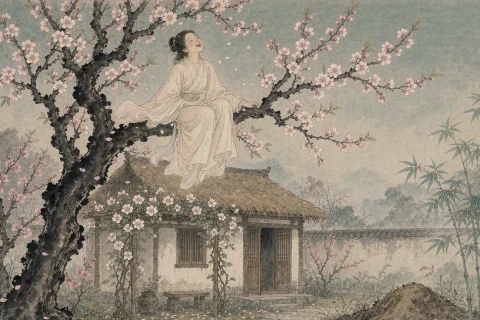
The room was cold and bare, and a film of ash lay on the offering table. He stood at the coffin and looked at the face inside. It was the same face he had read poems about and said aloud and never been able to bring home.
As he stood there, an old pain opened in his chest, from the inside out, as if the cut had been made again.
Then he followed her.
When a person dies, the road does not end.
The soul of Qiao Danian drifted a long way, and came to a place where cold wind carried smoke, and shadows came and went in the distance, and no one looked at anyone else.
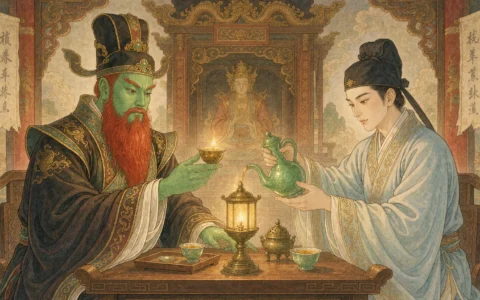
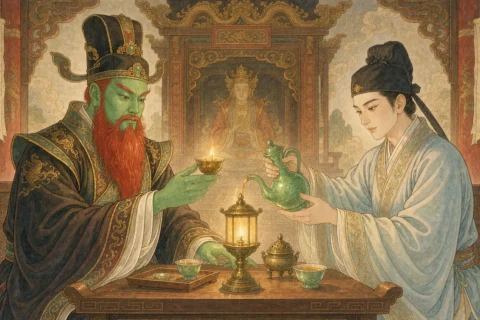
There he met Gu, a friend from the years before. Gu had died a few years ahead of him and now kept a small office among the clerks of the underworld.
Gu looked at him and was startled, and asked how he had come.
Qiao Danian told him the whole of it.
Gu sighed and said that the soul of Liancheng was due to arrive in a few days, and that Qiao Danian should wait.
And she did arrive. The two of them looked at each other through the cold wind and could not speak.
Gu read through the ledgers and worked for many days, above and below, until he found a road that would send them both back into the world.
Pu Songling tells the night of the return in careful detail.
Liancheng woke first. She opened her eyes and saw the mourning hall and the coffin, exactly as before. She touched her own arm and found it cold. She sat up and called the name of Qiao Danian.
In the coffin beside her, something moved at last.
Two of them, one climbing out of this coffin and one climbing out of that, still wearing their burial clothes with the ash of incense on them.
The household of Shi saw it and scattered, certain that the dead had risen.
Liancheng held the edge of the coffin and stood, and said that it was she, that she had come back.
Her father did not believe it and stepped back. Only when Liancheng spoke of something that no one else but the two of them knew did he believe, and he rushed forward and held his daughter and wept aloud.
Word came that Liancheng was alive, and Wang Huacheng came at once.
He brought his case again. He said that Liancheng was a ghost, that she was a thing not human, and that she did not belong to Qiao Danian.
This time even the officers of the court were thrown into confusion.
Liancheng stood up for herself.
She said that she had died once already, and that her life had been bought back with a life. If he truly wished to marry her, she said, then let him go and marry the coffin.
The affair had gone so far that the Wang family thought it unlucky, and gave way at last.
Only then did Qiao Danian and Liancheng bow to each other as husband and wife.
Pu Songling could have ended it here, on a happy note.
But he wrote one line more. After her marriage, Liancheng still fell ill again and again, and lay in bed more than half of every year. That was the price of the return. Her body was never the one she had been born with.
Qiao Danian stayed with her. He too carried an old wound. The place on his chest, where the piece had been taken, ached quietly on every day that the sky turned wet.
So the two of them lived on, one ill and one aching, from one day to the next, and in that way the days did pass.
One winter, Liancheng finished a new embroidery and laid down her needle. She said that her whole life seemed to have been picked up a piece at a time from other hands.
Qiao Danian smiled and did not answer.
Snow was falling outside the window. The two of them sat side by side and watched the threads on the new work hang down, one after another, onto the clean white cloth.