It was the middle of the night on a road between one town and the next, and the dew had flattened the grass. Song Dingbo was walking alone when he noticed that somebody had joined him.
He had no idea when the man had caught up. They went fifty paces shoulder to shoulder, and the stranger did not breathe, and there was only one set of footsteps on the road. Song Dingbo counted them. One, and then one more.
This story is short, and it survives in a book called In Search of the Supernatural, written in the fourth century by a man named Gan Bao.
Gan Bao explained in his preface why he had spent his life on this. His father had died and come back. His brother had stopped breathing and sat up days later with an account of the underworld. A serving girl in the household had climbed out of her own coffin. So he set out to write down every strange thing he could find, one item at a time, not to invent stories but to prove that the spirit world was real.
Most of the book is like that. A few lines each. In such and such a year, in such and such a place, a man saw a ghost. A family ox spoke. Recorded flatly, like a clerk filing reports. Gan Bao was in fact a court historian, and he filed his ghosts the way he filed his dynasties.
Chinese ghost stories are full of this tone, and this particular one is the closest thing in the whole book to a joke. Chinese urban legends have kept the same taste for two thousand years. The frightening thing arrives, and then an ordinary man outsmarts it and goes home with the money.
Why would a man who set out to prove that ghosts are real write down a story in which the ghost is the fool? Because the proof still holds. The point of the entry is not that ghosts are frightening. The point is that they are there. A court historian does not need them to be terrifying. He needs them to be documented.
Here is the first thing to understand about a Chinese ghost, because it runs against the West. In the West a ghost is a task. Find the bones, say the sentence, and it stops, and the story ends. A Chinese ghost is more often a person who happens to be dead. It keeps the temper it had when it was alive. It is polite, forgetful, slow to take offence, and entirely capable of being fooled.
Which means the ghost can be bullied.
That is the part that should make you uneasy. Not the ghost. The fact that it is not the one you have to watch.
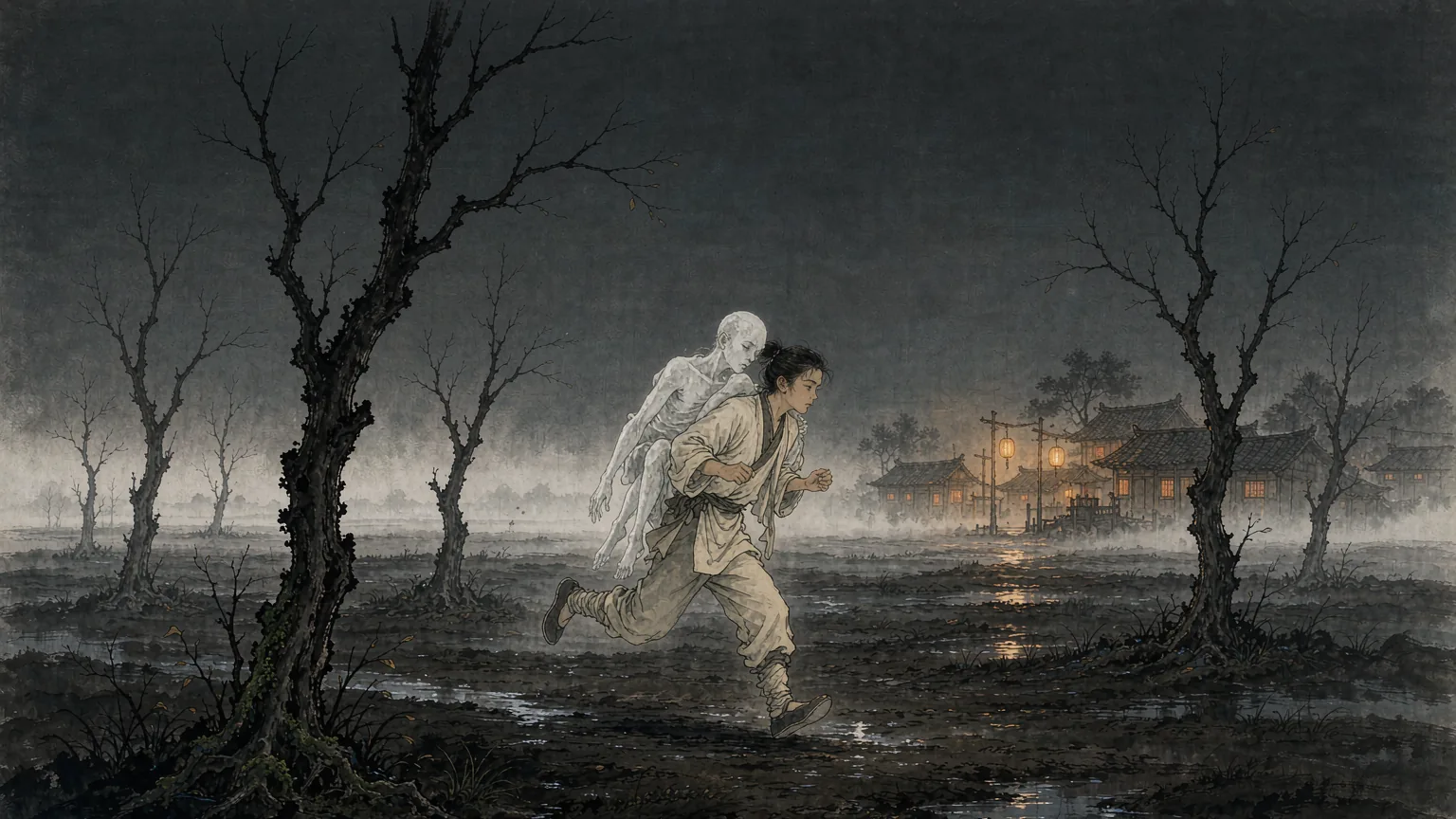
Song Dingbo was young then.
He spoke first. He asked the man beside him who he was.
The answer came back without any hesitation. I am a ghost.
Then the ghost asked him the same question.
Something went cold in Song Dingbo’s chest. His mouth, however, kept going. He said that he was a ghost too.
The ghost believed him.
That one sentence decided how the rest of the night would go. Song Dingbo lay up there on a dead man’s back and listened to his own heart, and heard no breathing underneath him at all. He began counting the trees along the roadside to keep his mind still, and working out what he would do if the thing currently holding his legs decided to drop him.
At first they were civil to each other and talked as they walked. The ghost said it was going to the market town of Wan. Song Dingbo was going there as well. Wan was a busy place in those days, with roads running into it from every direction, and he said that they might as well keep each other company.
After a few li the ghost lost patience with walking.
It said that this was too slow. It suggested that they take turns carrying each other. One would carry, the other would ride, and they would both save half their strength.
Song Dingbo agreed. The ghost offered to go first, so Song Dingbo climbed onto its back.
They went a few li in silence, and then the ghost stopped in the middle of the road.
It said that he was very heavy. It asked whether he was sure he was a ghost.
Song Dingbo broke into a sweat up there, in the dark, on a dead man’s shoulders. He said that he had died only a few days ago. He said that a new ghost had not yet lost the weight of a body.
The ghost made a small sound of understanding. It believed him.
Then it was Song Dingbo’s turn to carry. He reached back and took the ghost up, and the thing settled onto him like an empty coat. There was no weight to it at all.
A while later the ghost asked how long he had been dead.
Not long, Song Dingbo said.
The ghost asked whether he still had family.
That one Song Dingbo could not answer. He mumbled something about a few relatives and turned the talk aside, and the ghost let it go.
So they went on, one carrying the other, then trading places, then trading back.
On the third change Song Dingbo asked the question he had been saving.
He said that as a new ghost he did not yet know the rules. He asked whether there was anything the dead were not supposed to do.
The ghost answered him honestly. It said that there was really only one thing. Ghosts did not like being spat on.
Song Dingbo filed that away.
Further on, the road came to a river.
Song Dingbo said that the ghost should go first.
The ghost walked down into the water. Song Dingbo listened as hard as he could, and heard nothing. The water went through it the way water goes through water. Not so much as a splash.
Then Song Dingbo stepped in, and the river came up with a crash that carried across the empty fields.
The ghost stopped on the far bank and turned around. It asked why he made a noise.
Song Dingbo said that he was newly dead and had not yet got used to water, and asked it not to think anything of it.
The ghost believed that too. It stood in the middle of the river and waited for him, and when he reached it, it put out a hand and pulled him along. The hand was as light as the rest of it.
Song Dingbo came out on the far bank with the bottom half of his clothes soaked, and the wind went through them and set him shivering. He noticed something then. The river had not been wide. He had simply walked it far more slowly than he needed to. He had been dragging his feet the whole way, because every step of it he had been working out what to say next.
By now he understood his companion. It was an honest creature. It answered whatever it was asked and believed whatever it was told. They had come all this way and it had never once checked who he was.
The sky was beginning to lighten. Wan was close, and he could see lamps ahead of him, and carts, and the noise of people carrying water. A market town at dawn is the busiest place there is.
Song Dingbo bent forward and said that he would carry the ghost the last stretch.
The ghost thought nothing of it and climbed onto his shoulders.
The moment it was up, Song Dingbo turned both hands and locked them around its legs and ran.
The ghost began to scream. The sound was thin and sharp and came out in a series of little cracks, nothing like a human voice. It begged him to put it down. It begged him over and over.
Song Dingbo paid no attention. He held on and walked straight toward the lamplight.
The market was full of people. Men selling vegetables, men driving carts, men carrying water, and not one of them looked twice at the young man running past with sweat on his face and nothing much on his shoulders.
Song Dingbo walked into the middle of the market and dropped his load on the ground.
The screaming stopped the moment it landed.
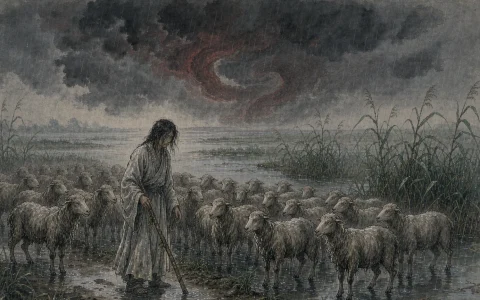
The ghost had turned into a sheep.
An ordinary sheep, standing on the ground with its head down.
Song Dingbo watched it and did not dare breathe out. He remembered what he had been told on the road. There was one thing ghosts disliked.
He spat on the sheep.
It did not change back. Only then did his legs start to shake. He had run the last fifty paces with an armful of dead weight and no clear memory of the road at all, only of the lights ahead of him getting closer and brighter the whole way.
He led it around the market twice before he found a livestock dealer, an old man of about fifty crouched behind a row of cages. The old man looked at the sheep, and then at Song Dingbo, and said that it was thin.
Song Dingbo told him to name a price.
The old man felt along the sheep’s spine and pried open its mouth to check its teeth. The sheep stood perfectly still and let him do it. The old man could not tell whether the animal was docile or something else entirely.
They settled on fifteen hundred coins. When Song Dingbo took the money his palm was wet.
He walked out of the market with the coins and could not help looking back once. The cages were as noisy as ever. The sheep had not made a sound.
Fifteen hundred coins was not a small sum in those days. He took it and went.
Later writers added a line about a famously rich man of that era named Shi Chong, who heard the story and liked to repeat the punch line in company.
Dingbo sold a ghost, he would say, and got fifteen hundred.
That is where the story stops.
Nobody ever asked which pen the sheep went into. Nobody ever asked whether Shi Chong was laughing because the story was funny, or because fifteen hundred coins for a ghost was the best piece of business he had ever heard of.
Nobody ever asked how a living man carried a dead one for several li on his back, while the dead one spent the entire journey believing it had met one of its own kind.
It never did work out what it had done wrong.