In summer the nights were warm.
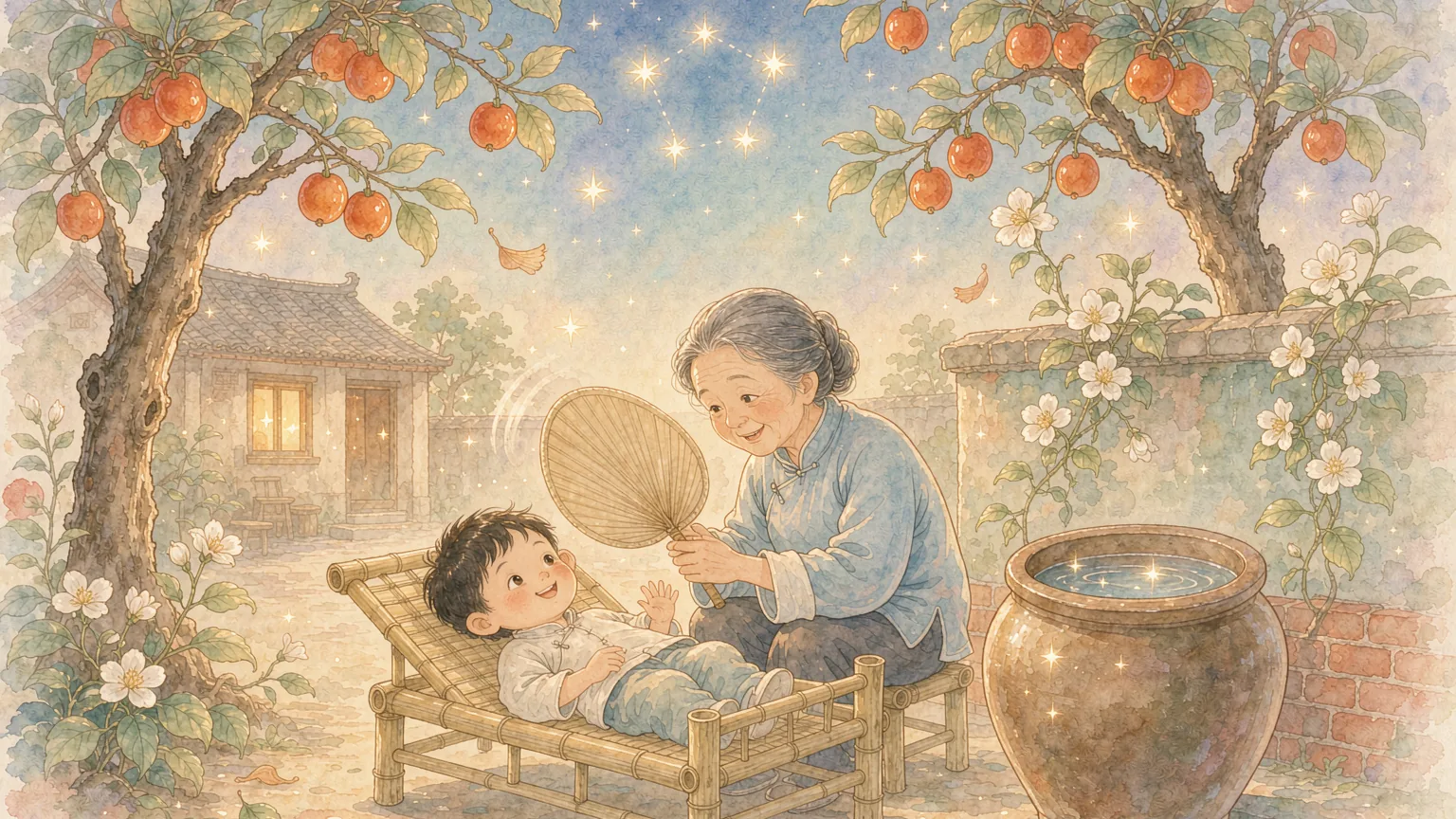
A boy lay on a bamboo bed.
The bed stood under two jujube trees.
His grandmother sat beside him.
She waved a big palm-leaf fan.
The wind came and went.
It kept the mosquitoes away.
The night smelled of grass and dust.
The fan made a soft sound.
It went hush, hush, hush.
Near the wall stood a big water jar.
The stars were shining in the water.
They blinked there too.
The jar held a second sky.
A boy looked up. A boy looked down.
The boy kept his eyes open.
He looked up at the sky.
The sky was full of stars.
One star.
Two stars.
Three stars.
He counted very slowly.
At the seventh star he stopped.
Those seven stars made a shape.
The shape looked like a spoon.
Grandmother said: that is the Big Dipper.
The boy asked: why does it not fall?
Grandmother said: it is nailed up there.
The boy asked: why does it keep its eyes open?
Grandmother laughed.
She said: they are sleepy too.
She said: but they want to watch you sleep.
The boy did not believe her.
So he counted some more.
At seventeen he forgot his place.
He started again.
At twenty-three he forgot again.
Then he chose the brightest star.
He said: this one is mine.
Grandmother asked: and what will you call it?
The boy thought for a long time.
He thought and thought, but found no name.
Grandmother said: never mind. You can name it later.
She said: you do not need to count each one.
Grandmother said: count to a hundred, and then you sleep.
The boy said: all right.
Then he saw a pale white band.
It stretched across the sky.
Grandmother said: that is a river.
She said: it has no water. Only stars.
The boy asked: are there boats?
Grandmother said: yes.
She said: they sail after you fall asleep.
On the other side of the yard grew a vine.
Small white flowers opened at night.
They were quiet and small.
The jujube leaves were dark and small.
They hid little green fruit.
Grandmother said: farmers use that spoon up there.
She said: it points the way home in the dark.
The boy asked: does it point to our house?
Grandmother said: it points north. Our house is north.
The boy was pleased.
Grandmother hummed something low.
It had no words.
It went on and on.
Next door, the lights went out one by one.
The lane grew quiet.
A dog barked once, and then stopped.
Somewhere a baby was crying.
Then the baby stopped.
A cricket started in the corner.
It sang one long note.
Then it stopped and listened.
Then it sang again.
The boy began again from the first star.
One star.
Two stars.
Three stars.
Four.
He lost his place again and again.
The stars stayed the same.
Not one of them would leave.
The palm-leaf fan slowed down.
It stopped once, then moved again.
Now only the insects were singing.
The boy reached past forty.
His voice grew softer and softer.
Then he stopped counting.
His eyes were still open.
He looked at the sky a little longer.
Then his eyelids came down.
Grandmother laid the fan beside him.
She pulled a thin cloth over him.
She did not go inside.
She stayed by the bamboo bed.
Up in the sky the stars were blinking.
One star, one blink.
Another star, another blink.
They were waiting for him to sleep.
The wind moved the jujube leaves.
The leaves made one small sound, and then were still.
He yawned once.
He did not mean to.
Long after that night, people learned his name.
The boy who counted the stars was Zhang Heng.
When he grew up, he drew the stars in a book.
People had never seen a chart like that.
But on this night he only reached forty.
In China, whole families still sleep outdoors on hot summer nights.
They set a bamboo bed under the trees and watch the sky.
That is how the old story of The Boy Who Counted the Stars began.
This is an old Chinese folktale.
It is a gentle Chinese fairy tale, and one of the oldest Chinese bedtime stories for children.
Now it is time to close your eyes.
Good night, little counter.
Good night, all the stars.
This is a very old Chinese bedtime story. It is not long, and it is very gentle. Best read slowly, with the lights low.