In every home there is a kitchen, and in every kitchen there is a stove.
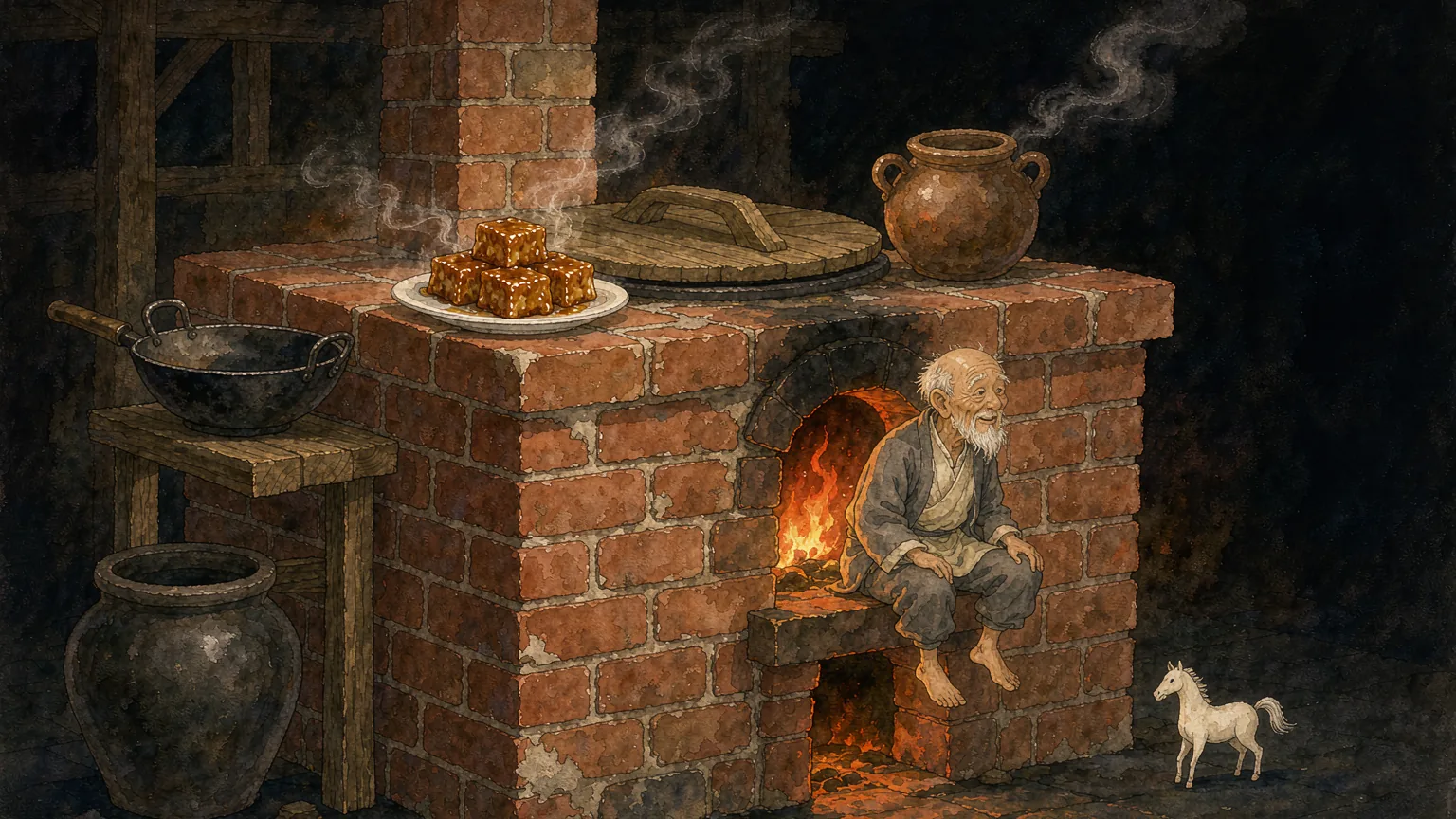
It is built of brick.
The fire has made it black.
There is a pot on the stove.
Most nights there is rice in it.
The lid of the pot is made of wood.
The lid gets warm on the inside.
The fire burns three times a day.
Once in the morning, once at noon, once at night.
Every time, the kitchen god watches.
Beside the stove lives a little kitchen god.
He is very old.
He is also very small.
He is smaller than a cricket.
His beard is very long.
Nobody can see him.
But he is there all the same.
He does not sleep.
He does not eat either.
He only watches.
He has watched for a long time.
At night, when the family is asleep, he is awake.
He likes the dark kitchen.
He watches the family.
He watches the mother wash the bowls.
The bowls knock against each other a little.
They are stacked up high.
He watches the father put wood on the fire.
The wood is dry, and it burns well.
Sparks fly up the chimney.
He watches the child eat the last grain of rice.
There is one grain on the corner of the child’s mouth.
The mother wipes it away with her hand.
She does it without thinking.
He watches the apron hanging behind the door.
There are spots of oil on the apron.
The apron is old, but it is clean.
He watches the salt jar on the windowsill.
The salt is white, like snow.
At night he writes down the day.
He does not say it was good, and he does not say it was bad.
He only remembers.
He has remembered for many years.
He never forgets anything.
Then the coldest day of winter came.
That day comes near the end of the last month.
The days were short, and the nights were long.
The well had ice on it in the morning.
On that day the smoke went straight up the chimney.
There was no wind at all.
Grandmother got up early.
She wiped the stove until it was clean.
Then she wiped it again.
She brought out a plate of sweets.
The plate was white.
The plate was the best one.
The sweets were yellow.
The sweets were sticky.
If you picked one up, a thin thread would follow it.
These sweets are called sugar melons.
They are only made once a year.
The child stole a little piece.
It stuck to his fingers.
Grandmother did not scold him.
The child asked: who are they for?
Grandmother said: for the kitchen god.
The child asked: why do we give him sweets?
Grandmother said: because tonight he goes up to heaven to talk.
Grandmother said: if his mouth is sweet, he will say sweet things.
So the family put the plate beside the stove.
Father also made a small paper horse.
He made it out of red paper.
It had a head, and legs, and a tail.
The horse was white.
One small horse was enough.
It stood on four thin legs.
It was for riding.
It was for riding up to heaven.
At night the fire in the stove was small.
The fire was red. It was not bright.
The smell of the sweets stayed in the kitchen.
It was sweet. It was warm.
It was a good smell for sleeping.
The child breathed it in, and grew sleepy.
The kitchen was very quiet.
The fire ticked as it cooled.
All the bowls were put away.
In the morning the plate was empty.
Grandmother smiled.
She said: he has gone.
The child looked beside the stove.
There was only an empty plate.
He thought about the little horse.
In China, this day is called Little New Year.
Families send the kitchen god up and say: speak only good things in heaven.
The stove was still warm.
The bowls were dry by the fire.
There was a little white steam on the pot lid.
Under the ashes, a little red was left.
This story is an old Chinese folktale.
It is a quiet Chinese fairy tale.
And it is a Chinese bedtime story that families have told for hundreds of years.
Now it is time to close your eyes.
Good night, kitchen god.
Good night, sweet things in the kitchen.
This is a very old Chinese bedtime story. It is not long, and it is very gentle. Best read slowly, with the lights low.