Here is a bet you can win at almost any dinner table: Cinderella did not come from Europe. She is not German. She is not French. And she has nothing to do with glass slippers. The oldest version of the story anyone has ever found was written down in China — roughly eight hundred years before the Brothers Grimm were even born.
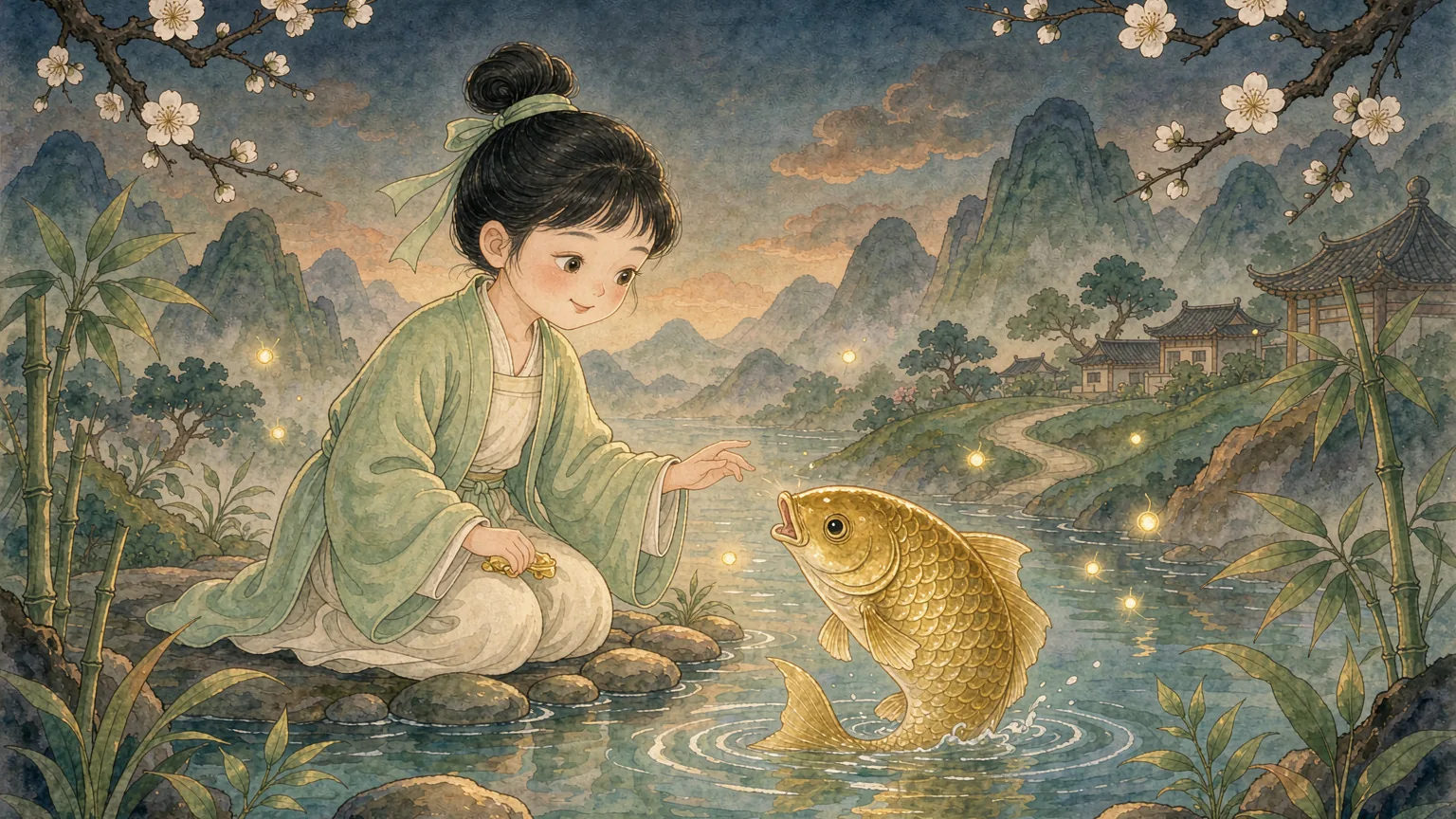
Her name is Ye Xian (say it “Yeh Shyen”). And once you know her story, pumpkins will never look quite the same again.
A girl, a fish, and a truly awful stepmother
Ye Xian grew up in southern China, in a green corner of the world where the mountains lean over the rivers and the mist gets stuck between them like laundry. She was clever and kind, and by the time she was a teenager she could do something most people could not: she made genuinely beautiful pottery. Not the “nice try, sweetie” kind — the kind that made neighbors stop in the road and stare.
Then her mother died. Her father remarried, and not long after, he died too — which left Ye Xian alone with a stepmother and a stepsister who had copied every one of their mother’s worst habits, then added a few of their own.
They took her fine clothes. They gave her the hardest chores. And they found a new way to be cruel every single day, which is honestly more effort than most villains put in.
But Ye Xian had one friend. A fish.
Not a pet-shop fish in a bowl. A big golden fish, with fins like wet silk, that lived in the pond behind the house. Every morning Ye Xian saved a little of her food and fed him; every evening he swam up to meet her. In a life with no softness left in it, this fish was the soft part.
Her stepmother found out. And because some people simply cannot stand to see anyone else happy, she did something spectacularly petty: she put on Ye Xian’s clothes, went down to the pond, and killed the fish. Then she cooked it and ate it.
Ye Xian ran to the pond. No golden fish. Just water, and her own reflection, which looked exactly how she felt.
Then an old man appeared — one of those mysterious old men who turn up in fairy tales at precisely the right moment. He told her something strange: the fish bones had power. He told her to gather them up, keep them safe, and whenever she truly needed something, simply ask.
She did. And it worked. Whenever Ye Xian asked, the bones gave her food, money, and comfort — quietly, and only when she really needed it.
The night of the Cave Festival
Now, every year the village held the Cave Festival — a night of music, dancing, and lanterns, where young people dressed up, showed off, and generally hoped to be noticed. Think of it as the local ball, minus the ballroom and plus a lot of firelight.
Ye Xian wanted to go. Her stepmother, of course, said no — and gave her a giant pile of chores to keep her busy, then walked out the door with her own daughter.
Ye Xian waited. Then she asked the fish bones for help. What they gave her was not an ordinary dress. It was a gown of deep blue silk, and a pair of golden shoes so small and light they seemed to be made of sunlight.
She went to the festival. She tried very hard to be invisible. It did not work.
People turned. People stared. Her stepsister narrowed her eyes and thought, that looks familiar.
Ye Xian noticed, panicked, and ran — and in her hurry she left one golden shoe behind in the road.
One shoe, an entire kingdom
The shoe was found, and it eventually made its way to the king of a nearby island kingdom. And here is where the story gets wonderfully weird: he did not keep it on a velvet cushion. He sent it out to every household in his land, with simple orders — find the woman this fits.
Down the road went the shoe. Girl after girl tried it. Too big. Too small. A few of them, the story admits, tried to squeeze a foot in anyway, which suggests that some things about human beings have not changed in twelve hundred years.
Then the shoe reached Ye Xian’s house. Her stepsister tried it on. It did not fit.
And then — quietly, almost out of habit — Ye Xian slid it onto her own foot.
It fit perfectly. It fit so well that she reached into her sleeve and pulled out the other one.
Her stepmother and stepsister went a very interesting color. Ye Xian put on the blue silk gown. The king’s men bowed. And the girl who had fed a fish when nobody was kind to her became, in that one sentence, a queen.
The part where this stops being a fairy tale
You might be wondering: where did this story come from?
The answer is a book called the Miscellaneous Morsels from Youyang, written by a Chinese scholar named Duan Chengshi around the year 860, during the Tang Dynasty. It is one of the earliest written versions of any Cinderella story on Earth — and it beats the European ones by about eight hundred years.
One more thing, because it tends to come up: the golden shoe has nothing to do with tiny feet. That custom came much later, and this story is older than it. Ye Xian’s shoes are small because fairy tales love a good detail, not because they are measuring anything.
What the story does carry is China: the pond behind the house, the festival of lanterns, the quiet belief that kindness is repaid — sometimes by a fish, sometimes by a bone, and sometimes by a king who is willing to walk his whole kingdom with a single shoe in his hand.
So the next time someone tells you that Cinderella is a European story, you can smile, lean back, and say: “Actually — she’s Chinese. And she’s older than you think.”
Ye Xian goes to sleep a queen. Sleep well.