The sky turned dark.
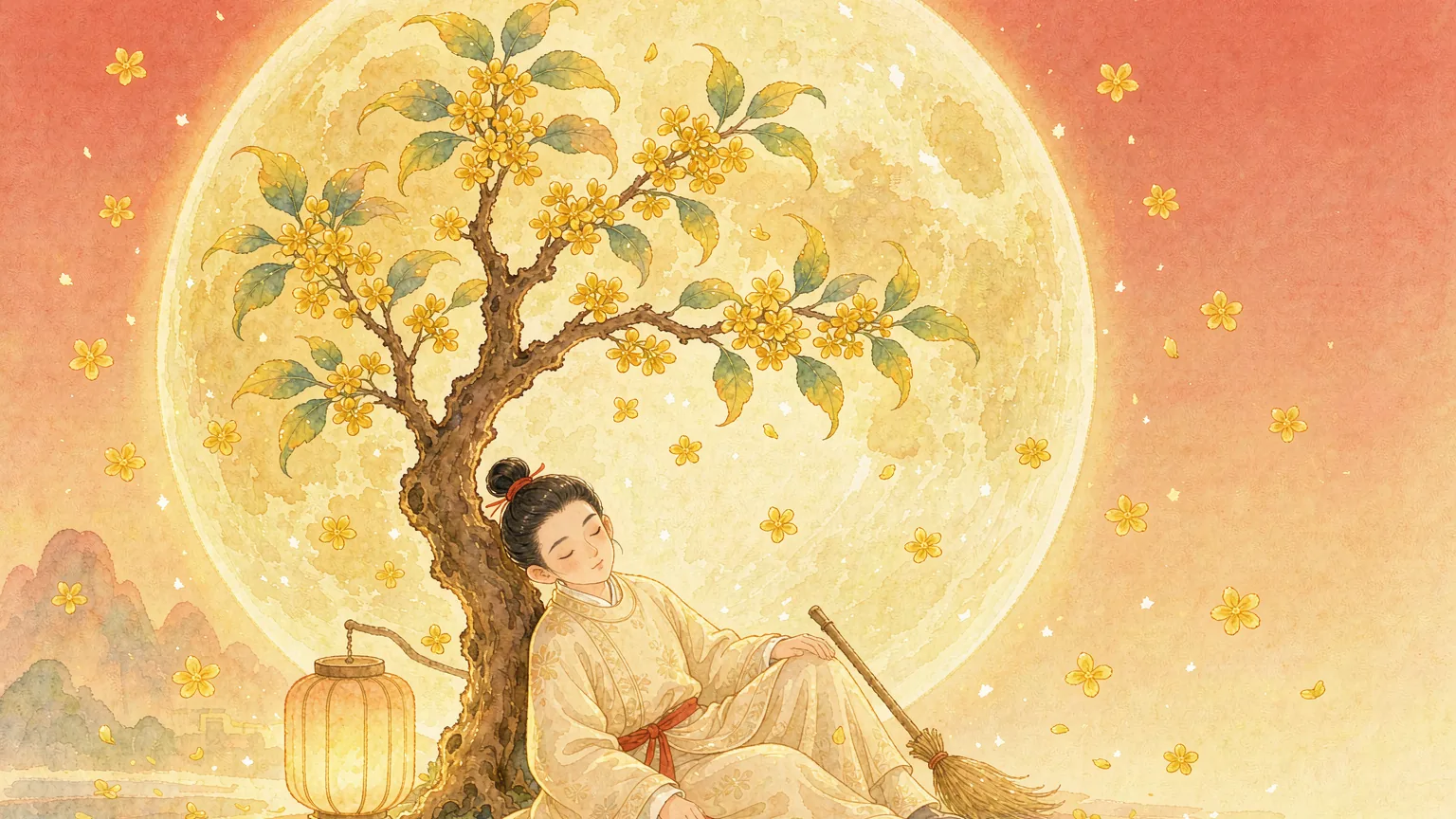
The moon came up.
It was round and bright.
Something moved on it.
A shadow.
What was it?
It was a big tree.
People call it the osmanthus tree.
The tree was tall.
The tree was wide.
Small flowers covered it.
They were yellow.
One by one they opened.
They smelled very sweet.
A man lived up there too.
His name was Wu Gang.
Every night he stood under the tree.
He held a little broom.
He swept the flowers.
He did not leave one behind.
He also watched the flowers.
He watched them open, one by one.
The flowers fell gently.
They fell onto the moon.
The moon smelled sweet.
They fell without a sound.
In China, the osmanthus blooms in autumn.
When the wind blows, the whole yard smells sweet.
People on the ground breathe it in.
Then they say: the osmanthus is blooming on the moon.
One autumn night, a grandmother held a child.
She pointed at the moon.
She said: look, there is a tree on the moon.
The child looked.
The child breathed in.
The child said: it smells so sweet.
Wu Gang swept all night.
He was tired.
He sat down against the big tree.
The smell was gentle.
It was like a soft hand.
He breathed it in.
He breathed it in again.
His eyes closed, little by little.
The moon kept moving.
It moved from east to west.
The osmanthus tree moved with it.
The little flowers rocked.
Rock, rock.
Rock, rock.
Down below, every home turned off its light.
One lamp went out.
Then another.
Then another.
The children were all asleep.
The sweet smell rode the wind down.
It drifted over the roofs.
It came to every windowsill.
It came to every little bed.
People say if you fall asleep to osmanthus, you dream something sweet.
A dream with no worry in it.
A dream that smells like autumn.
Wu Gang fell asleep too.
He slept on the moon.
The flowers stayed with him.
The shadow of the tree covered him.
The moon walked on, slowly.
Year after year.
Night after night.
It never made a sound.
Autumn passed.
Then winter came.
On the moon, the tree was still there.
It was not afraid of the cold.
The flowers fell, and new ones opened.
Wu Gang swept and swept.
He did not hurry.
He swept one flower at a time.
The moon moved slowly.
He moved slowly too.
One spring he looked up.
Down on the earth, the flowers were open.
The flowers on the ground looked like the flowers on the moon.
They were the same yellow.
He smiled a little.
Then he swept again.
The moon was quiet.
The only sound was the falling flowers.
It was soft.
It was like a light rain.
Wu Gang listened to it.
It made him feel calm.
People on the earth kept their own gardens.
In autumn, the osmanthus opened there too.
Grandmothers picked the small yellow flowers.
They made sweet cakes with them.
They put them in a little dish.
They set the dish by the window.
They said: this is for the man on the moon.
Then they went to bed.
The sweet smell filled the house.
It filled the pillows.
It filled the dreams.
The sky was getting light.
The moon was going home.
It drifted toward the west.
The shadow of the tree grew long.
Wu Gang put away his broom.
He lay down.
He closed his eyes.
The flowers fell around him.
They made a soft yellow blanket.
Over the earth, the children were sleeping.
Over the earth, the windows were dark.
In one window, a small child had a dream.
The dream smelled like osmanthus.
The dream was warm.
The dream was yellow.
And on the moon, one man slept too.
A whole tree kept him company.
The night was long.
The night was gentle.
Nothing had to happen.
Nothing had to change.
And the moon kept walking.
Slow and quiet.
All night long.
The moon was a quiet place.
The tree was a quiet place.
Only the flowers were awake.
They fell, one by one.
Then they slept too.
The whole sky was calm.
The whole night was soft.
Everyone was where they should be.
That is the old story of the osmanthus tree on the moon.
It is a gentle Chinese folktale.
It is also a Chinese fairy tale, and one of the oldest Chinese bedtime stories for children.
Now it is time to close your eyes.
Good night, Wu Gang.
Good night, osmanthus tree.
This is a very old Chinese bedtime story. It is not long, and it is very gentle. Best read slowly, with the lights low.