Long ago, beside a clear river, there stood a small house.
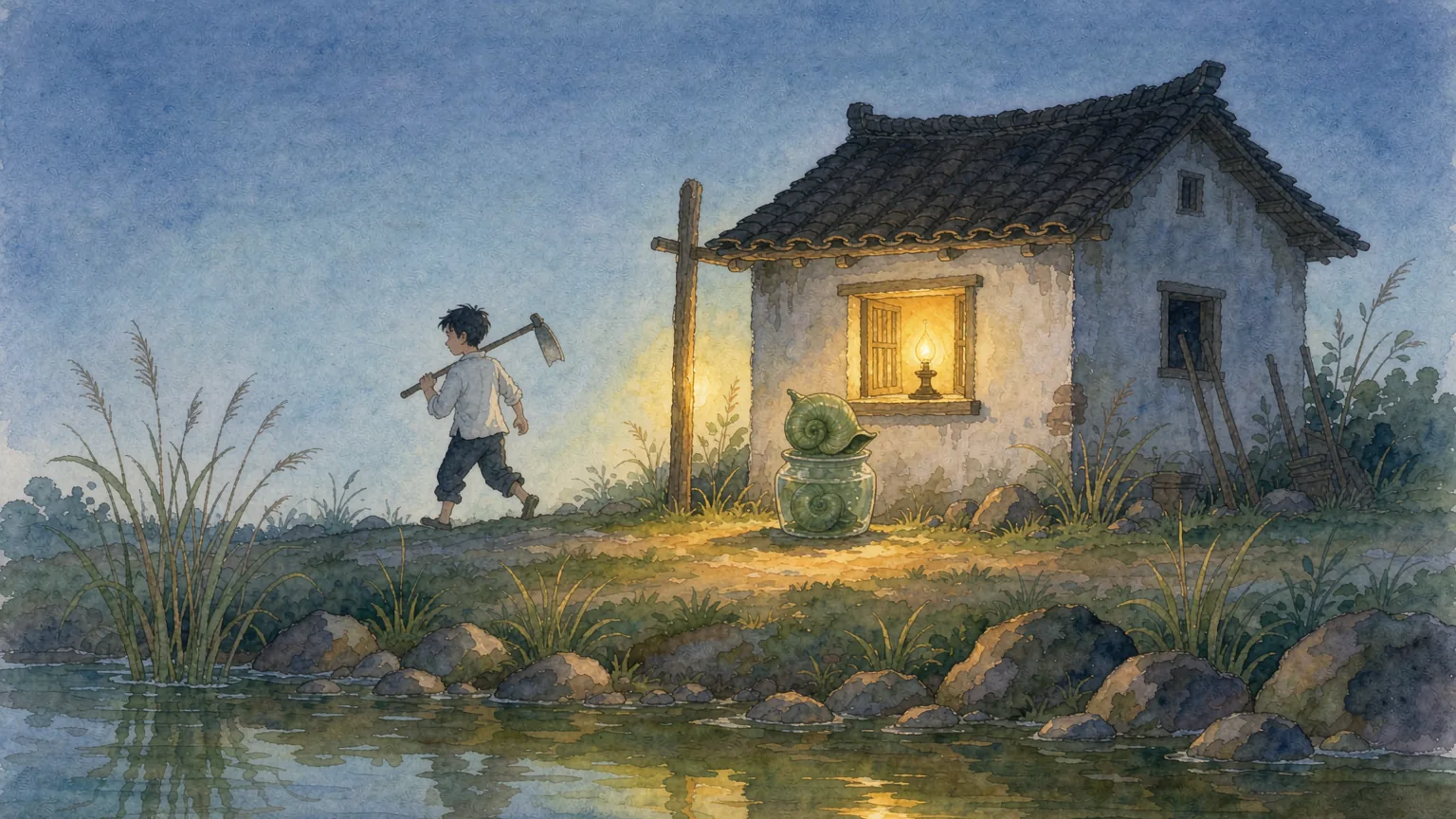
The house had one room, and one window, and one little stove.
Only one person lived in it. A young man, all by himself.
He had no mother and no father. So he worked alone, and he ate alone, and he slept alone.
He was not unhappy. But sometimes, at night, the house felt very big.
The village was kind. People waved, and people said hello.
But in the evening, every house had its own door. And every door was closed.
Every morning, he went out to the fields.
Every evening, when the sun went down, he carried his hoe home.
But the house was always dark. The stove was always cold. And there was nothing in the pot.
One day, down by the river, he found a snail.
It was a big one. Its shell was green and round, and smooth as a little bowl.
“Someone as pretty as you should not be out here alone,” he said.
So he carried it home, and set it in his water jar, and poured in clean water.
He put the jar on the windowsill, where the light was good.
And every night, before he went to bed, he gave the snail fresh water.
“Good night,” he said.
Then he slept.
The next day, he came home from the fields.
He pushed the door open.
And he stopped.
The stove was warm. There was rice in the pot. And on the table stood a bowl of soup, still steaming.
He stood in the doorway for a long time.
“Who has been here?” he said.
He went to ask the old woman next door. She was mending a shoe, and she shook her head.
“It wasn’t me.”
He went to ask the old man at the end of the lane. He was sitting in the sun, and he shook his head.
“It wasn’t me.”
The next day, the same thing.
The day after that, the same thing.
And the day after that, the same thing again.
Someone was lighting his fire. Someone was washing his rice. Someone was sweeping his floor.
And for the first time in his life, the young man came home to a warm meal.
Rice, and greens, and soup. And once, a little fish.
The house did not feel big any more.
Now he wanted to know.
So one day he came home early, while the sun was still up.
He did not open the door. He crept to the window, and crouched down low, and looked in.
Inside, in the water jar, the big snail was opening its shell.
And out of the shell stepped a girl.
Her dress was the color of river water.
She went to the stove. She knelt down and lit the fire.
She washed the rice. She tore the greens. She filled the pot with water.
Her hands were quick and quiet. Her feet made no sound at all.
The young man could not move.
Then he opened the door.
The girl turned around.
She did not run away.
“You kept me in your water jar,” she said. “You gave me clean water, every single day.”
“You never once forgot me.”
“So I came to cook you a warm meal.”
The young man thought about it.
“Then stay,” he said. “Please don’t go.”
“Your house is small. But it is warm.”
The girl smiled.
And she stayed.
The neighbours never found out who had come to his house.
He never told them.
After that, he worked in the fields, and she kept the house.
When the sun went down, a lamp was lit, and a little smell of rice came out of the door.
He would open the door and call, “I’m home.”
And she would answer, “Come and eat.”
The little house was never dark again.
In China, this story has been told for more than a thousand years.
People tell it beside the river, and people tell it up in the hills.
The Snail Girl is one of the gentlest Chinese folktales, and it is still a favorite Chinese fairy tale at bedtime.
Tonight, the river is still running.
The fire in the stove is small, and warm.
The water in the jar is clear, and bright, and still.
Now it is time to close your eyes.
Good night, snail girl.
Good night, the one who came home.
This is a very old Chinese bedtime story. It is not long, and it is very gentle. Best read slowly, with the lights low.