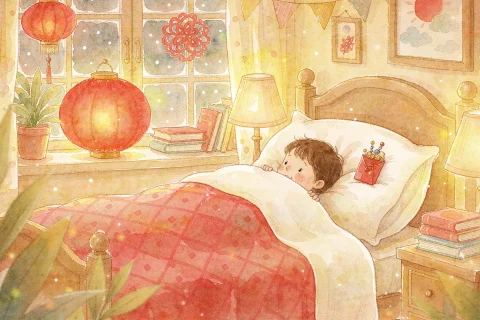
Spring came.
The air turned soft.
The days grew longer.
The mulberry tree put out new leaves.
They came out one by one.
The leaves were small and soft.
They were the best food in the world.
A tiny silkworm crawled out of an egg.
He was all alone.
He was very small.
He was smaller than a grain of rice.
The world was very big.
The leaf was big too.
He lifted his head and sniffed.
He sniffed again.
The air smelled of mulberry leaves.
It smelled green and sweet.
He had never smelled anything before.
He crawled over and began to eat.
He ate a little hole in the leaf.
Then a bigger hole.
Munch, munch.
Munch, munch.
It was the only sound in the room.
He ate slowly.
He ate all day.
He ate carefully.
He never hurried.
That is how silkworms eat.
After a few days, he had grown.
He had grown a lot.
It was time for new clothes.
His old skin felt tight.
He slept for a while.
He did not move at all.
When he woke, he had a new skin.
It was soft and white.
A few days later, he changed again.
And then again.
After the fourth time, he was white and round and fat.
He was as fat as a small finger.
His skin was smooth.
It shone a little.
He lay on a leaf and did not move.
He felt heavy and slow.
The people who kept silkworms brought fresh leaves.
They were careful people.
The leaves still had dew on them.
The drops caught the light.
The silkworm crawled onto the freshest leaf.
He took his time.
This time he ate very slowly.
He took one small bite.
Then another.
He felt a little full.
It was a good feeling.
He did not want to eat any more.
He had eaten enough.
He lifted his head.
Above him he saw a thin thread.
It shone like water.
It was bright, and it grew, bit by bit.
He watched it for a while.
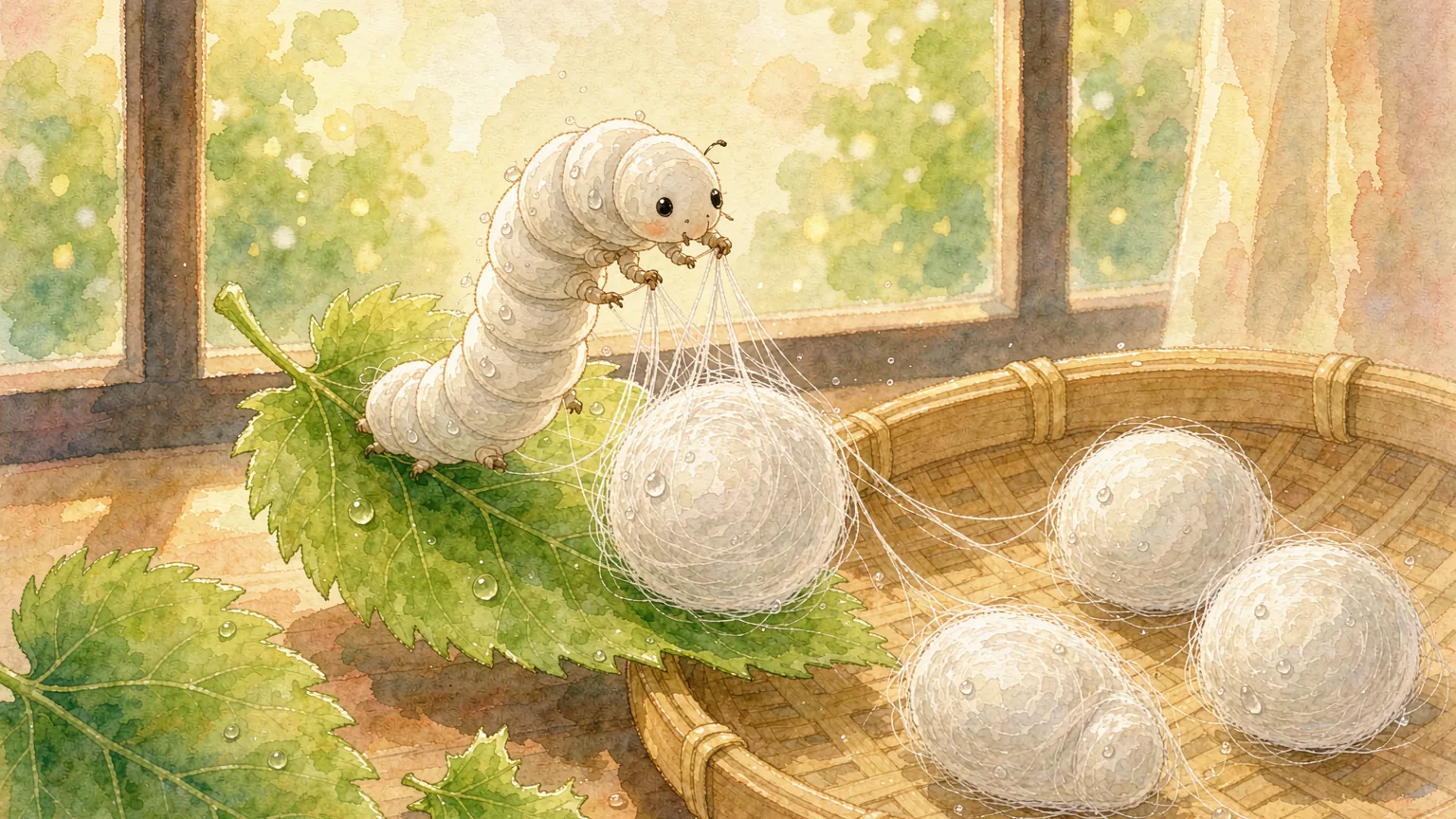
He began to spin.
He did not know how he knew.
He just knew.
He turned his head gently, left and right.
One thread, and then another.
They came out in a thin line.
The threads grew and grew.
They wrapped around him.
He made himself a little house.
He worked slowly and neatly.
The house was round and white.
It looked like a small moon.
It hung in the corner.
He crawled inside.
The door closed behind him.
Inside it was very quiet.
It was the quietest place he knew.
It was his own place.
Nobody else could come in.
The munching outside slowly faded away.
Everything outside faded away.
He curled up.
He made himself small and round.
He closed his eyes.
His body felt warm.
His body felt safe.
He was going to sleep for a long, long time.
A good, long sleep.
A sleep with no hurry in it.
In China, people have kept silkworms for thousands of years.
They step past quietly and do not speak.
They only say: the silkworm is sleeping.
They say it very quietly.
The sky went dark, then light again.
Then dark again.
Then light again.
The mulberry tree kept growing leaves.
The leaves grew bigger every day.
In the corner of the room, the small white house stayed quite still.
Nobody touched it.
Seasons go by in the little room.
The window opens in spring.
It closes in winter.
When spring is deep, and summer comes.
When the warm days come.
The little house will shake, just a little.
Something inside will stir.
Then the silkworm will wake up.
He will push at the door.
The door will open easily.
He will have wings.
Soft white wings.
They will be wet at first.
He will fly out and look around.
He will see the world again.
Everything will be green.
He will find the mulberry tree.
He will lay tiny eggs.
And then new little silkworms will come.
But now he is very sleepy.
Very, very sleepy.
Now he wants to sleep.
That is the old story of The Little Silkworm.
It is a gentle Chinese folktale.
It is also a Chinese fairy tale, and one of the oldest Chinese bedtime stories for children.
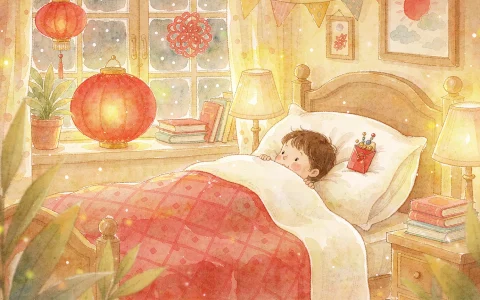
Now it is time to close your eyes.
Good night, little silkworm.
Good night, small white house.
This is a very old Chinese bedtime story. It is not long, and it is very gentle. Best read slowly, with the lights low.