Long ago, in a green forest high in the hills of China, there lived a family of monkeys.
Every night, the monkeys slept high up in the tall trees. Every morning, they woke up hungry and happy.
There were big monkeys and small monkeys. There were loud monkeys and quiet monkeys. And there was one very little monkey, who was always the last one to fall asleep.
One evening, the sun went down behind the hills. The sky turned from orange to pink to deep, dark blue.
The stars came out, one by one.
Then the moon rose. It was big. It was round. It was white and bright.
The monkeys sat in their trees and watched it climb the sky.
Down below, near the edge of the forest, there was an old stone well. The water inside was still and dark.
The little monkey was not sleepy yet. So he crept down the tree and went to look into the well.
He leaned over the edge.
He looked down.
And there, deep in the dark water, he saw the moon.
“The moon!” he cried. “The moon has fallen into the well!”
Up in the trees, the other monkeys woke up.
“What did he say?”
“The moon has fallen into the well!”
One by one, the monkeys climbed down. They gathered around the well. They leaned over the edge and looked in.
And there it was. Round. White. Shining. Floating deep in the water.
“Oh no,” said the monkeys. “Poor moon.”
“We must help it,” said one.
“We must put it back in the sky,” said another.
So the monkeys made a plan.
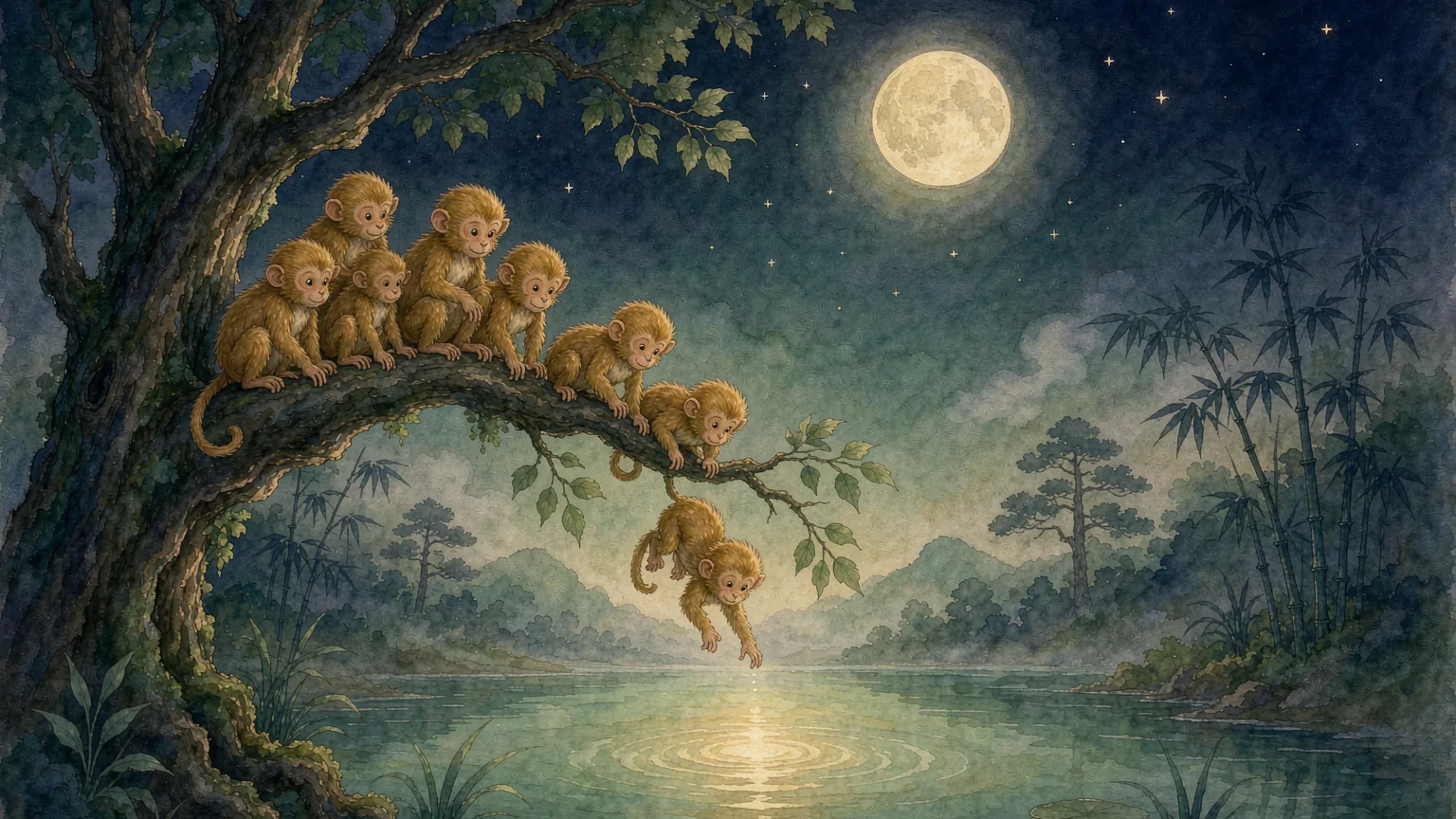
One tall tree grew right beside the well, and its longest branch reached out over the water.
The biggest monkey climbed the tallest tree and held on to a strong branch. He reached down and took hold of the second monkey’s tail.
The second monkey held the tail of the third monkey.
The third monkey held the tail of the fourth.
Down and down they went, one by one, until the little monkey was hanging just above the water.
It was a long, wobbly chain of monkeys.
“Almost there,” said the little monkey.
He reached down. He stretched out one small hand.
His fingers touched the water.
Splash.
The moon broke into a hundred pieces.
The little monkey pulled his hand back.
“Oh no,” he said. “I broke the moon.”
The monkeys looked down. The shining pieces moved on the water for a moment. Then they were gone.
“We broke the moon,” the monkeys whispered.
They climbed back up, one by one. They sat together in the branches. Nobody said a word. The forest was very quiet.
Then the oldest monkey lifted her head.
She looked up.
And there, high above the trees, was the moon. Whole. Round. Bright. Exactly where it had always been.
The monkeys looked up too.
For a moment, nobody spoke.
Then the little monkey began to laugh.
“Oh,” he said. “The moon was never in the well. It was only playing in the water.”
The oldest monkey smiled.
“Yes,” she said. “But the moon is also in the water. That is how the moon is — it can be in the sky, and in the water, and in your eyes, all at the same time.”
She looked at the little monkey and smiled.
“The moon was never lost,” she said. “It was never lost at all. Now, it is late. Time to sleep.”
So the monkeys climbed up to their highest branch. They sat close together. They held on to each other, the way monkey families do.
One by one, they closed their eyes.
The wind moved softly through the leaves. The well was still. The water was calm. And in the water, the moon shone quietly, whole again, keeping the little monkeys company through the night.
In China, parents and grandparents have told this story for hundreds of years. It is a favorite Chinese folktale about the moon, and it is often called Monkeys Scooping the Moon. It is a gentle Chinese fairy tale about being small, and about how it is okay to make a mistake — just smile softly, and look up at the sky.
The moon is still there, in wells and ponds and puddles, on every clear night. It does not fall. It does not break. It just waits for someone small to look down and say hello.
So if you look out of your window tonight, you may see it too — one moon in the sky, and one in every little puddle by the door.
Now it is time to close your eyes.
Good night, little monkey.
Good night, moon.
This is a very old Chinese bedtime story. It is not long, and it is very gentle. Best read slowly, with the lights low.